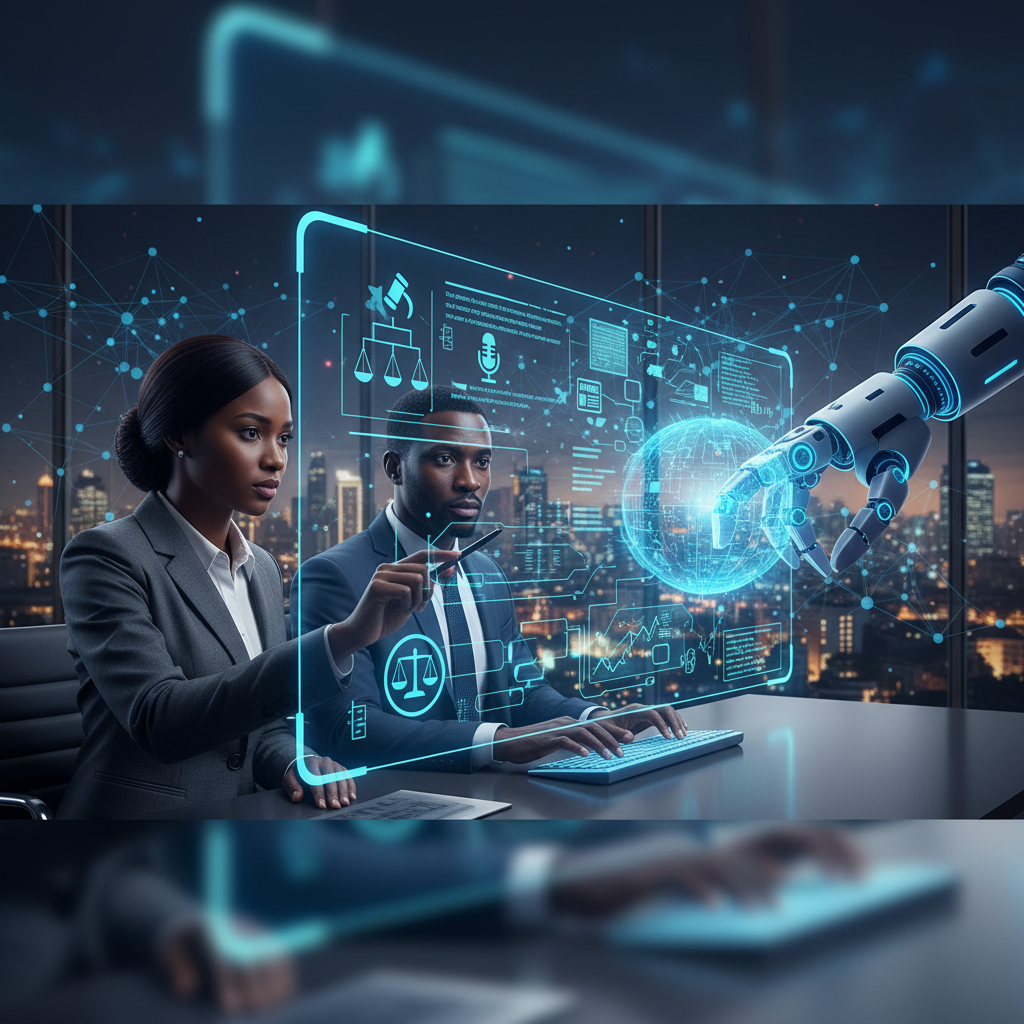

The air conditioning in the sleek, glass-fronted office building in Airport City, Accra, usually hums with the focused energy of a dozen junior consultants. Today, it felt different. A palpable tension hung heavy, a silence punctuated only by the distant city traffic. Kwame, a sharp young analyst who had dreamed of a career at this global firm since his days at the University of Ghana, stared at his screen. His latest report, a market analysis for a major regional client, had just been returned with minimal edits. Not by his team lead, but by 'Project Gemini', the firm's new AI assistant, powered by Google's advanced models.
Kwame knew what this meant. The firm had been slowly integrating AI into their workflows, promising 'augmented intelligence' and 'enhanced productivity'. But the reality, whispered in hushed tones during coffee breaks, was that the junior ranks were becoming redundant. Their meticulous research, their initial drafts, their data synthesis, tasks that once took days, were now completed in hours by an algorithm. This scene, playing out in consulting firms, law offices, and even newsrooms across Ghana, is not an isolated incident. It's the quiet revolution, or perhaps, the silent erosion, of white-collar work here in Africa.
I believe we are standing at a critical juncture, a moment where the promise of technological advancement clashes head-on with the fundamental human right to dignified work. This affects every single one of us, from the young graduate dreaming of a corporate career to the seasoned professional navigating an increasingly automated landscape. The narrative often spun by tech giants is one of liberation from mundane tasks, but for many, it feels more like liberation from employment itself.
Reports from global consultancies paint a stark picture. McKinsey & Company, a firm that itself leverages AI heavily, estimated in a recent analysis that generative AI could automate tasks accounting for 60 to 70 percent of employees' time across various functions. While they emphasize augmentation, the implication for roles focused on information processing and content generation is clear. Another report by Gartner predicted that by 2026, over 80 percent of enterprises will have used generative AI APIs or deployed generative AI enabled applications, up from less than 5 percent in 2023. This rapid adoption is not bypassing Ghana. Local subsidiaries of multinational corporations, and increasingly, indigenous firms, are embracing these tools with gusto, driven by the allure of reduced operational costs and increased output.
Consider the legal sector. Once a bastion of meticulous research and document drafting, AI tools are now transforming it. Platforms like LexisNexis AI and Thomson Reuters' CoCounsel, powered by large language models, can sift through thousands of legal documents, identify precedents, and draft initial legal briefs in minutes. While these tools are primarily aimed at Western markets, their impact is felt globally as legal firms with international operations standardize their practices. In Ghana, this means that the demand for entry-level paralegals or junior associates whose primary role was document review and basic research is diminishing. The legal profession, traditionally a highly respected and stable career path, is now facing a reckoning.
Newsrooms are another battleground. As a journalist, this one hits particularly close to home. The pressure on media houses to do more with less has always been immense. Now, AI tools are being deployed for everything from generating initial news summaries and social media posts to even drafting entire articles based on data feeds. Reuters, for instance, has been experimenting with AI for years to automate earnings reports and sports summaries. While they maintain that human journalists are indispensable for complex reporting and analysis, the line is blurring. For local Ghanaian news outlets, often operating on shoestring budgets, the temptation to replace human labor with a cheaper, faster AI solution is immense. Silence is complicity if we do not critically examine the implications for the future of journalism and the diverse voices it represents.
Who are the winners and losers in this unfolding drama? The winners, undoubtedly, are the tech giants like OpenAI, Google, and Microsoft, whose AI models and platforms are driving this transformation. Their revenues are soaring. Companies that successfully integrate AI to streamline operations and innovate are also seeing significant gains in productivity and profitability. For example, a major consulting firm with offices in Accra reportedly reduced the time spent on preliminary client research by 40 percent using AI, allowing them to take on more projects with the same headcount, or in some cases, a reduced one.
The losers, sadly, are often the workers whose skills are rendered obsolete, particularly those in roles requiring repetitive cognitive tasks. The youth, who form a significant portion of Ghana's workforce, are particularly vulnerable. How do we prepare them for a job market where the entry points they once relied upon are disappearing? The Akan proverb, 'Obi nnim a, obisa' meaning 'If one does not know, one asks,' reminds us that seeking knowledge and understanding is paramount. We must ask difficult questions and demand answers from our leaders and educators.
I recently spoke with Dr. Ama Nkrumah, a leading economist at the Institute of Statistical, Social and Economic Research (isser) at the University of Ghana. She expressed profound concern. "The rapid deployment of AI in white-collar sectors presents a dual challenge for Ghana," Dr. Nkrumah told me. "On one hand, it offers opportunities for efficiency and innovation that could boost our economy. On the other, it threatens to exacerbate unemployment, particularly among our educated youth, if we do not proactively invest in reskilling and re-evaluating our educational curricula. We cannot afford to be passive observers." Her words resonate deeply with the urgency I feel.
Another voice, Mr. Kofi Mensah, the CEO of a mid-sized Ghanaian law firm, offered a more pragmatic view, though not without its own anxieties. "We are certainly exploring AI tools for legal research and document generation," he admitted during a recent industry panel. "The efficiency gains are undeniable. However, the human element, the nuanced understanding of client needs, the art of negotiation, and the ethical judgment, these are areas where AI simply cannot compete. Our challenge is to integrate AI as a powerful assistant, not a replacement for our most valuable asset: our people." This sentiment, while hopeful, still leaves many questions unanswered about the future of entry-level positions.
What is coming next? The trajectory is clear. AI will continue to permeate every layer of white-collar work. The roles that will thrive are those that require uniquely human skills: creativity, critical thinking, complex problem-solving, emotional intelligence, and interpersonal communication. We need to shift our educational focus dramatically, moving away from rote learning and towards fostering these indispensable human capabilities. Our universities, like the Kwame Nkrumah University of Science and Technology, must be at the forefront of this transformation, not just in developing AI, but in preparing graduates to work alongside it, or to create entirely new fields of endeavor.
Furthermore, there is a pressing need for policy frameworks that address the social and economic impact of AI. This includes exploring ideas like universal basic income, robust social safety nets, and government-funded reskilling programs. We must ensure that the benefits of AI are broadly shared, and that the burdens do not fall disproportionately on the most vulnerable. The digital divide is not just about access to technology, but about access to the opportunities and protections in an AI-driven world. For more insights on the broader societal implications of AI, I often refer to articles on Wired.
I believe Ghana has an opportunity to lead in this space, not just by adopting AI, but by shaping its ethical and equitable deployment. We must leverage our rich cultural heritage, our spirit of communal support, and our inherent resilience. The concept of 'Sankofa', looking back to draw wisdom from the past to build the future, is more relevant than ever. We must learn from the industrial revolutions of the past, which often left many behind, and forge a different path for the AI revolution. We must demand that technology serves humanity, not the other way around. For ongoing developments in the AI industry, TechCrunch provides excellent coverage.
The conversation about AI and white-collar jobs is not just an economic one; it is a moral one. It is about the kind of society we want to build for our children and grandchildren. Will it be one where innovation creates widespread prosperity and new forms of human flourishing, or one where a privileged few benefit while many are left struggling to find their place? The choice, my friends, is ours to make. Let us choose wisely, with compassion and foresight.