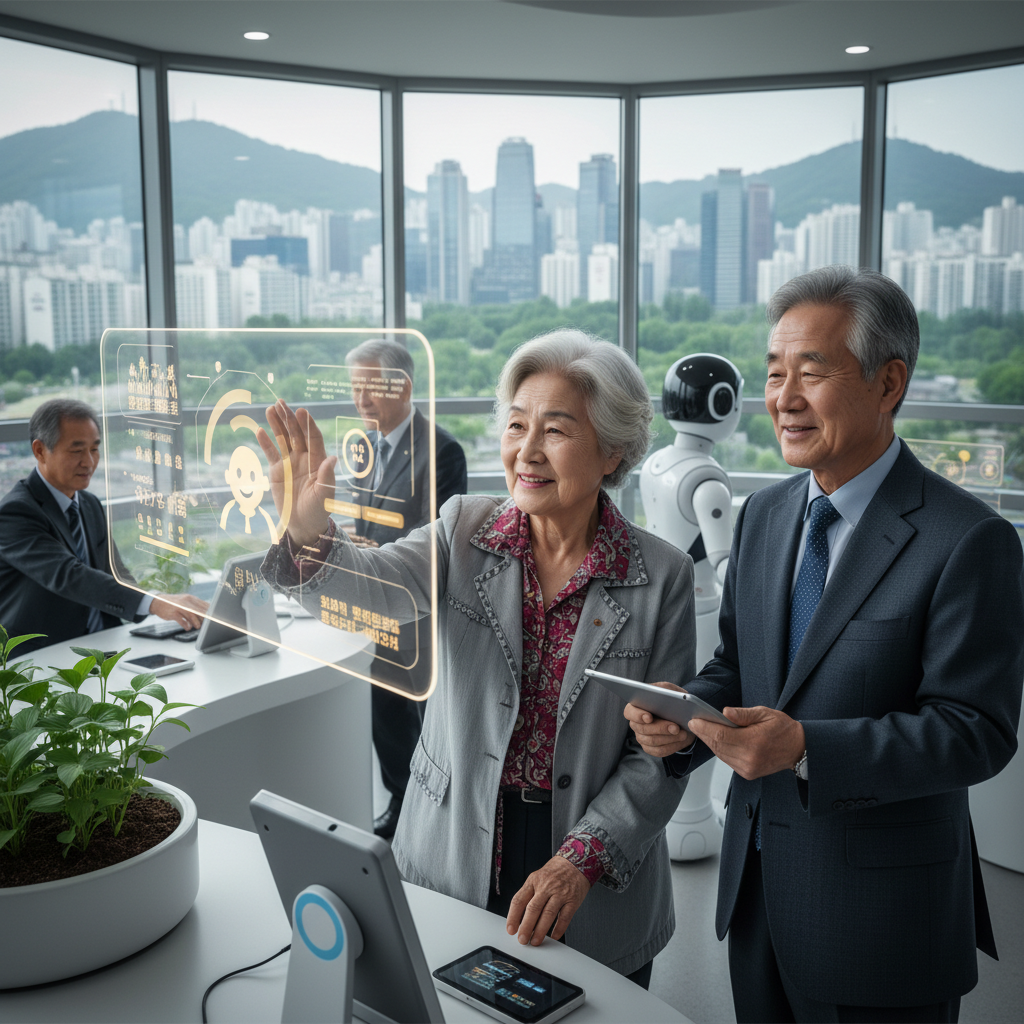

The Republic of Korea, a nation forged in rapid industrialization and technological advancement, now faces a demographic challenge of unprecedented scale. Our birth rate, hovering stubbornly below 0.7, coupled with increasing life expectancy, paints a stark picture: by 2050, nearly 40 percent of our population will be over 65 years old. This is not merely a 'silver tsunami' as some Western media might phrase it; it is a fundamental reshaping of our societal fabric, demanding innovative, data-driven solutions. And here, AI is not just a tool, it is the cornerstone of our national response.
For decades, the Korean spirit has been defined by speed and adaptability. From the ashes of war, we built global conglomerates like Samsung and LG, mastering semiconductor manufacturing and display technology. Now, this same ingenuity is being channeled into a new frontier: extending healthy human lifespans and ensuring dignified care for our aging citizens. The Korean approach to AI in this domain is fundamentally different; it is holistic, integrating hardware, software, and a deep understanding of human psychology.
Consider the burgeoning field of eldercare robotics. While many nations explore automated companions, South Korea's focus is on practical, assistive devices that seamlessly integrate into daily life. Take, for instance, the advancements from companies like Hyundai Robotics. Their latest generation of 'carebots' is not just about fetching items or reminding medication schedules. These sophisticated machines, often equipped with advanced natural language processing honed for the nuances of the Korean language, can monitor vital signs, detect falls with millimeter-wave radar, and even engage in therapeutic conversations. "Our goal is not to replace human interaction, but to augment it, to provide a layer of constant, intelligent support that human caregivers simply cannot maintain 24/7," explains Dr. Lee Min-jun, Head of AI Research at Hyundai Robotics. "We are seeing a 30 percent reduction in emergency callouts in trial homes, a testament to their proactive capabilities."
This robust hardware is underpinned by equally sophisticated AI. Samsung's latest move reveals a deeper strategy in this space. Beyond their consumer electronics dominance, their advanced AI division is developing predictive analytics platforms that integrate data from wearables, smart home sensors, and medical records. This allows for early detection of cognitive decline or chronic disease exacerbation. Imagine an AI system that, by analyzing subtle changes in gait patterns or speech cadence, can flag potential neurological issues months before they become clinically apparent. This is the technical breakdown that defines our cutting edge.
Longevity research, too, is experiencing an AI-driven revolution. Institutions like the Korea Advanced Institute of Science and Technology, Kaist, are leveraging machine learning to accelerate drug discovery for age-related diseases. By analyzing vast genomic and proteomic datasets, AI algorithms can identify novel therapeutic targets and predict drug efficacy with unprecedented speed. "What used to take a decade of laboratory work can now be simulated and refined in a matter of months," states Professor Kim Ji-yeon, a lead researcher in AI-driven pharmacology at Kaist. "We are moving beyond treating symptoms; we are aiming to understand and intervene in the fundamental processes of aging itself."
Healthcare AI extends beyond just robots and drug discovery. Telemedicine platforms, powered by AI diagnostics, are becoming indispensable, particularly in rural areas where access to specialists is limited. Companies like Kakao Healthcare are building AI models that can analyze medical images, such as X-rays and MRIs, with accuracy comparable to, and sometimes exceeding, human radiologists. This not only speeds up diagnosis but also democratizes access to high-quality medical expertise. A recent government report indicated that AI-assisted diagnostic tools have reduced misdiagnosis rates for certain conditions by 15 percent across pilot programs.
The investment landscape reflects this national priority. The South Korean government has earmarked over 2 trillion won, approximately 1.5 billion US dollars, for AI and robotics research specifically targeting the aging population over the next five years. This includes subsidies for companies developing eldercare solutions and grants for universities pursuing longevity research. This is not merely an economic investment; it is a societal compact, a commitment to our elders who built this nation.
However, the path is not without its challenges. Ethical considerations surrounding data privacy, algorithmic bias, and the potential for over-reliance on technology are paramount. Ensuring that AI systems are developed with transparency and accountability is crucial. The Korean Data Protection Agency has been proactive, issuing guidelines for the ethical deployment of AI in healthcare, emphasizing informed consent and robust security protocols. As Reuters recently highlighted, balancing innovation with ethical safeguards is a global challenge, and South Korea is navigating this delicate equilibrium with careful deliberation.
Furthermore, the integration of these advanced technologies into the lives of the elderly requires careful design and user-friendly interfaces. A robot, however sophisticated, is only useful if it is accepted and understood by its user. This is where cultural sensitivity and human-centered design become critical. Korean companies are investing heavily in user experience research, often involving elderly citizens in the design process to ensure acceptance and ease of use. This commitment to the human element is a distinguishing feature of our approach.
Looking ahead, the synergy between 5G and soon 6G networks, coupled with edge computing, will unlock even greater potential. Real-time data processing for continuous health monitoring, seamless communication between care robots and medical professionals, and ultra-low latency for remote surgical assistance will become standard. The vision is not a cold, automated future, but one where technology acts as a warm, intelligent extension of human care and connection. Our journey is a testament to the idea that demographic challenges, when met with strategic innovation and a national will, can become catalysts for a brighter, healthier future for all. This is a topic that resonates deeply within our society, and one that DataGlobal Hub will continue to monitor closely, as the implications extend far beyond our borders. For more insights into how AI is transforming healthcare globally, you might find our recent report on AI in drug discovery [blocked] particularly relevant. The global race for longevity solutions is accelerating, and South Korea is firmly in the lead, not just in technology, but in the thoughtful integration of these advancements into the very fabric of society. For those interested in the broader implications of AI in society, MIT Technology Review offers comprehensive analysis.