
The morning sun, still a gentle caress on the corrugated iron roofs of Alexandra township, always brings with it the familiar symphony of Johannesburg waking up. Taxis hoot, street vendors call out their wares, and somewhere, a radio plays a gospel hymn. It is a world of vibrant human connection, of negotiation and direct engagement. Then I open my laptop, and the global AI news hits me, stark and often distant from this reality.
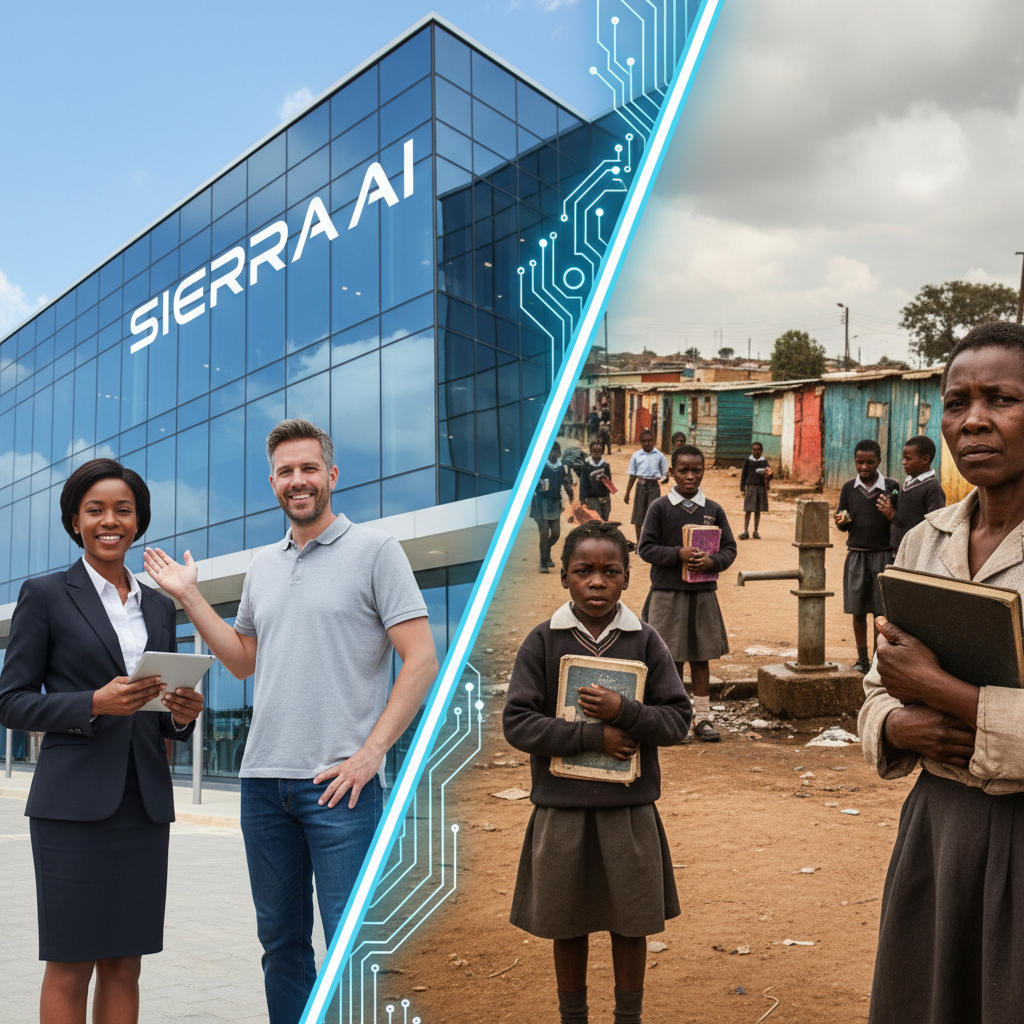
This week, the big talk, the only talk it seems in the tech world, is Sierra AI. Founded by Bret Taylor, former co-CEO of Salesforce, and Clay Bavor, a long time Google executive, this customer service AI startup has just landed a staggering $4 billion valuation. Let that sink in. Four billion US dollars, for a company promising to transform how businesses interact with their customers, largely by automating those interactions. The headlines are buzzing, analysts are predicting massive shifts, and the venture capitalists are, no doubt, popping champagne corks.
Here's the thing nobody's talking about, not really, not with the urgency it deserves: what does this mean for the millions of people, particularly young people, across Africa who rely on customer service roles for their livelihoods? South Africa alone has a significant business process outsourcing BPO sector, employing hundreds of thousands in call centers that serve global clients. These are not just jobs; they are lifelines, providing stability, income, and a pathway to the middle class for many families. When an AI like Sierra comes along, promising to handle complex customer queries, resolve issues, and even anticipate needs, the immediate question that echoes in my mind, and in the minds of many here, is: where do our people go?
I spoke recently with Nomusa Dlamini, a team leader at a major call center in Durban, a woman whose warmth and patience define her work. She has been in the industry for over a decade. "We hear the whispers, Amahlé," she told me, her voice tinged with concern. "They say the robots are coming for our jobs. We try to tell ourselves that human connection, empathy, that can't be replaced. But then you see these systems, how clever they are becoming, and you wonder. Will our skills be enough?" Her question is not just rhetorical; it is a cry for foresight and a plea for inclusion in this rapidly accelerating technological future.
Sierra AI's pitch is compelling, I will grant them that. They aim to use advanced generative AI to provide more personalized, efficient, and scalable customer support. Imagine an AI that understands context, remembers past interactions, and can access vast databases of information to solve problems instantly. For businesses, the allure of reduced costs and improved customer satisfaction is undeniable. Bret Taylor himself, in a recent interview, emphasized the potential for AI to "augment human capabilities" and free up human agents for more complex, empathetic tasks. "Our goal is not to replace humans, but to empower them to do more meaningful work," Taylor reportedly stated. While that sounds promising, the practical rollout often tells a different story on the ground.
This isn't just a tech story because it's a justice story. The global south, particularly Africa, often finds itself at the sharp end of technological disruption, absorbing the impacts without always having a seat at the design table. The digital divide is not just about access to the internet; it is increasingly about access to the skills, the infrastructure, and the economic opportunities that AI creates. If AI is going to automate away entry-level jobs, what are the plans for retraining, for upskilling, for creating new industries that can absorb this workforce? Where is the Ubuntu philosophy in this equation, the idea that my humanity is bound up in yours, that we rise or fall together?
Consider the sheer scale of investment. Sierra AI's valuation places it among the most promising startups globally, attracting significant capital from top-tier investors. This kind of financial muscle enables rapid development and deployment. According to TechCrunch, the enterprise AI market is projected to grow exponentially, with customer service solutions being a major driver. The speed at which these technologies are advancing means that the window for adaptation for economies like South Africa's is shrinking.
South Africa's Department of Trade, Industry and Competition has been actively promoting the BPO sector, recognizing its potential for job creation. Initiatives like the Mzansi BPO program aim to attract more international investment and create thousands of new jobs annually. But how do these efforts stand up against the tide of AI automation? "We need proactive strategies," says Professor Thandiwe Nkosi, an economist at the University of Cape Town. "Our government and industry leaders must engage with these global tech companies, not just as consumers of their products, but as partners in shaping their impact. We need investment in AI literacy, in coding bootcamps, in fostering local AI innovation that addresses our unique challenges, not just replicating Silicon Valley models." Her point is crucial: we cannot afford to be passive observers.
We have seen glimpses of how AI can be a force for good here. Local fintech startups are using AI to provide financial services to underserved communities, and health tech innovators are leveraging machine learning to improve diagnostics in rural areas. These are examples of technology serving community, of AI being built with a local context in mind. But these efforts often struggle for the same level of funding and attention that global giants receive.
The conversation around Sierra AI's success, while commendable for its technological prowess, needs to broaden significantly. It needs to include the voices from the call centers of Manila, the back offices of Bengaluru, and the bustling BPO hubs of Cape Town. It needs to ask not just what AI can do, but for whom and at what cost to human dignity and economic stability. As these powerful AI systems become more ubiquitous, the responsibility of their creators and deployers to consider their global human impact becomes paramount. Otherwise, we risk creating a future where technological advancement is celebrated in one part of the world, while it quietly erodes the foundations of livelihood in another. It is a balance we must strike, and strike with urgency, if we truly believe in a future where everyone can thrive. For more insights on the broader societal implications of AI, readers might find perspectives on MIT Technology Review helpful. We must ensure that the promise of AI lifts all boats, not just the biggest ones.