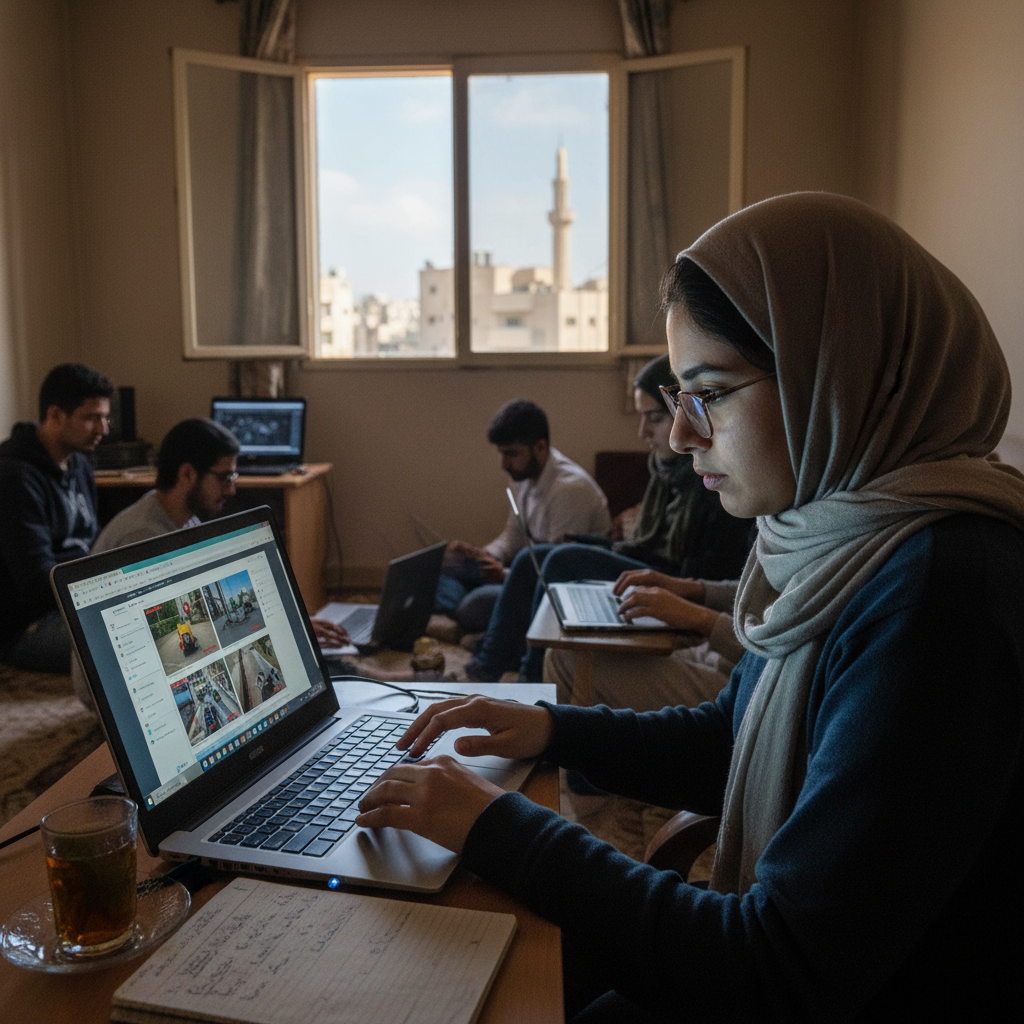
The gleaming towers of Silicon Valley cast long shadows, reaching far beyond the Californian coastline, all the way to the bustling streets of Amman. We hear the grand pronouncements from Sam Altman at OpenAI, Sundar Pichai at Google, and Mark Zuckerberg at Meta about the transformative power of AI, about a future where machines write our code and cure our diseases. But let us be honest, shall we? This future, this technological marvel, is built on the backs of an unseen, often exploited, global workforce, and nowhere is this more evident than in the burgeoning data labeling industry right here in Jordan.
For too long, the narrative has been dominated by the West, celebrating the algorithms while conveniently ignoring the human cost. The West has it backwards. They talk of AI ethics in abstract terms, debating existential risks, while a very real, very present ethical crisis unfolds in front of our eyes: the precarious labor conditions of the data annotators, the digital artisans who painstakingly tag images, transcribe audio, and categorize text, teaching the machines to 'see' and 'understand.' These are the invisible hands behind the machine learning pipeline, and their rights are systematically overlooked.
Consider the scale of this operation. Every time a self-driving car distinguishes a pedestrian from a lamppost, every time a medical AI identifies a tumor, every time a chatbot understands a nuanced query, it is because thousands, sometimes millions, of data points have been meticulously labeled by humans. Many of these humans are in countries like Jordan, where the promise of digital work offers a lifeline, but often at wages that barely sustain a family. We are talking about tasks that are repetitive, mentally taxing, and often expose workers to disturbing content, all for a fraction of what a software engineer in San Francisco earns.
“We are not just punching keys; we are shaping the intelligence of tomorrow, yet our dignity is often an afterthought,” states Fatima Al-Hassan, a team lead at a data annotation firm in Irbid, Jordan. Her team spends eight hours a day, six days a week, categorizing images for a major American tech company she cannot name due to non-disclosure agreements. “The work is constant, the deadlines are tight, and the pay, frankly, is insulting when you consider the profits these AI giants make. We are the foundation, but we live in the basement.”
Indeed, the numbers are stark. While an AI engineer at OpenAI might command a salary upwards of $300,000 annually, a data annotator in Jordan might earn as little as $300-$500 per month. This is not just a wage gap; it is an economic chasm. And it is a chasm that is actively maintained by the very companies who preach about 'AI for good' and 'democratizing AI.' They outsource this critical, foundational work to regions where labor is cheap and regulations are lax, effectively externalizing their ethical responsibilities.
This isn't a new phenomenon, of course. The global supply chain has always relied on cheaper labor in developing nations. But with AI, the product is intelligence itself, and the human input is not merely manufacturing; it is teaching. It is the transfer of human cognition to machine algorithms. This makes the exploitation even more egregious. We are not talking about assembling circuit boards; we are talking about imparting knowledge, judgment, and cultural context.
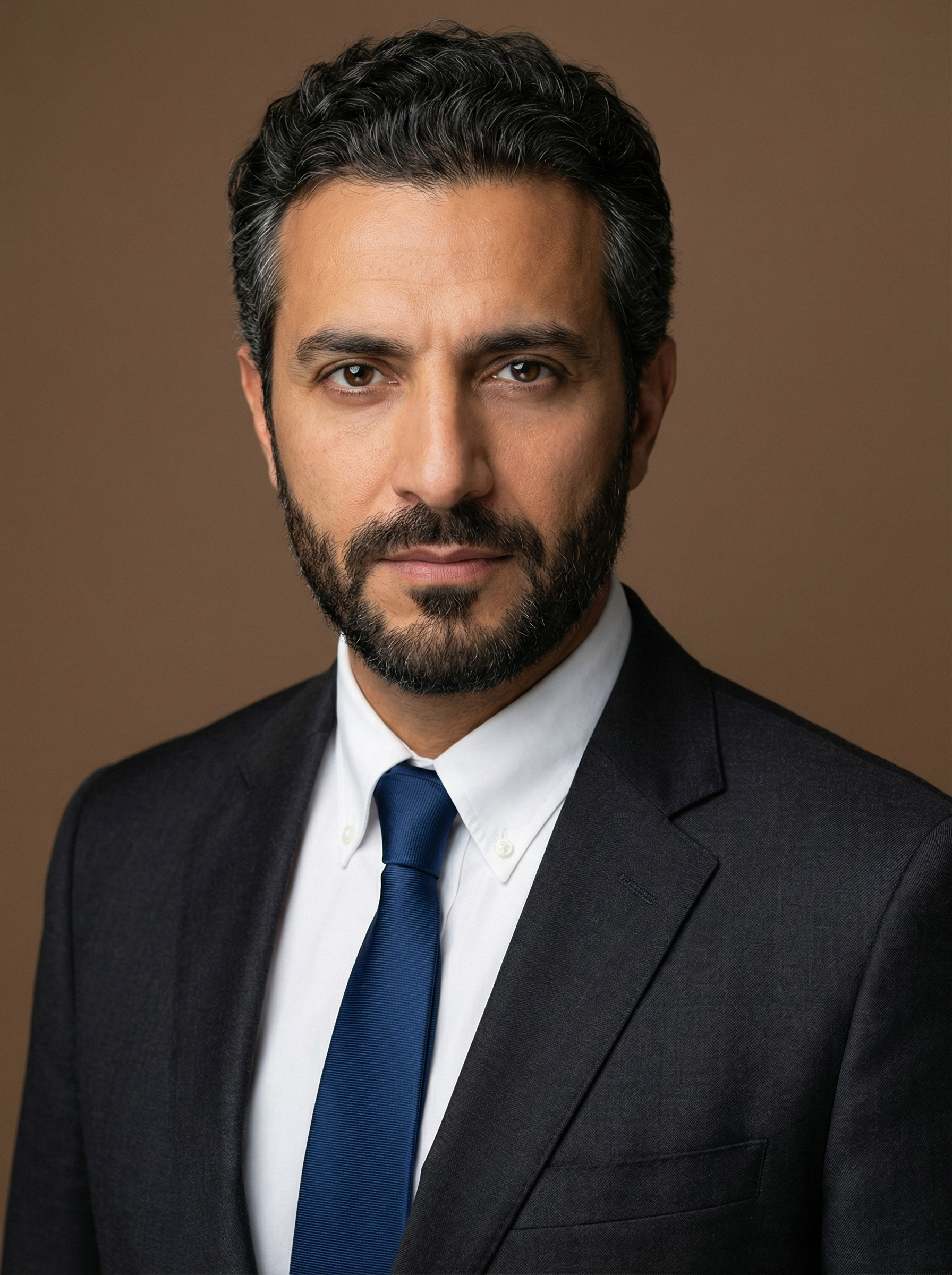
Dr. Omar Al-Khateeb, a labor economist at the University of Jordan, emphasized this point in a recent discussion. “The intellectual property of these AI models is built on the collective intelligence of thousands of annotators, yet they receive no credit, no residuals, and certainly no equity. It is a new form of digital colonialism, where our human intelligence is extracted and commoditized for the benefit of a few powerful corporations.” He estimates that over 15,000 Jordanians are currently employed in some form of data labeling or content moderation for global AI firms, a number that has grown by 40% in the last two years alone.
The implications for workers' rights are profound. These are often contract workers, lacking benefits, job security, and collective bargaining power. The gig economy model, so prevalent in the West, is amplified here, stripped of even the minimal protections sometimes afforded in wealthier nations. When an algorithm changes, or a project ends, these workers are often left with nothing. There is no severance, no retraining, just an abrupt end to their livelihood.
Unpopular opinion from Amman: Jordan's approach makes more sense than Silicon Valley's. While Western companies chase the next billion-dollar valuation, we in Jordan are grappling with the immediate, tangible impact of this industry on our people. We see the potential for economic growth, yes, but we also see the potential for exploitation. This is why discussions are emerging within the Jordanian Ministry of Labor about establishing baseline protections for digital workers, including minimum wage standards for annotation tasks and mental health support for those exposed to harmful content. It is a small step, but a crucial one.
We need to move beyond platitudes about 'reskilling' and 'upskilling' workers, which often serve as an excuse to avoid addressing the fundamental issues of fair compensation and dignified labor. The conversation needs to shift from how AI will replace jobs to how we can ensure the jobs AI creates are good jobs, jobs that respect human dignity and provide a living wage.
Major tech players like Google and Microsoft, with their vast resources, have an ethical imperative to lead the charge here. They set the standards. If they demand fair labor practices from their hardware suppliers, why not from their data suppliers? The argument that these are 'third-party contractors' is a flimsy shield against moral responsibility. The algorithms cannot function without this human input; these workers are integral to their core product.
According to a recent report by Reuters Technology, the global data labeling market is projected to reach over $10 billion by 2027. This is a massive industry, and it is growing rapidly. Yet, the lion's share of this wealth is concentrated at the top, leaving those at the bottom scrambling for scraps. This imbalance is not sustainable, nor is it just.
We must ask ourselves: what kind of AI do we want to build? One that perpetuates existing inequalities and creates a new class of digital serfs, or one that truly elevates humanity? The choice is ours, but the responsibility lies squarely with the tech giants who profit most from this labor. It is time for them to look beyond their quarterly earnings reports and acknowledge the human beings who are making their AI dreams a reality. The future of AI should not come at the expense of human rights. Wired has extensively covered the ethical dilemmas of AI, but the focus often remains on the abstract, not the concrete human impact in places like Jordan. We need more than just awareness; we need action, regulation, and a fundamental shift in how these companies value the labor that underpins their empires.
This isn't just about Jordan; it is a global issue. From the Philippines to Kenya, from India to Venezuela, the story is often the same. The digital sweatshops are thriving, hidden in plain sight. It is time we pull back the curtain and demand that the humans behind the machine learning pipeline are treated with the respect and fairness they deserve. Anything less is a betrayal of the very ideals AI claims to represent. For more on the broader ethical considerations of AI, particularly concerning data and privacy, one might consider the ongoing debates surrounding Perplexity AI's data practices [blocked], which highlight another facet of the human-AI interface. The conversation must be holistic, encompassing both the visible and invisible labor that powers our increasingly intelligent world.