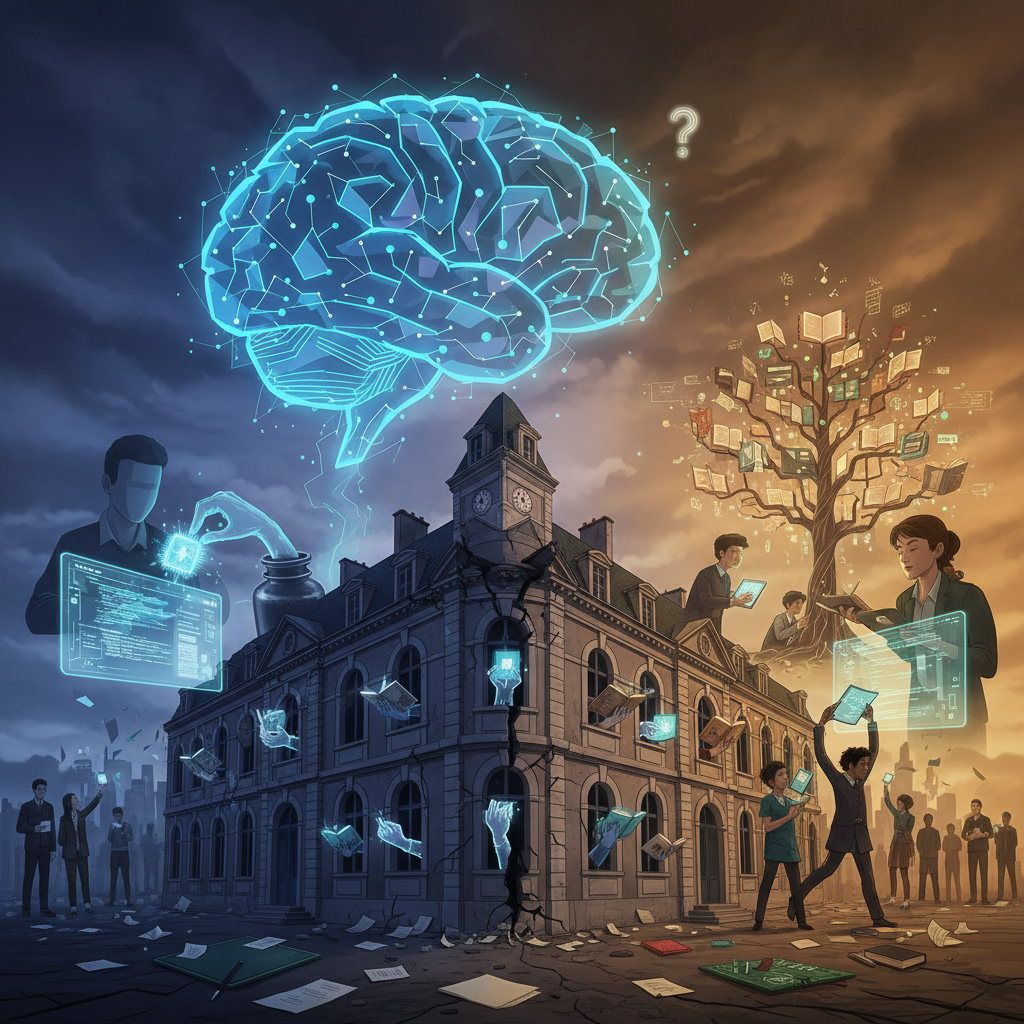

Mon Dieu, the arrogance of Big Tech, to assume their tools will seamlessly integrate into our venerable institutions without a single ripple. We are told, with an almost religious fervor, that AI chatbots like OpenAI's GPT models or Google's Gemini are either the harbinger of academic ruin, enabling a generation of students to cheat their way to diplomas, or the ultimate personalized tutor, democratizing knowledge. As a journalist from France, I find this binary, American-centric view utterly simplistic and frankly, quite boring. The reality, particularly here in Europe, is far more nuanced, rooted in our distinct educational philosophies and our unwavering commitment to digital sovereignty.
The risk scenario is painted in vivid, often sensational, strokes: a student, perhaps a lycéen in Bordeaux, uses a sophisticated AI to write their dissertation on Camus, bypassing critical thinking and original thought. The teacher, overwhelmed by class sizes and administrative burdens, fails to detect the AI's polished prose. The outcome, we are warned, is a devaluation of education itself, a generation unable to critically engage with complex ideas, reliant on algorithms for intellectual heavy lifting. This is not merely a hypothetical; reports from the US and UK, even from institutions as prestigious as Stanford, have documented instances of students leveraging AI for assignments, leading to widespread debate and often, frantic policy-making.
Technically, the challenge lies in the sophistication of these large language models (LLMs). Models like GPT-4 or Anthropic's Claude 3 are not just glorified search engines; they are generative. They can synthesize information, mimic human writing styles, and produce coherent, contextually relevant text that can be incredibly difficult to distinguish from human-generated content. The underlying architecture, often transformer networks, allows them to process vast amounts of text data, learning patterns, grammar, and even subtle stylistic nuances. This means they can write essays, solve complex mathematical problems, and even generate creative content with remarkable fluency. Detection tools, often themselves AI-powered, struggle to keep pace with the rapid evolution of these models. It becomes a cat and mouse game, where the AI tools for cheating are often just a step ahead of the AI tools for detection. This technological arms race is exhausting and, I would argue, misses the fundamental point.
The expert debate is, predictably, a cacophony of voices. On one side, you have the alarmists, often educators and traditionalists, who see AI as an existential threat to academic integrity. They advocate for stricter policies, AI detection software, and a return to pen-and-paper exams. Professor Cécile Dejean, a prominent education researcher at the Sorbonne Nouvelle University in Paris, articulated this concern eloquently in a recent interview, stating, "We risk fostering a generation of intellectual automatons, incapable of genuine inquiry if we do not safeguard the process of learning, not just the outcome." This perspective resonates deeply in France, where critical thinking and the art of argumentation are cornerstones of our educational system. The idea of a machine writing a belle lettre for a student is, for many, anathema.
On the other side, proponents argue for integration, seeing AI as a powerful assistant. They envision AI chatbots as personalized tutors, research aids, and tools for fostering creativity. Dr. Yann LeCun, Meta's Chief AI Scientist and a luminary in the field, has consistently championed the potential of AI to augment human intelligence. While not directly addressing schools, his broader message about AI's role in expanding human capabilities is often cited by those advocating for AI in education. They suggest that instead of banning AI, we should teach students how to use it responsibly, ethically, and effectively, preparing them for a world where AI will be ubiquitous. Imagine, they say, a student struggling with a complex historical concept, receiving instant, tailored explanations from an AI, or using it to brainstorm ideas for a creative writing project. This is not cheating, they contend, but leveraging a tool.
For France, the real-world implications are particularly acute. Our education system, with its emphasis on rigorous intellectual development and the baccalauréat as a national rite of passage, is not easily swayed by every new technological wave. The Ministry of National Education has been cautious, issuing guidelines rather than outright bans, encouraging teachers to adapt. There is a strong sense that the European way is not the American way, and that's the point. We are not simply adopting tools because Silicon Valley deems them innovative; we are evaluating them through a lens of cultural preservation and pedagogical efficacy. The French approach often involves extensive deliberation, pilot programs, and a focus on teacher training, rather than a top-down mandate. We saw this with the initial rollout of digital whiteboards; adoption was gradual, thoughtful, and often localized. The idea of a blanket deployment of OpenAI's latest model across all French schools without careful consideration is, frankly, laughable.
Furthermore, the question of data privacy and algorithmic bias looms large. French and European regulations, particularly the General Data Protection Regulation (GDPR) and the impending EU AI Act, place stringent requirements on how personal data is collected, processed, and used. Can we trust commercial AI providers, often based outside Europe, with the sensitive data of our children? The answer, for many, is a resounding non. France says non to Silicon Valley's vision of a frictionless, data-hungry digital education if it compromises our values of privacy and intellectual autonomy. There is a palpable concern that relying on proprietary, black-box AI systems could inadvertently embed biases into our educational processes or expose student data to unforeseen risks. This is not merely a technical concern; it is a matter of national sovereignty and cultural integrity.
So, what should be done? First, we must move beyond the simplistic 'cheating versus revolution' dichotomy. The conversation needs to shift from prohibition to pedagogy. Educators must be empowered, not just to detect AI, but to integrate it thoughtfully. This means training teachers, providing them with resources, and fostering a culture of critical digital literacy among students. The goal should not be to outlaw AI, but to teach students how to harness its power ethically, to understand its limitations, and to recognize when it is merely a crutch versus a genuine aid to learning. This requires a significant investment in professional development and curriculum reform.
Second, Europe must champion its own AI solutions for education. Instead of relying solely on US tech giants, we should foster the development of open source, transparent, and ethically designed AI tools that align with our values. Imagine a consortium of European universities and tech companies developing an AI assistant specifically tailored to the French curriculum, with robust privacy protections and built-in transparency. This would not only provide better-suited tools but also strengthen our digital economy and technological independence. We already have incredible talent, like Mistral AI, demonstrating that Europe can compete at the highest levels of AI research. Why not leverage this for our schools?
Finally, we must redefine what constitutes