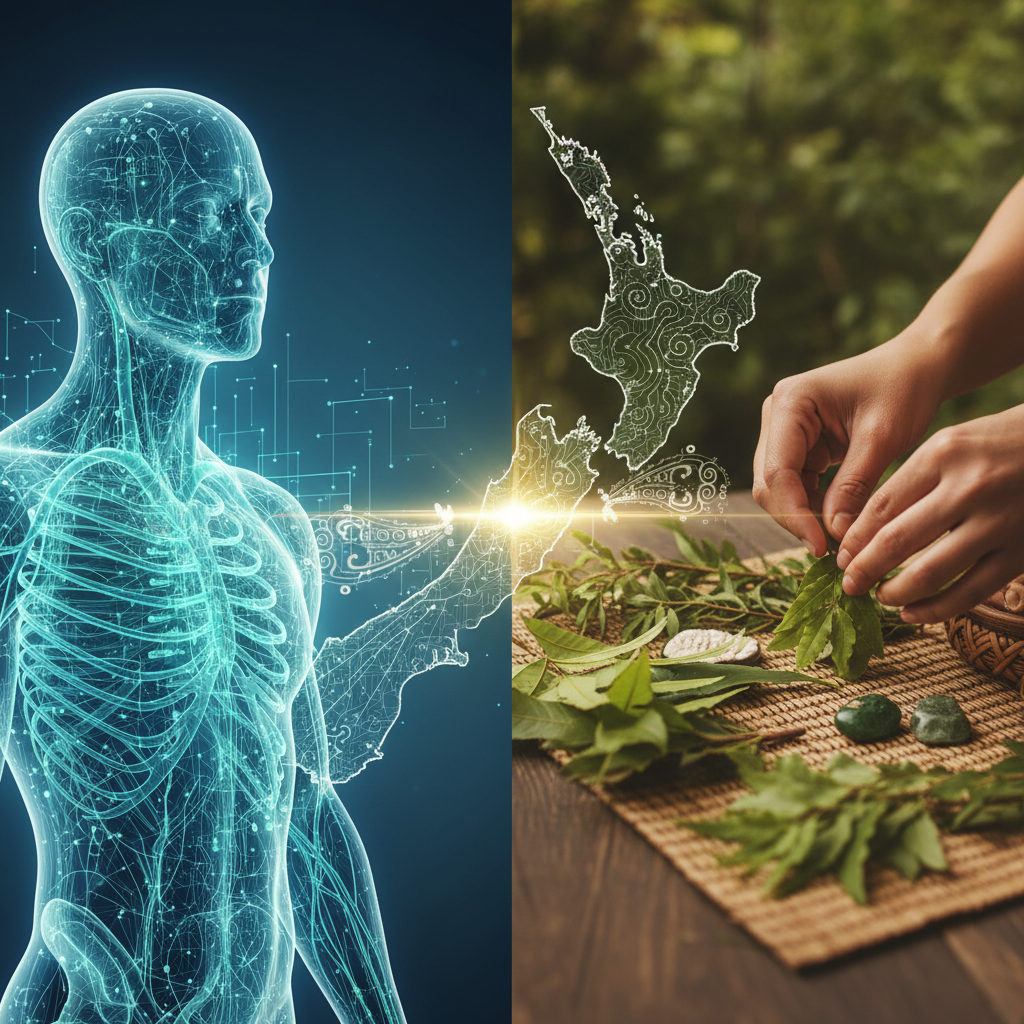
The wind whispers through the pōhutukawa trees, carrying the scent of the ocean and the hum of progress. Here in Aotearoa, New Zealand, we often find ourselves at the crossroads of ancient wisdom and cutting-edge innovation. It is a place where the digital revolution meets the deep-rooted understanding of rongoā Māori, our traditional healing practices. This unique vantage point gives us a particular lens through which to view the global healthcare revolution, a revolution increasingly powered by artificial intelligence, particularly in diagnostics, vaccine development, and telemedicine. For developers, data scientists, and technical professionals, understanding the underlying architecture and ethical considerations is paramount, especially when building for diverse populations.
The Technical Challenge: Bridging Disparity with Data
Healthcare in New Zealand, like many nations, faces significant challenges: geographic isolation, an aging population, and persistent health inequities, particularly for Māori and Pasifika communities. The problem we are solving is not just about faster diagnoses or more efficient drug discovery, it is about equitable access and culturally appropriate care. Imagine a scenario where a remote marae (Māori meeting ground) can access specialist diagnostic support without a patient having to travel hundreds of kilometers. Or where vaccine development can be accelerated while ensuring clinical trials are inclusive and representative. This requires robust, secure, and adaptable AI systems, capable of handling diverse datasets and delivering insights at the point of need.
Architecture Overview: A Federated, Secure Ecosystem
Our vision for AI in healthcare in Aotearoa leans heavily on a federated learning architecture, combined with edge computing and robust cloud infrastructure. This design addresses critical concerns around data sovereignty, privacy, and computational efficiency. At its core, we envision a multi-layered system:
- Edge Devices and Local Gateways: These are the frontline tools, from smart diagnostic devices in rural clinics to telemedicine platforms on patient smartphones. They perform initial data capture and pre-processing, often using lightweight, optimized models. Think of NVIDIA's Jetson modules powering portable ultrasound devices or smart stethoscopes.
- Regional Data Hubs: These hubs aggregate anonymized or pseudonymized data from local sources, acting as secure intermediaries. They might host NVIDIA Clara Guardian applications for real-time inference and anomaly detection.
- National AI Platform (Cloud/On-Premise Hybrid): This is where the heavy lifting occurs. Large language models (LLMs) for clinical decision support, deep learning models for image analysis, and reinforcement learning for drug discovery are trained and refined here. Major cloud providers like Microsoft Azure and Google Cloud offer specialized healthcare AI services, but for sensitive health data, many New Zealand institutions prefer hybrid models, keeping core data processing within national borders, often leveraging NVIDIA's DGX systems for computational power.
System Components:
- Data Ingestion & Pre-processing: Apache Kafka for streaming data, Apache Spark for batch processing, ensuring data quality and anonymization (e.g., using techniques like differential privacy).
- Model Training & Management: Kubernetes for container orchestration, Kubeflow for ML pipelines, and tools like MLflow for model versioning and tracking. NVIDIA's Clara Train SDK provides frameworks for medical imaging AI development.
- Inference & Deployment: RESTful APIs for model serving, NVIDIA Triton Inference Server for optimized deployment across various hardware, from edge to cloud.
- Security & Compliance: End-to-end encryption, blockchain for data provenance, and adherence to New Zealand's Health Information Privacy Code and the Māori Data Sovereignty principles embodied by Te Mana Raraunga.
Key Algorithms and Approaches
For diagnostics, convolutional neural networks (CNNs) remain the workhorse for image analysis (X-rays, MRIs, pathology slides). For example, a ResNet or U-Net architecture can be trained on vast datasets of medical images to detect anomalies with high accuracy. In vaccine development, generative AI models like variational autoencoders (VAEs) or generative adversarial networks (GANs) are exploring novel molecular structures, while graph neural networks (GNNs) analyze protein-protein interactions. For telemedicine, natural language processing (NLP) models, often transformer-based architectures like those from Google's Gemini or OpenAI's GPT series, are crucial for transcribing consultations, summarizing patient notes, and providing clinical decision support. However, these models require careful fine-tuning on domain-specific, culturally relevant datasets to avoid bias.
Conceptual Example: Federated Learning for Diagnostic Imaging
# Pseudocode for Federated Learning client (e.g., a regional hospital)
def train_local_model(local_data, global_model_weights):
 local_model = load_model_architecture()
 local_model.set_weights(global_model_weights)
 local_model.train(local_data, epochs=E, batch_size=B)
 return local_model.get_weights()

# Pseudocode for Federated Learning server (e.g., national AI platform)
def aggregate_weights(client_weights_list):
 # Perform secure aggregation (e.g., FedAvg, secure multi-party computation)
 new_global_weights = calculate_average(client_weights_list)
 return new_global_weights

# Overall flow:
# 1. Server sends initial global model weights to clients.
# 2. Clients train locally on their private data, send updated weights (not data) back.
# 3. Server aggregates weights, updates global model.
# 4. Repeat.
# Pseudocode for Federated Learning client (e.g., a regional hospital)
def train_local_model(local_data, global_model_weights):
 local_model = load_model_architecture()
 local_model.set_weights(global_model_weights)
 local_model.train(local_data, epochs=E, batch_size=B)
 return local_model.get_weights()

# Pseudocode for Federated Learning server (e.g., national AI platform)
def aggregate_weights(client_weights_list):
 # Perform secure aggregation (e.g., FedAvg, secure multi-party computation)
 new_global_weights = calculate_average(client_weights_list)
 return new_global_weights

# Overall flow:
# 1. Server sends initial global model weights to clients.
# 2. Clients train locally on their private data, send updated weights (not data) back.
# 3. Server aggregates weights, updates global model.
# 4. Repeat.
This approach allows models to learn from diverse patient populations across different regions without centralizing sensitive patient data, a crucial aspect for maintaining trust and data sovereignty, especially within Māori communities.
Implementation Considerations
Deploying these systems is not without its complexities. Data annotation for medical imaging requires highly specialized expertise, and ensuring consistency across different annotators is a significant challenge. Model interpretability is another critical factor; clinicians need to understand why an AI made a particular recommendation. Techniques like Shap (SHapley Additive exPlanations) or Lime (Local Interpretable Model-agnostic Explanations) are vital here. Furthermore, continuous monitoring for model drift and bias is essential, as patient demographics or disease prevalence can change over time. Technology must serve the people, not the other way around, and this means constant vigilance over its impact.
Benchmarks and Comparisons
When evaluating AI diagnostic models, metrics like sensitivity, specificity, accuracy, and AUC (Area Under the Receiver Operating Characteristic Curve) are standard. However, in a New Zealand context, we also need to consider equity metrics, such as performance differences across ethnic groups. For instance, a model might achieve 95% accuracy overall but perform significantly worse for Māori patients due to underrepresentation in training data. Comparing a federated learning approach against a centralized one often shows a slight performance trade-off for the former, but with significant gains in data privacy and sovereignty, which is often a worthwhile exchange for our communities. Companies like Google Health and Microsoft's AI for Health initiatives are setting high benchmarks, but their models often need substantial localization and validation for our unique population.
Code-Level Insights
For deep learning, TensorFlow and PyTorch are the dominant frameworks. For medical imaging, libraries like Monai (Medical Open Network for AI), often integrated with NVIDIA Clara, provide specialized tools for data loading, augmentation, and model architectures. For NLP, Hugging Face Transformers offers pre-trained models that can be fine-tuned on clinical text. For robust MLOps, platforms like AWS SageMaker, Google Cloud Vertex AI, or Azure Machine Learning provide managed services for experiment tracking, model deployment, and monitoring. When working with sensitive data, secure computing frameworks like OpenMined's PySyft can facilitate federated learning and homomorphic encryption.
Real-World Use Cases
- Auckland District Health Board (adhb) and Radiology AI: Adhb has been piloting AI models for early detection of diabetic retinopathy from retinal scans, reducing wait times and improving access for patients in underserved areas. This involves a CNN-based diagnostic model trained on anonymized local data, integrated into their existing Pacs (Picture Archiving and Communication System).
- Malaghan Institute of Medical Research and Vaccine Discovery: Leveraging high-performance computing clusters, the Malaghan Institute is using AI to accelerate the identification of potent vaccine candidates. This involves molecular docking simulations powered by AI and generative models predicting protein structures, significantly shortening the initial discovery phase. They often collaborate with NVIDIA for GPU acceleration.
- Te Whatu Ora (Health New Zealand) Telehealth Expansion: Following the pandemic, Te Whatu Ora rapidly expanded its telehealth services. AI-powered chatbots for initial symptom assessment and NLP tools for summarizing virtual consultations are now being explored to enhance efficiency and ensure continuity of care, particularly for rural communities. This reduces the burden on primary care providers and improves patient triage.
- Māori Health Providers and Data Sovereignty: Organizations like Hāpai Te Hauora are exploring how AI can support community health initiatives while upholding Māori data sovereignty. This includes developing culturally informed AI models for predictive health analytics, using data governance frameworks that empower iwi (tribes) and hapū (sub-tribes) to control their own health data. In Te Reo Māori, we have a word for this: rangatiratanga, self-determination, which extends to our digital taonga, our data.
Gotchas and Pitfalls
One significant pitfall is data bias. If training data disproportionately represents certain demographics, the AI model will inevitably perform poorly or even harm others. For instance, diagnostic models trained predominantly on European skin tones may misdiagnose conditions in darker skin. Another is the 'black box' problem, where complex deep learning models lack transparency, making it difficult for clinicians to trust or explain their outputs. Over-reliance on AI without human oversight can also lead to critical errors. Finally, cybersecurity vulnerabilities in healthcare AI systems are a constant threat, as patient data is highly valuable. Ars Technica often reports on these types of security challenges.
Resources for Going Deeper
For those looking to dive deeper, I recommend exploring the NVIDIA Clara platform documentation for medical AI development. The Monai framework is an excellent open-source resource for medical imaging. For ethical AI and data sovereignty, look into the work of Te Mana Raraunga, the Māori Data Sovereignty Network. Academic papers on federated learning in healthcare, often found on arXiv, provide cutting-edge research. Courses on deep learning for medical applications from institutions like Stanford or Coursera can also provide a solid foundation. Remember, building AI for healthcare is not just a technical exercise, it is a profound responsibility.
Aotearoa's Unique Path Forward
Aotearoa's approach to AI is rooted in indigenous wisdom, a perspective that emphasizes collective well-being and long-term sustainability. We are not just adopting global AI trends, we are adapting them, infusing them with our values of manaakitanga (hospitality, care) and kaitiakitanga (guardianship). The integration of AI into our healthcare system is not merely about technological advancement, it is about building a future where health equity is a reality for all, where the promise of AI is realized through a lens of justice and cultural respect. This is the journey we are on, a journey where every line of code, every algorithm, must ultimately serve the health and well-being of our people.