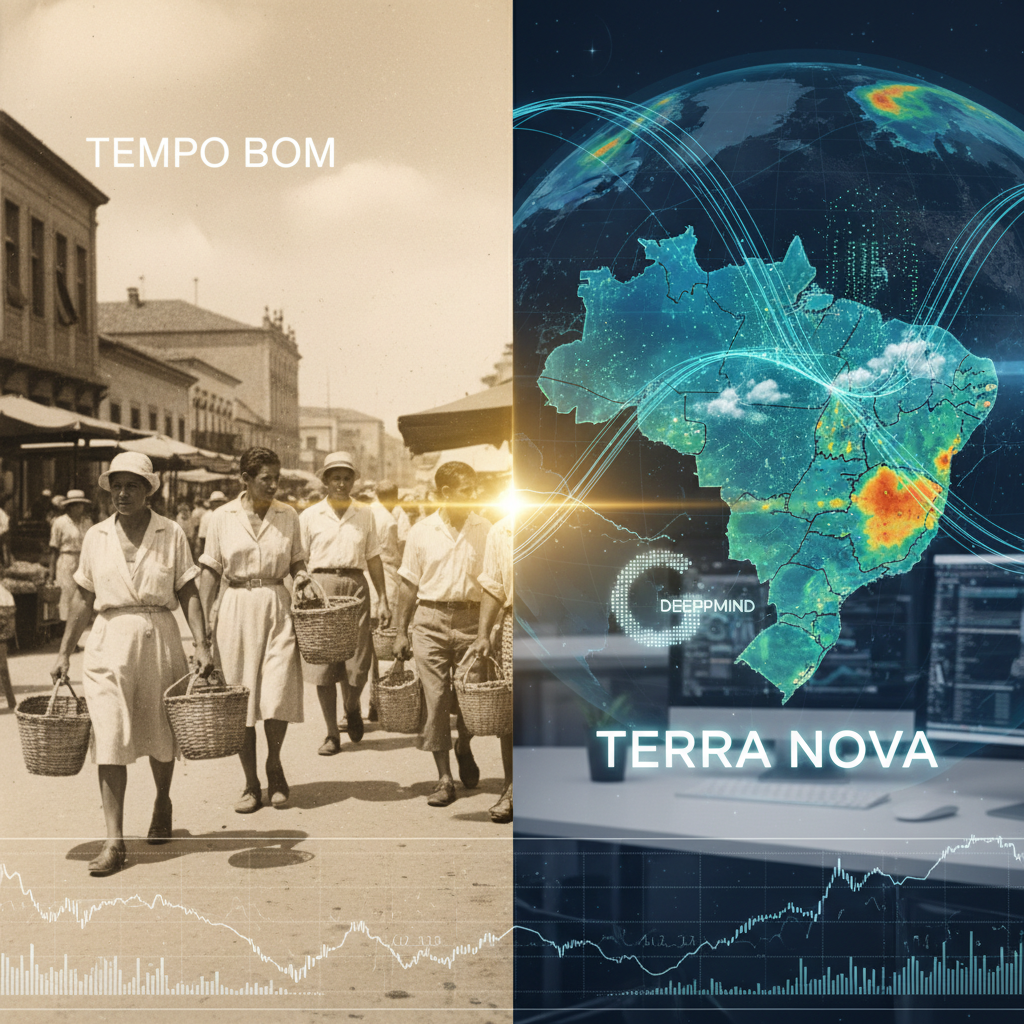

Olá, meus amigos! Luciànò Ferreiràs here, from the heart of Brazil, and today we need to talk about something truly transformative, something that touches every corner of our lives, from the farmer in the interior to the banker in São Paulo: the weather. For generations, predicting the weather has been a complex, often frustrating, dance with the unknown. We have relied on supercomputers churning through billions of equations, but even with all that power, a sudden chuva de verão could still catch us off guard. But what if I told you that the very fabric of weather forecasting is being rewoven, not by more powerful physics simulations, but by artificial intelligence, specifically by models like Google DeepMind's GraphCast, which are outperforming traditional systems by orders of magnitude? This is not just an incremental improvement; it is a paradigm shift, a terra nova in meteorology.
The big picture here is simple yet profound: AI is learning the language of the atmosphere better and faster than our best human-designed models. Imagine a vast, intricate ballet of wind, temperature, pressure, and humidity, constantly changing across the globe. Traditional numerical weather prediction, or NWP, models try to simulate this ballet using fundamental laws of physics. They are like brilliant mathematicians trying to calculate every single step of every dancer. AI, on the other hand, is like a master choreographer who has watched this ballet millions of times. It has learned the patterns, the subtle cues, and can predict the next sequence of moves with uncanny accuracy, even when the physics are too complex for direct calculation.
Here in Brazil, with our diverse climates, from the Amazon rainforest to the arid Northeast and the temperate South, accurate forecasting is not a luxury, it is a necessity. Our agriculture, a cornerstone of our economy, depends on it. Early warnings for floods, droughts, or severe storms can save lives and billions of reais. This is why the advancements in AI weather forecasting are so critical for us.
The Building Blocks: How AI Learns the Weather's Secrets
So, how does this magic happen? Let me explain the architecture. At its core, an AI weather model like GraphCast is a type of neural network, specifically a 'graph neural network.' Think of it like this: the Earth's atmosphere is not a flat map, it is a complex, interconnected system. A graph neural network treats the Earth's surface and atmosphere as a giant graph, where each point, or 'node,' represents a specific location with its own weather variables, and the 'edges' between nodes represent how these locations influence each other. It is a brilliant way to capture spatial relationships, much like how our Brazilian cities are connected by roads and rivers.
These models are trained on colossal datasets of historical weather observations and forecasts. We are talking decades of satellite imagery, ground station readings, radar data, and outputs from traditional NWP models. The AI digests this information, learning the intricate, non-linear relationships between variables. It is like teaching a child to recognize patterns in clouds, but on a planetary scale and with incredible precision.
Key components include:
- Encoder: This part takes the raw weather data, like temperature, pressure, wind speed, and humidity at various altitudes, and converts it into a format the neural network can understand. It is like translating raw sensor readings into a common language for the AI.
- Processor (Graph Neural Network): This is the brain. It propagates information across the atmospheric graph, learning how changes in one area affect others. It identifies complex atmospheric dynamics that might be too subtle for traditional models to explicitly calculate. This is where the AI truly shines, finding hidden correlations and causal links.
- Decoder: Once the processor has made its predictions, the decoder translates these internal representations back into human-readable weather variables, like a forecast for temperature, precipitation, and wind for the next few hours or days.
Step by Step: From Input to Prediction
Imagine a typical forecasting cycle:
- Step 1: Data Ingestion: Billions of data points pour in from weather stations, satellites, buoys, and aircraft across the globe. This real-time snapshot of the atmosphere is the starting point.
- Step 2: Encoding the Present: The AI's encoder transforms this vast input into a structured graph representation. Each node in the graph holds the current weather state for its location.
- Step 3: Iterative Prediction: The graph neural network then performs a series of calculations. It takes the current state, processes it through its learned patterns, and predicts the weather state for a short time step into the future, say, 6 hours. It then takes this new predicted state and feeds it back into itself to predict the next 6 hours, and so on. This iterative process allows it to build a forecast for several days ahead.
- Step 4: Decoding the Future: Finally, the decoder translates the AI's internal predictions for each node back into standard meteorological variables, producing a comprehensive forecast map.
This entire process, from raw data to a 10-day forecast, can take minutes on powerful GPUs, significantly faster than traditional models that can take hours on supercomputers. As Dr. Remi Lam, a lead researcher at Google DeepMind, recently stated, "GraphCast can generate a 10-day forecast in less than one minute on a single machine, achieving higher accuracy than traditional methods that take hours on supercomputers." This speed is a game-changer, especially when rapid updates are needed during fast-developing weather events.
A Worked Example: Predicting a Frente Fria in Southern Brazil
Let us consider a common scenario in Brazil: a strong frente fria, a cold front, moving up from the South Atlantic towards the southern states like Rio Grande do Sul and Santa Catarina. Traditionally, meteorologists would run several NWP models, analyze their outputs, and make a judgment call. These models might take 6-12 hours to produce a 7-day forecast.
With an AI model like GraphCast, the process is streamlined. As the cold air mass begins to organize over the ocean, satellite data, buoy readings, and atmospheric pressure changes are fed into the AI. The graph neural network immediately starts identifying the characteristic patterns of a developing cold front. It recognizes the pressure gradients, the temperature advection, and the moisture transport that signify its approach. Within minutes, it can generate a high-resolution forecast, showing the front's trajectory, its speed, the expected temperature drop, and areas likely to receive significant rainfall or even frost. This rapid, accurate prediction allows farmers to protect crops, civil defense to issue warnings, and energy companies to anticipate demand spikes. The code tells the real story here: it is about efficiency and precision.
Why It Sometimes Fails: Limitations and Edge Cases
No model is perfect, and AI weather forecasting is no exception. While incredibly powerful, these models have limitations. They are only as good as the data they are trained on. If historical data lacks examples of extremely rare or unprecedented weather events, the AI might struggle to predict them accurately. This is particularly relevant with climate change introducing new extremes.
Furthermore, while AI excels at pattern recognition, it does not understand physics in the same way a traditional model does. It learns correlations, not necessarily causation. This means that if a truly novel atmospheric phenomenon occurs, one outside its training distribution, the AI might produce a less reliable forecast. As Dr. Sarah Gille, an oceanographer at Scripps Institution of Oceanography, noted, "AI models are powerful interpolators, but extrapolation to entirely new regimes remains a challenge." This is why hybrid approaches, combining the strengths of both AI and traditional physics-based models, are likely the future.
Another challenge is 'model drift.' Over long prediction horizons, small errors can accumulate, causing the AI's forecast to diverge from reality. This is an active area of research, with scientists developing techniques to keep the AI grounded in physical reality.
Where This Is Heading: A Brighter, More Predictable Future
The future of AI weather forecasting is incredibly promising, especially for a country as geographically diverse and climate-vulnerable as Brazil. We are already seeing the integration of these models into national meteorological services. The European Centre for Medium-Range Weather Forecasts (ecmwf), a global leader, has been actively comparing AI models to their own state-of-the-art NWP systems, often finding AI to be competitive or superior in many metrics. Reuters has reported extensively on this shift.
Expect to see more specialized AI models, trained for specific regions or phenomena, like predicting extreme rainfall in the Amazon basin or severe droughts in the Northeast. The computational efficiency of AI also means that forecasts can be run more frequently and at higher resolutions, providing hyper-local predictions for cities and even individual neighborhoods. Imagine knowing with high certainty if your street in Rio will flood in the next hour, not just your city.
The collaboration between global tech giants like Google DeepMind and local institutions is also crucial. Brazil's developer community is massive and talented, and we have a unique perspective on our own climate challenges. Integrating local expertise with global AI capabilities will unlock even greater potential. The next generation of weather models will likely be 'hybrid,' combining the foundational physics of NWP with the pattern-recognition prowess of AI, creating a system that is both physically consistent and incredibly accurate. This will empower us to better manage our natural resources, protect our communities, and build a more resilient Brazil. The forecast, my friends, is looking very bright indeed. For more on the cutting edge of AI, keep an eye on MIT Technology Review.