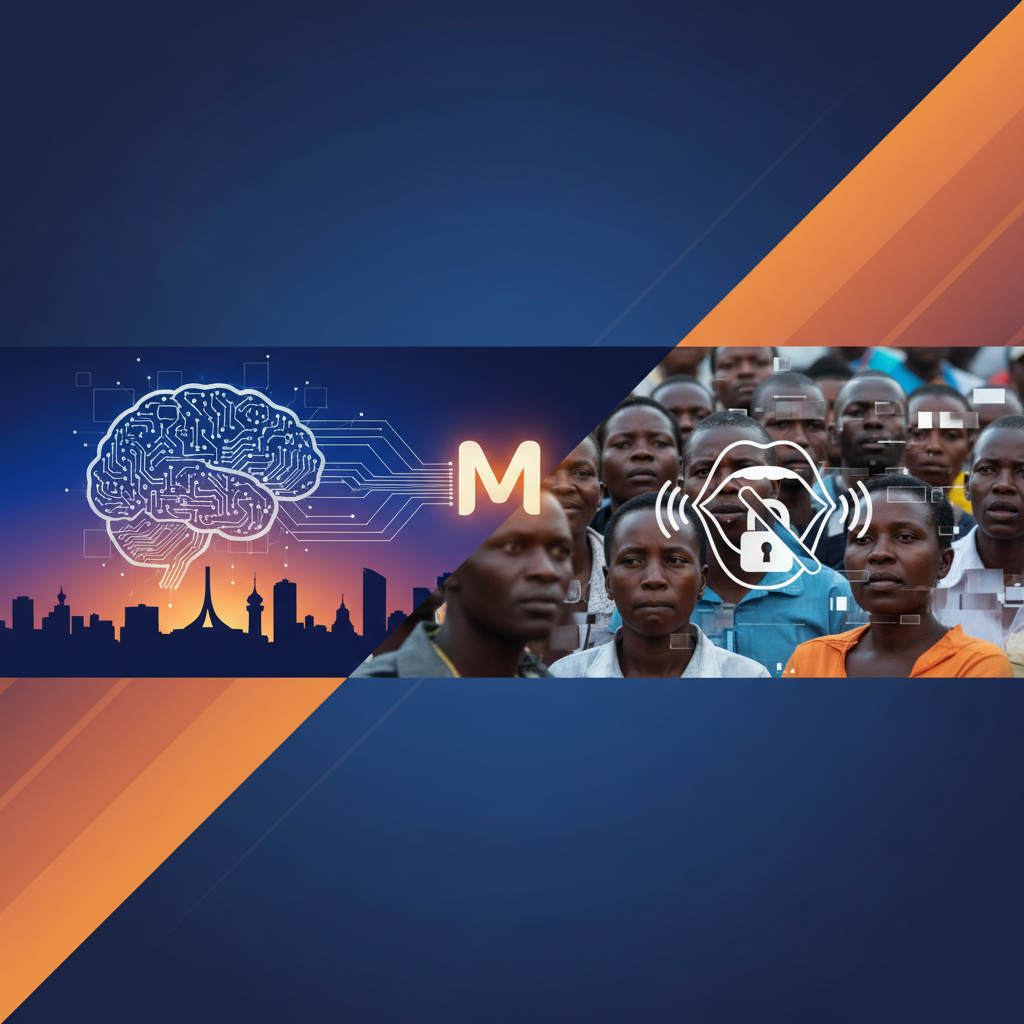

Let's be frank, the internet, for all its promise, has become a wild, untamed beast, and the reins are held by algorithms. Here in Harare, on the bustling streets of Mbare, or in the quiet contemplation of a coffee shop in Borrowdale, we see how much of our public discourse now happens online. But who decides what's heard and what's silenced? It's not just human moderators anymore; it's AI, and that, my friends, is a technical deep dive we absolutely must take.
The challenge is monumental. Platforms like Meta, Google, and ByteDance are faced with billions of pieces of content daily. They have to sift through hate speech, misinformation, incitement to violence, and plain old spam, all while trying to uphold some semblance of free expression. For us in Africa, where political narratives can be particularly sensitive and local languages often misunderstood by global models, this isn't just a technical problem; it's a matter of sovereignty and cultural preservation. The technical problem boils down to building scalable, accurate, and context-aware systems that can identify harmful content across diverse languages and cultural nuances, often in real time, without stifling legitimate dissent or creative expression.
Architecture Overview: The Digital Gatekeepers' Blueprint
Imagine a massive digital filtration plant. That's essentially what these content moderation systems are. At a high level, their architecture typically involves several stages:
- Ingestion Layer: This is where all user-generated content, from text posts to videos, enters the system. It's often distributed, using technologies like Apache Kafka or Google Cloud Pub/Sub to handle the immense data streams.
- Feature Extraction: Raw content is converted into numerical representations, or 'embeddings', that machine learning models can understand. For text, this might involve transformer models like Bert or OpenAI's GPT variants. For images and video, convolutional neural networks (CNNs) are common, extracting features like objects, faces, and actions.
- Detection Models (Classification): This is the core. Multiple specialized AI models run in parallel or sequence. One model might detect hate speech, another child exploitation, another spam. These are often deep neural networks, trained on vast, labeled datasets. For instance, a model might classify content into categories like
HateSpeech,Violence,Misinformation,Harassment,Neutral, etc. - Contextual Analysis & Risk Scoring: This is where things get tricky and where African contexts often get lost. Beyond simple classification, systems try to understand the intent and impact of content. This might involve graph neural networks to analyze social networks and propagation patterns, or reinforcement learning to adapt to evolving threats. A 'risk score' is assigned, indicating the likelihood of harm.
- Human Review & Annotation: No AI is perfect. High-risk content, or content that the AI is uncertain about, is flagged for human review. This is where the human element, often outsourced to moderation farms globally, comes in. These human reviewers also provide crucial feedback for retraining and improving the AI models.
- Decision & Enforcement: Based on AI scores and human review, actions are taken: content removal, flagging, demonetization, user bans, or simply allowing the content to remain.
Key Algorithms and Approaches: The Brains of the Operation
At the heart of these systems are sophisticated machine learning algorithms. Let's look at a few:
- Transformer Models for Text: For understanding natural language, transformers are king. They excel at capturing long-range dependencies and contextual meaning. For African languages, the challenge is often a lack of pre-trained models and sufficient training data. Imagine trying to moderate Shona slang with a model trained predominantly on English and Mandarin. It's a recipe for disaster. Fine-tuning models like Meta's Llama on local vernaculars and cultural idioms is critical here.
 # Conceptual pseudocode for text classification
 def classify_text_content(text_input, language_model, classifier_head):
 # Step 1: Tokenize and generate embeddings
 embeddings = language_model.encode(text_input)

 # Step 2: Pass embeddings through a classification head
 # This head is typically a feed-forward neural network
 prediction_logits = classifier_head(embeddings)

 # Step 3: Apply softmax to get probabilities
 probabilities = softmax(prediction_logits)

 # Step 4: Determine class (e.g., HateSpeech, Neutral)
 predicted_class = argmax(probabilities)

 # Step 5: Return class and confidence score
 return predicted_class, max(probabilities)
 # Conceptual pseudocode for text classification
 def classify_text_content(text_input, language_model, classifier_head):
 # Step 1: Tokenize and generate embeddings
 embeddings = language_model.encode(text_input)

 # Step 2: Pass embeddings through a classification head
 # This head is typically a feed-forward neural network
 prediction_logits = classifier_head(embeddings)

 # Step 3: Apply softmax to get probabilities
 probabilities = softmax(prediction_logits)

 # Step 4: Determine class (e.g., HateSpeech, Neutral)
 predicted_class = argmax(probabilities)

 # Step 5: Return class and confidence score
 return predicted_class, max(probabilities)
-
Convolutional Neural Networks (CNNs) for Vision: For images and videos, CNNs are used to identify objects, scenes, and potentially harmful actions. Techniques like object detection (e.g., Yolo, Faster R-cnn) can spot prohibited items or symbols, while action recognition models can detect violence or explicit acts. The challenge for us is ensuring these models are trained on diverse datasets that represent African realities, not just Western ones.
-
Active Learning: This approach helps reduce the human labeling burden. The AI identifies data points it's most uncertain about, and these are prioritized for human review. This makes the human feedback loop more efficient, especially when dealing with new or evolving forms of harmful content.
-
Federated Learning: For privacy-sensitive scenarios, especially in countries with strict data localization laws, federated learning allows models to be trained on decentralized data (e.g., on users' devices) without the raw data ever leaving the device. Only model updates are aggregated. This could be vital for building more localized, privacy-preserving moderation models in Zimbabwe.
Implementation Considerations: More Than Just Code
Building these systems isn't just about picking an algorithm; it's about infrastructure, data, and ethics.
- Data Scarcity: For many African languages and cultural contexts, high-quality, labeled datasets are scarce. This is a massive hurdle. Initiatives like the Masakhane project are trying to address this, but platforms need to invest more in local data collection and annotation.
- Bias in Training Data: If your training data reflects biases, your AI will amplify them. This can lead to disproportionate censorship of certain communities or viewpoints. Regular bias audits and diverse data collection are non-negotiable.
- Scalability: Processing petabytes of data and making decisions in milliseconds requires robust, distributed cloud infrastructure. Companies often leverage Kubernetes, serverless functions, and specialized hardware like NVIDIA GPUs for inference at scale.
- Explainability (XAI): When an AI flags content, why did it do so? Understanding the model's reasoning is crucial for transparency, especially when dealing with sensitive issues like free speech. Techniques like Lime or Shap can offer insights.
Benchmarks and Comparisons: How Do We Measure Fairness?
Traditional metrics like precision, recall, and F1-score are useful, but they don't capture the nuances of content moderation, especially when false positives (legitimate content flagged) or false negatives (harmful content missed) have severe societal consequences. We need metrics that account for fairness across different demographic groups, languages, and political viewpoints. Comparing the performance of a Meta model versus, say, an open-source alternative fine-tuned on specific Zimbabwean datasets, would require not just accuracy scores but also human evaluations of perceived fairness and cultural appropriateness. ArXiv is full of papers trying to define these new metrics, but the real-world application is still evolving.
Code-Level Insights: The Developer's Toolkit
For developers looking to build or contribute to these systems, the toolkit is diverse:
- Frameworks: TensorFlow and PyTorch are the dominant deep learning frameworks. Libraries like Hugging Face Transformers are indispensable for working with language models.
- Cloud Platforms: AWS, Google Cloud, and Azure offer managed services for machine learning (e.g., SageMaker, Vertex AI) and scalable data processing.
- Data Orchestration: Tools like Apache Airflow or Prefect manage complex data pipelines, from ingestion to model training and deployment.
- MLOps: For productionizing these systems, MLOps practices are crucial, focusing on continuous integration, continuous delivery, and continuous training of models.
Real-World Use Cases: Beyond the Big Tech Silos
- Community-driven Moderation: Imagine a platform for local Zimbabwean artists, like a digital gallery for Chapungu Sculpture Park. Instead of relying solely on a global AI, they could implement a hybrid system where local community leaders or designated cultural experts contribute to the training data and review process, ensuring that artistic expression isn't stifled by a foreign algorithm.
- Misinformation Detection in Local News: A Zimbabwean news aggregator could use fine-tuned LLMs to detect propaganda or misinformation in Shona and Ndebele, working closely with local fact-checking organizations. This would require models trained on local news sources and historical context.
- Hate Speech Detection in Public Forums: A local online forum for civic discourse could deploy a custom-built classifier, trained on specific examples of hate speech relevant to Zimbabwean social dynamics, rather than a generic model that might miss subtle local slurs or coded language.
- Protecting Vulnerable Groups: NGOs working with marginalized communities could develop AI tools to monitor online spaces for targeted harassment against these groups, using models specifically trained to understand the unique threats they face.
Gotchas and Pitfalls: The Digital Minefield
- Over-censorship (False Positives): An overly aggressive AI can silence legitimate voices, leading to a chilling effect on free speech. This is particularly dangerous in politically sensitive environments.
- Under-censorship (False Negatives): A weak AI allows harmful content to proliferate, eroding trust and potentially inciting real-world harm.
- Adversarial Attacks: Malicious actors can intentionally craft content to bypass AI detection, a constant cat-and-mouse game for platform security teams.
- Cultural Insensitivity: What's acceptable in one culture might be offensive in another. A global AI model often struggles with this, leading to misinterpretations and unfair moderation decisions. This is where the local context of Zimbabwe is paramount.
- Transparency Deficit: When platforms don't explain why content was removed, it breeds distrust and fuels accusations of bias or censorship.
Resources for Going Deeper: Your Next Steps
For those of you who want to roll up your sleeves, I recommend diving into the research. Start with papers on fairness in AI and multilingual NLP. Check out the work being done by organizations like Masakhane, which focuses on natural language processing for African languages. For general AI news and developments, TechCrunch is always a good read. For the ethical implications, Wired's AI section often has insightful pieces. And for the raw technical details, the academic papers on MIT Technology Review are invaluable.
The future is African, and that includes the future of our digital public spaces. We cannot afford to be passive recipients of algorithms designed in Silicon Valley or Beijing. We must understand them, adapt them, and build our own. I'm calling it now: the next decade will see a surge in localized, culturally aware AI solutions coming out of places like Harare, addressing these very challenges. Watch this space, because the conversation around AI and free speech is just beginning, and our voices, amplified by technology, must be heard loud and clear. This isn't just about code; it's about our collective future, our right to express, to create, and to connect, without fear of an algorithm's silent judgment.