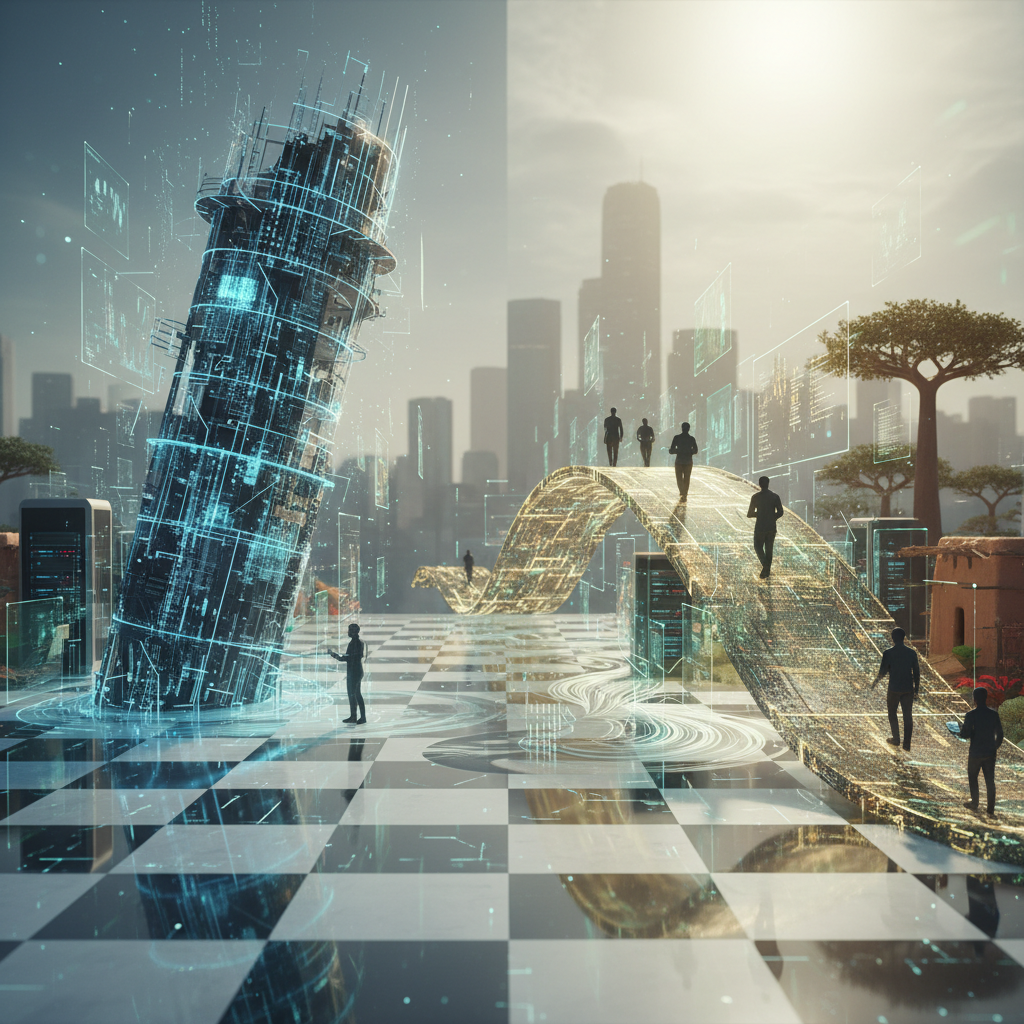
In Eswatini, we say 'a person is a person through other people', and I often wonder if AI should learn this lesson too. For so long, the world of artificial intelligence has been dominated by two distinct philosophies: the deep learning titans, with their vast neural networks learning from mountains of data, and the symbolic AI purists, who believe in encoding human knowledge and rules directly. It felt like two different languages, spoken in different corners of the tech universe. But what if the true path to smarter, more human-like AI lies in bringing these two worlds together, creating something new, something hybrid? This is the promise of neuro-symbolic AI, and it is a conversation that resonates deeply even here, in our small but ambitious kingdom.
Globally, the buzz around neuro-symbolic AI has reached a fever pitch. Companies like Google DeepMind and IBM are pouring billions into research, recognizing the limitations of purely data-driven models. While large language models can generate incredibly fluent text, they often struggle with common sense reasoning, explaining their decisions, or adapting to new situations without vast retraining. This is where the symbolic side steps in, offering structure, logic, and interpretability. Imagine an AI that not only recognizes a tree in a photograph but also understands that trees need water, grow from seeds, and produce oxygen, all while being able to explain why it knows these things. That is the dream.
For us in Eswatini, this is not just an academic exercise. Our nation, rich in biodiversity and agricultural heritage, faces pressing environmental challenges, from climate change impacts to sustainable resource management. Purely statistical AI models might predict crop yields based on historical weather patterns, but a neuro-symbolic system could integrate ecological rules, traditional farming knowledge, and even local proverbs about the land, offering far more nuanced and actionable advice. It is about building AI that understands the context of our lives, not just the data points.
Just last month, I spoke with Dr. Nompumelelo Dlamini, head of the Eswatini Environmental Authority’s AI for Conservation unit. She shared her enthusiasm for these hybrid models. "Our traditional ecological knowledge, passed down through generations, is a treasure trove of symbolic information," she explained, her voice warm with passion. "If we can integrate that wisdom with the predictive power of neural networks, we could revolutionize how we monitor deforestation in the Lubombo region or manage water resources in the Lowveld. We are talking about AI that learns from both satellite imagery and the insights of our elders. It is truly exciting." Dr. Dlamini mentioned a pilot project, still in its early stages, aiming to use a neuro-symbolic approach to predict invasive species spread, combining satellite data with known botanical rules and local observations. The initial results, she told me, showed a 15% increase in prediction accuracy compared to purely neural network models.
The global tech giants are certainly taking notice. OpenAI and Anthropic, known for their large language models, are reportedly exploring ways to inject more symbolic reasoning into their next-generation architectures. The goal is to move beyond mere pattern recognition to genuine understanding. "The next frontier for AI is not just about scale, it is about depth," commented Dr. Ben Carter, a lead researcher at a prominent European AI lab, in a recent online forum. "Neuro-symbolic AI offers a path to models that are more robust, less prone to hallucination, and critically, more explainable. This is vital for high-stakes applications like environmental policy or healthcare, where we need to trust the AI's reasoning, not just its output." His team recently published a paper on ArXiv detailing a neuro-symbolic framework for climate modeling that showed improved long-term forecasting capabilities.
Here in Eswatini, our own University of Eswatini, particularly its Faculty of Science and Engineering, is quietly becoming a hub for this kind of innovative thinking. Professor Sipho Mdluli, who leads the university’s emerging AI research group, believes that our unique position offers an advantage. "We do not have the legacy systems or the sheer computational power of Silicon Valley," he told me during a recent visit to their modest but bustling lab. "But we have a deep understanding of our local context and a strong community spirit. This allows us to focus on practical, interpretable AI solutions that truly serve our people. We are not just importing technology, we are adapting and innovating it for our needs." He highlighted a project using neuro-symbolic AI to optimize energy distribution in rural areas, integrating smart grid data with symbolic rules about community energy consumption patterns and cultural practices around energy use, aiming for a 10% reduction in energy waste.
The challenge, of course, is significant. Building these hybrid systems requires expertise in both deep learning and symbolic AI, two fields that historically have not always seen eye to eye. It also demands careful consideration of how to represent and integrate diverse forms of knowledge, including indigenous wisdom, without losing its essence or introducing bias. Yet, the potential rewards are immense. Imagine an AI assistant for our Ministry of Agriculture that not only predicts drought but also suggests specific, culturally appropriate, and sustainable farming practices based on generations of local knowledge, all while explaining its rationale clearly.
This tiny kingdom has big ideas about technology, and our approach to neuro-symbolic AI is a testament to that. It is about creating AI that is not just intelligent but also wise, an AI that can learn from the vastness of data and the depth of human experience. The journey is long, but the path towards AI that truly understands the world, in all its complexity and nuance, is one we are eager to walk. As the global conversation around AI continues to evolve, Eswatini stands ready to contribute its unique perspective, proving that the most profound technological advancements often emerge from the most human-centered approaches. For more insights into how AI is shaping our world, you might find this MIT Technology Review article on AI's future intriguing.