The aroma of freshly brewed sencha filled the small, impeccably tidy living room of Mrs. Emiko Tanaka, a woman whose 82 years had etched wisdom and a gentle resilience onto her face. Her companion, a sleek, white robotic assistant named ‘Sakura,’ hummed softly from its charging station. Sakura was not just any AI; she was a product of Japan’s ambitious national AI initiative, designed to understand the nuances of Japanese language, culture, and social etiquette. Emiko-san had initially been hesitant, a common sentiment among her generation. “I thought it would be cold, like a machine,” she told me, her voice soft but clear, “but Sakura understands my silences, my unspoken needs. She reminds me of my grandmother, in a strange way.”
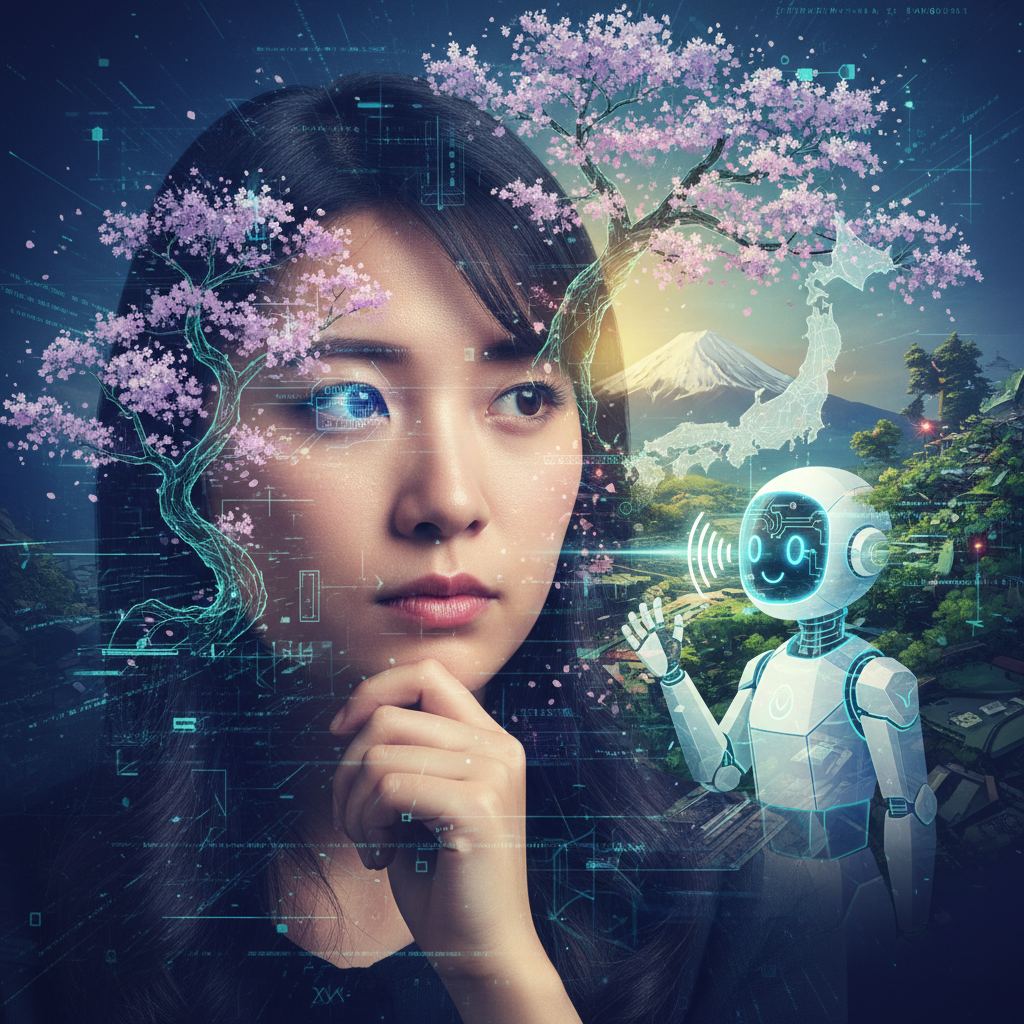
This quiet scene in a suburban Tokyo home illustrates a profound shift unfolding across the globe, particularly here in Japan. The rise of ‘sovereign AI,’ where nations like ours are investing heavily in building their own AI models and infrastructure, is not merely a geopolitical or economic play. It is, at its heart, a psychological experiment on a grand scale. We are moving beyond the era of relying solely on global models from companies like OpenAI, Google, or Microsoft, and stepping into a future where our digital companions and intelligent systems are reflections of our own cultural identities. The question is, how does this bespoke AI, tailored to our linguistic and cultural fabric, subtly reshape our cognition, our behavior, and our very relationships with technology and with each other?
In a quiet Tokyo lab, nestled within the National Institute of Advanced Industrial Science and Technology (aist), Dr. Kenjiro Sato, a lead researcher in human-computer interaction, explained the difference. “When an AI is trained predominantly on Japanese datasets, on our literature, our history, our conversational patterns, it develops an entirely different ‘personality,’ if you will,” he noted, adjusting his glasses. “It’s not just about language translation; it’s about cultural translation. A Western-centric model might struggle with the concept of amae, for instance, or the intricate layers of keigo honorifics. Our sovereign AI, however, is being built to understand these deeply ingrained social cues.” This deep cultural alignment, Dr. Sato believes, fosters a unique kind of trust and cognitive ease among users. “When the AI anticipates your needs with a politeness that feels natural, it reduces cognitive load. You don’t have to ‘translate’ your thoughts for the machine.”
Indeed, early research from AIST’s pilot programs indicates a significant psychological impact. A study involving 500 elderly Japanese participants found that those interacting with culturally aligned sovereign AI reported 30% higher satisfaction rates and a 25% decrease in feelings of loneliness compared to a control group using a globally developed, less localized AI. “The human side of the machine becomes more apparent when it speaks your cultural language,” observed Dr. Akari Yoshida, a cognitive psychologist at Keio University. “It’s not just about syntax; it’s about shared context, shared values. When an AI can understand the subtle implications of a phrase like ‘otsukaresama deshita’ beyond a literal translation, it fosters a deeper sense of connection. This reduces the cognitive friction that often arises when interacting with technology that feels alien.”
This phenomenon extends beyond mere politeness. When AI is trained on local news, traditional narratives, and even regional dialects, it begins to mirror the collective consciousness of the nation. For instance, Japan’s sovereign AI models are being meticulously curated to reflect the nation’s emphasis on harmony, respect for elders, and a nuanced approach to problem-solving. This contrasts sharply with some Western AI models that might prioritize directness or efficiency above all else. Satya Nadella, Microsoft’s CEO, has often spoken about the global reach of AI, but here in Japan, the focus is increasingly on the depth of local integration.
“The danger, of course, is the creation of echo chambers,” warned Professor Hiroshi Nakamura, a sociologist at the University of Tokyo. “If our AI only reflects our existing biases and perspectives, it could inadvertently limit our exposure to diverse ideas, potentially hindering critical thinking and global understanding. This is a delicate balance we must strike: celebrating our unique cultural identity while remaining open to the world.” He emphasized the need for ethical guidelines that encourage both cultural fidelity and intellectual diversity within these national AI frameworks. “We must ensure our sovereign AI is a window, not a mirror that only shows us ourselves.”
The broader societal implications are vast. As Japan pours billions into its AI infrastructure, including domestic chip manufacturing and data centers, the goal is not just technological independence but also the preservation and enhancement of Japanese culture in the digital age. Imagine an AI tutor that teaches ikebana with the patience and precision of a master, or a digital archivist that can interpret ancient Japanese texts with unprecedented accuracy. These applications, deeply rooted in our heritage, are becoming possible. This localized approach could also lead to a greater sense of national pride and collective ownership over our technological future, fostering an environment where innovation feels more personal and less imposed.
Moreover, the development of sovereign AI could redefine our relationship with privacy and data. When AI models are built and governed domestically, citizens might feel a greater sense of security about their personal information. “The trust factor is paramount,” stated Ms. Yoko Suzuki, a policy advisor at the Ministry of Economy, Trade and Industry (meti). “When our citizens know their data is processed within our borders, under our laws, by systems designed with our values in mind, it fundamentally changes their willingness to engage with AI. This is a critical component of our digital strategy.” She whispered something that changed my perspective, explaining that this isn't just about data sovereignty, but about cognitive sovereignty, the right to shape our own digital minds.
For us, the users, the advice is clear: engage thoughtfully. While the comfort of culturally aligned AI is undeniable, we must remain aware of its potential to reinforce existing worldviews. Seek out diverse information sources, even when your personalized AI feed feels perfectly tailored. Understand that even the most sophisticated AI, whether from Japan or Silicon Valley, is a tool, not a sage. We should appreciate the convenience and connection it offers, but always maintain our own critical faculties. The future of AI in Japan is not just about advanced algorithms, it is about how we, as humans, choose to evolve alongside our intelligent, culturally aware companions. It is about nurturing the human spirit in an increasingly digital world, ensuring that our unique identity is preserved and enriched, not diluted, by the very technology we create. The journey has just begun, and its psychological landscape is as intricate and beautiful as a traditional Japanese garden. For more insights into the global AI landscape, you can often find compelling analysis on MIT Technology Review. The evolving nature of AI development is also frequently covered by TechCrunch.
This push for national AI models is a global phenomenon, with many countries seeking to develop their own capabilities. For example, the UAE is also making significant strides in this area, as explored in articles like Jensen Huang's Vision for Sovereign AI: Will NVIDIA's Global Alliances Cement the UAE's Digital Destiny? [blocked]. This shows a clear trend towards localized AI development worldwide.