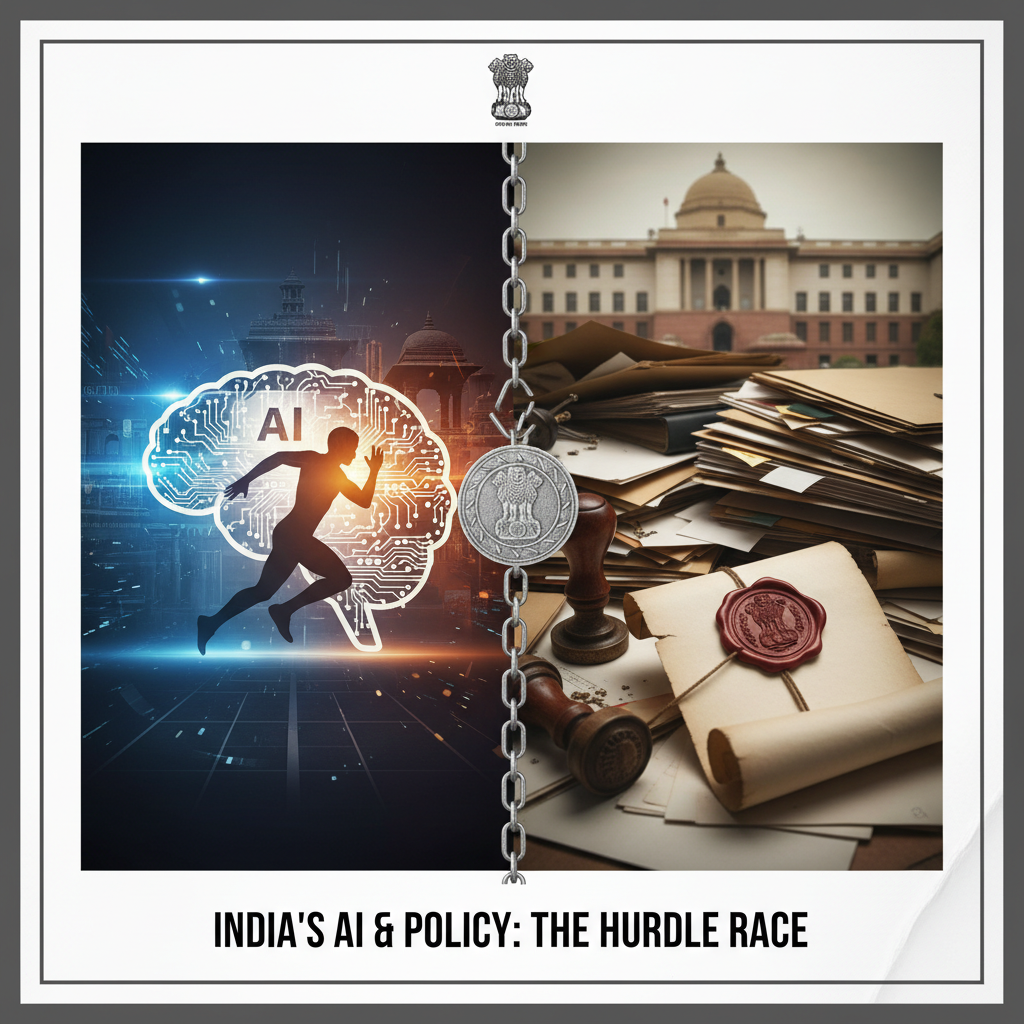
Ah, the grand pronouncements from Delhi. You can almost hear the collective sigh, or perhaps a hopeful cheer, depending on which side of the AI fence you are sitting. This time, the Ministry of Electronics and Information Technology, or MeitY as we fondly call it, has unveiled its shiny new set of guidelines for what they term 'High-Risk AI Systems.' And what, pray tell, constitutes high risk in their eyes? Well, it is not just your run-of-the-mill generative AI anymore. We are talking about the new breed, the ones boasting 'breakthroughs in AI reasoning' and 'architectures that go beyond mere pattern matching.'
For years, the global tech conversation has been dominated by the likes of OpenAI's GPT models and Google's Gemini, marveling at their ability to generate text, images, and even code. But the real quiet revolution, the one that makes actual scientists sit up and spill their chai, has been in AI's ability to reason, to infer, to connect dots in ways that mimic human thought more closely than ever before. Companies like Anthropic with their constitutional AI approach, and even some of our own homegrown startups in Bengaluru, are pushing the boundaries of symbolic reasoning and neural-symbolic AI. This is not just about predicting the next word; it is about understanding context, making logical deductions, and even planning. It is the kind of AI that could truly transform everything from medical diagnostics to urban planning, and yes, even how we analyze sports data, which is where the 'Sports' category for this article comes in, I suppose, though the implications are far wider.
Now, MeitY, bless their diligent hearts, has decided it is time to put some reins on this wild horse before it gallops off into unforeseen ethical dilemmas. Their new framework, still in its draft stages but with a strong push for rapid implementation, mandates that any AI system exhibiting advanced reasoning capabilities, especially those deployed in critical sectors like healthcare, finance, or public infrastructure, must undergo rigorous pre-deployment testing. This includes bias audits, explainability assessments, and even a 'reasoning integrity' check, whatever that means in practice. The idea is to ensure these systems are not just clever, but also fair, transparent, and robust. It is a noble goal, certainly, but one has to wonder if the bureaucracy can keep pace with the innovation.
Who is behind this sudden burst of regulatory fervor? Well, it is a mix of seasoned bureaucrats, a few academic luminaries, and, surprisingly, some voices from the civil society sector who have been ringing alarm bells about AI's potential for harm. The official line, as articulated by a senior MeitY official, is that India cannot afford to be a passive consumer of global AI innovation. "We must ensure that AI deployed within our borders aligns with our constitutional values and societal needs," stated Shri Alok Kumar, Secretary of MeitY, during a recent press briefing. "These guidelines are a proactive step to foster responsible innovation, not stifle it." He emphasized the need for a 'Made in India, Made for India' approach to AI governance, which sounds wonderful on paper, does it not?
What does this mean in practice for the bustling AI labs and startups across India, from Hyderabad to Gurugram? For starters, it means more paperwork, more compliance officers, and potentially slower deployment cycles. If your AI model can, say, diagnose a rare disease by reasoning through complex patient data, or optimize logistics for a national supply chain, you are now under the microscope. Developers will need to provide detailed documentation on training data, model architecture, and decision-making processes. There is even talk of an independent regulatory body, perhaps an 'AI Ethics Board of India,' to oversee these assessments. Oh, the irony, we are creating AI that thinks, and then we need a human board to think about what the AI thinks. It is enough to make you want to go back to pen and paper.
Industry reaction has been, predictably, a mixed bag. The larger players, those with deep pockets and established legal teams, are grumbling but largely prepared to adapt. "Compliance is always a challenge, but we understand the intent," said Dr. Kavita Sharma, Head of AI Research at Tata Consultancy Services, in a recent interview with Reuters Technology. "Ensuring public trust in AI is paramount, especially as these systems become more sophisticated. We are already investing heavily in explainable AI and bias mitigation techniques." Her words carry the weight of a corporate giant. However, for the smaller startups, the nimble innovators who are often at the forefront of these reasoning breakthroughs, it is a different story. Many fear these regulations could become a significant barrier to entry, diverting precious resources from R&D to compliance. "We are a team of ten, trying to build something truly revolutionary," lamented Rohan Gupta, CEO of a promising Bengaluru-based AI startup specializing in neural-symbolic architectures, speaking off the record. "Now, instead of coding, I am going to be filling out forms and hiring lawyers. This could kill innovation before it even breathes." File this under 'things that make you go hmm.'
Civil society groups, on the other hand, are cautiously optimistic. They have long advocated for stronger oversight, especially concerning AI's potential for algorithmic bias and opaque decision-making. "For too long, AI development has been a black box," stated Anjali Singh, a policy analyst with the Centre for Internet and Society, a prominent digital rights organization. "These guidelines, while imperfect, are a crucial first step towards accountability. We need to ensure that advanced reasoning AI does not perpetuate or even amplify existing societal inequalities, especially in a diverse country like India." Her point is well taken. The complexities of Indian society, with its myriad languages, cultures, and socio-economic disparities, present a unique challenge for any AI system, let alone one that claims to 'reason.' Bias in data, after all, translates to bias in decisions, and that is a recipe for disaster.
So, will it work? Will these new guidelines truly foster responsible AI innovation, or will they simply add another layer of bureaucratic red tape that slows down India's burgeoning AI sector? The truth, as always, probably lies somewhere in the middle. The intent is good, the need is real, but the execution is where the rubber meets the road. India has a knack for both incredible innovation and labyrinthine bureaucracy. The success of this policy will depend heavily on its adaptability, on MeitY's willingness to listen to feedback from the industry, and on the capacity of our regulatory bodies to understand the rapidly evolving technical landscape. If the rules are too rigid, they will stifle the very innovation they seek to guide. If they are too lax, we risk repeating the mistakes of other tech revolutions, where ethical considerations played catch-up to technological prowess. Perhaps we need an AI to help us navigate the complexities of AI governance itself, a meta-AI, if you will. Now there is a thought. What Kerala knew all along is that common sense, often unwritten, is the best guide, and sometimes, the simplest solutions are the most profound. Let us hope Delhi remembers that as well. For more on the global AI regulatory landscape, you might want to check out MIT Technology Review. The journey of AI governance, much like the journey of AI itself, is just beginning.