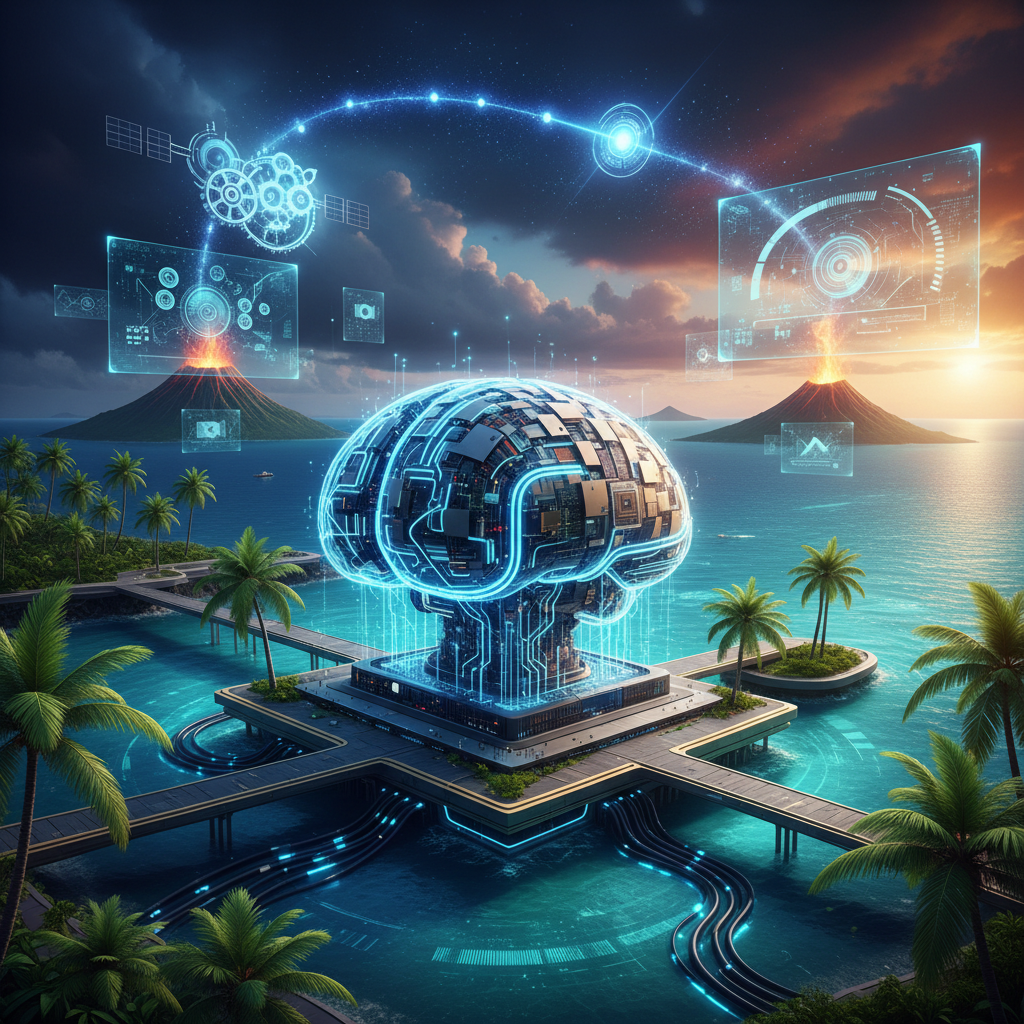

The ocean breeze carries whispers of change, not just through the palm fronds, but through the digital currents that connect our islands to the global stage. Here in Hawaii, we often feel the future arriving a little differently, a little later perhaps, but always with a unique resonance. When I look at what Runway ML and the AI video generation revolution are doing in Hollywood, I don't just see faster, cheaper content production; I see a seismic shift that will ripple across the Pacific, touching everything from our creative industries to the very preservation of our cultural narratives.
Imagine this: it is 2030. A young filmmaker from the Marshall Islands, using an AI-powered suite akin to Runway ML's latest iteration, crafts a visually stunning epic of navigation and ancestral voyages. She has no multi-million dollar budget, no sprawling studio backlot. Instead, her vision, fueled by a deep understanding of her heritage, is brought to life with a few prompts, a handful of reference images, and an AI that understands the nuances of light on water, the texture of a woven sail, and the expressions of a people who have long read the stars. This isn't just a fantasy; it is an inevitable future, one where the tools of creation are democratized to an unprecedented degree.
How do we get there from today, April 2026, when Runway ML is already pushing the boundaries of what is possible with Gen-1 and Gen-2, and other players like OpenAI's Sora are hot on its heels? The path is paved with innovation, but also with careful consideration of its impact. The initial wave, of course, is in Hollywood. Major studios, facing ever-increasing production costs and the insatiable demand for content from streaming services, are already integrating AI tools. We are seeing early experiments where AI generates background plates, animates minor characters, or even creates entire scenes based on script inputs. This isn't about replacing human creativity entirely, but augmenting it, allowing artists to iterate faster and bring more ambitious visions to life with fewer traditional constraints.
For us in the Pacific, this means a few things. First, the barrier to entry for high-quality video production will plummet. No longer will a lack of access to expensive equipment or large crews be an insurmountable obstacle. This is a game-changer for independent storytellers, indigenous communities, and educational initiatives. Think of the potential for language preservation, for instance. Imagine an AI trained on archival footage and linguistic data, capable of generating historically accurate visual narratives in endangered Pacific languages, making these stories accessible and engaging for new generations. As Dr. Keala Pono, a cultural anthropologist at the University of Hawaii at Manoa, recently stated,