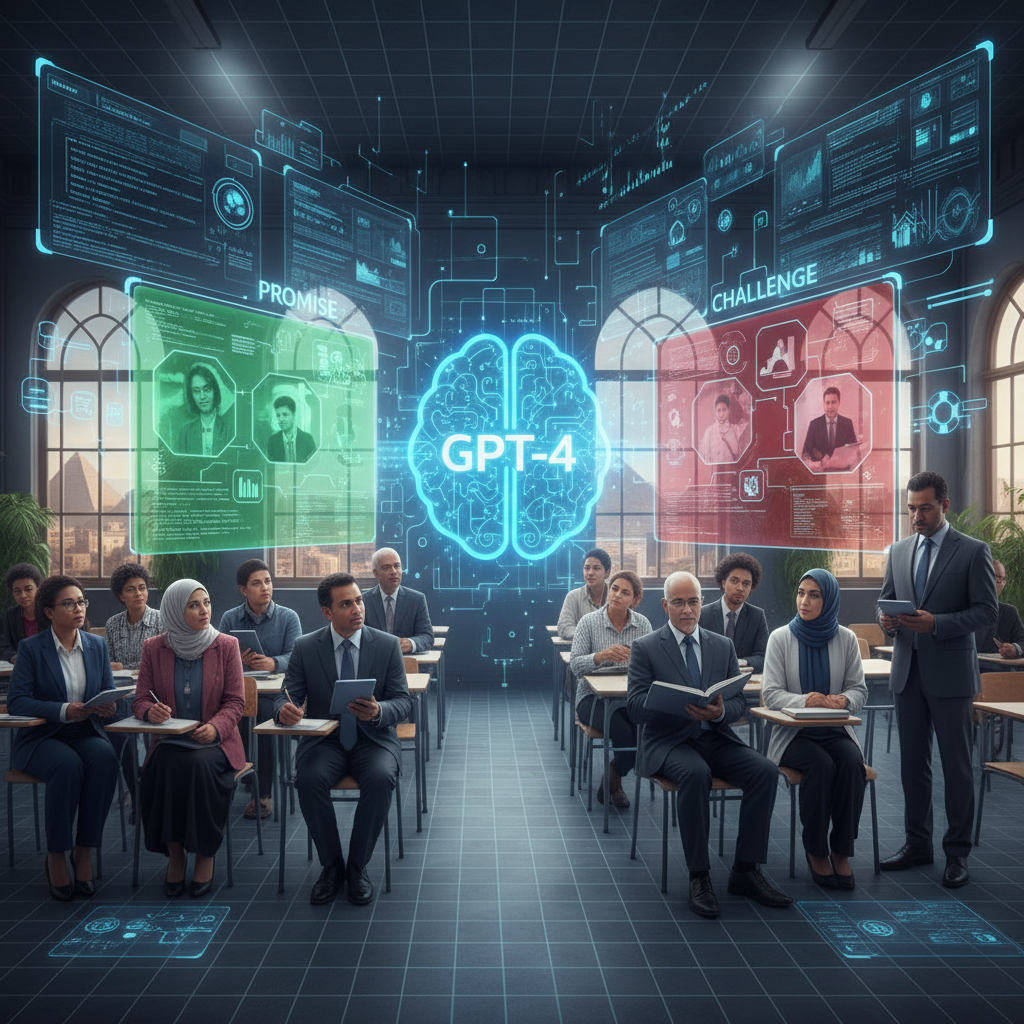
The morning sun beats down on the venerable walls of Cairo University, a place where generations of Egyptian minds have been shaped. But today, the hum of student chatter is laced with a new kind of anxiety, and perhaps, a new kind of opportunity. We are talking about artificial intelligence, specifically the sophisticated large language models like OpenAI's GPT-4, and their undeniable, often unsettling, presence in our classrooms.
For many, the immediate reaction to AI chatbots in education is fear: the fear of widespread cheating, of students losing the ability to think critically, of the very foundation of academic integrity crumbling. It is a valid concern, one echoed in faculty lounges from Alexandria to Aswan. But as a journalist who has spent years dissecting the intricacies of AI, and as someone who has seen firsthand the challenges and triumphs of education in our region, I believe we must look beyond the immediate panic. We must ask: Is this truly just a cheating crisis, or is it a catalyst for an educational revolution, particularly in contexts like Egypt and wider Africa?
The Breakthrough in Plain Language: Beyond the Plagiarism Panic
Let me break this down. The core research development isn't just that AI can write essays, we have known that for a while. The real breakthrough lies in the sophistication of these models. Recent advancements, particularly in transformer architectures and reinforcement learning from human feedback, have allowed models like GPT-4 to generate text that is not merely grammatically correct, but contextually nuanced, logically coherent, and often indistinguishable from human writing. Think of it this way: earlier AI might have been like a student who memorizes facts and regurgitates them. Modern AI is more like a highly articulate, well-read tutor who can synthesize complex information, explain concepts, and even engage in Socratic dialogue. It is this leap in capability that has transformed the discussion from 'can AI write?' to 'how can AI teach, and how can we teach with AI?'
Research from institutions like Stanford University and MIT's Computer Science and Artificial Intelligence Laboratory (csail) has shifted from merely detecting AI generated text to exploring its pedagogical applications. For instance, a paper published in Nature Machine Intelligence by researchers at Google DeepMind explored how large language models could be fine-tuned to act as personalized tutors, adapting to individual student learning styles and knowledge gaps. This isn't about replacing teachers, but augmenting them, providing a scalable, always-available resource that can explain the intricacies of quantum physics or the nuances of classical Arabic poetry with endless patience.
Why It Matters: A New Dawn for African Education?
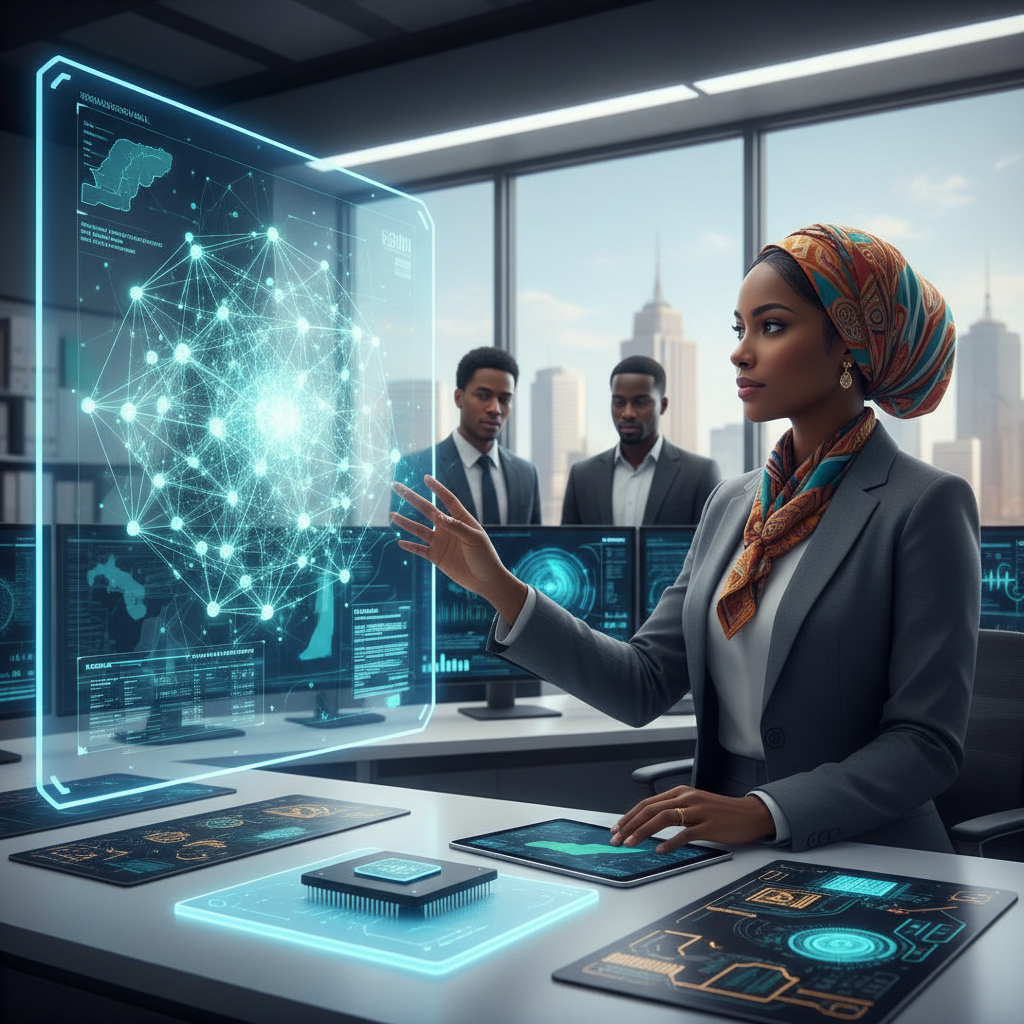
This development matters immensely for Egypt and other African nations. We face unique challenges in education: large class sizes, resource constraints, and often, a lack of personalized attention for students. Imagine a scenario where every student, regardless of their background or location, has access to a personal AI tutor. This isn't science fiction, it is becoming a tangible reality.
“The potential for AI to democratize access to high-quality education in Africa is immense,” states Dr. Ahmed El-Gendi, a prominent educational technology expert at the American University in Cairo. “We are not just talking about rote learning, but about critical thinking, problem-solving, and personalized feedback that was previously unimaginable for millions of students.”
Consider the sheer scale. According to Unicef, sub-Saharan Africa has the highest rates of education exclusion globally. While AI is not a magic bullet, it offers a pathway to bridge gaps. If an AI can provide instant feedback on an essay, explain a difficult mathematical concept in a student's native dialect, or even simulate historical debates, the implications for learning outcomes are profound. This could be particularly transformative in subjects requiring extensive writing and critical analysis, areas where traditional feedback loops are often slow and resource-intensive.
The Technical Details (Accessible): Beyond Keywords and into Understanding
Here's what's actually happening under the hood. Modern large language models, or LLMs, are built on neural networks with billions of parameters. They are trained on vast datasets of text and code, learning patterns, grammar, and even some level of 'common sense' knowledge. The 'transformer' architecture, first introduced by Google in 2017, is key. It allows the model to weigh the importance of different words in a sentence, understanding context much more effectively than previous models. This is like a seasoned translator who doesn't just translate word for word, but understands the cultural nuances and idiomatic expressions.
When a student asks GPT-4 to explain a concept, the AI doesn't just pull up a pre-written answer. It generates a response dynamically, based on its learned understanding of language and information. This generative capability is what makes it so powerful and, for some, so frightening. The ability to generate coherent, novel text is what makes it a 'creative' tool, not just a search engine.
Furthermore, techniques like 'Retrieval Augmented Generation' or RAG are becoming increasingly important. This means the AI can access external, up-to-date databases of information, ensuring its responses are not only well-articulated but also factually current. This is crucial for educational applications, where accuracy is paramount. Imagine an AI tutor that can not only explain the Arab Spring but also reference the latest geopolitical analyses from reputable sources.
Who Did the Research: A Global Effort with Local Impact
While the foundational research for these LLMs often comes from global tech giants like OpenAI, Google, and Meta AI, the application and adaptation for educational contexts are a more distributed effort. Universities across the globe, including those in Egypt, are actively researching how to integrate these tools responsibly.
For instance, the African Institute for Mathematical Sciences (aims), with campuses across the continent, is exploring how AI can be tailored to local curricula and languages. Similarly, researchers at Ain Shams University in Cairo are investigating the development of AI tools that can understand and respond in Egyptian Arabic dialects, making the technology more accessible and culturally relevant for local students. This localization is not a trivial task; it requires significant linguistic and cultural fine-tuning of these global models.
Implications and Next Steps: A Call for Thoughtful Integration
The implications are vast. We are moving beyond simply asking 'can students cheat with AI?' to 'how can AI enhance learning outcomes and prepare students for an AI-driven world?'
Firstly, educators must adapt. This means redesigning assignments to focus on critical thinking, ethical reasoning, and problem-solving that AI cannot easily replicate. It means teaching students how to use AI responsibly, as a tool for research, brainstorming, and drafting, rather than a substitute for thought. As Dr. Mona Khalil, a curriculum development specialist at the Egyptian Ministry of Education, recently observed, “Our role is no longer just to impart knowledge, but to teach students how to navigate and leverage powerful information tools, including AI. This requires a fundamental shift in pedagogy.”
Secondly, there is a critical need for policy and ethical frameworks. How do we ensure equity of access? How do we protect student data? How do we prevent over-reliance on AI? These are questions that governments, educational institutions, and technology providers must address collaboratively. The Egyptian National AI Strategy already emphasizes the ethical deployment of AI, and education is a prime area where these principles must be applied rigorously.
Finally, the development of localized AI models is paramount. While global models are powerful, their training data often reflects Western biases and may not fully understand the nuances of Egyptian culture, history, or educational context. Investment in local AI research and development, perhaps through partnerships between Egyptian universities and global tech companies, is essential to create AI tools that truly serve our students.
This is not a simple choice between crisis and revolution. It is a complex dance, a delicate balance between harnessing powerful technology and preserving the essence of human learning. The future of education in Egypt, and indeed across Africa, will depend on our ability to embrace this challenge with open minds, careful planning, and a steadfast commitment to our students' holistic development. The conversation has just begun, and the stakes could not be higher. For more insights into how AI is transforming various sectors, you can explore articles on TechCrunch or MIT Technology Review. The journey will be challenging, but the potential rewards are too great to ignore.