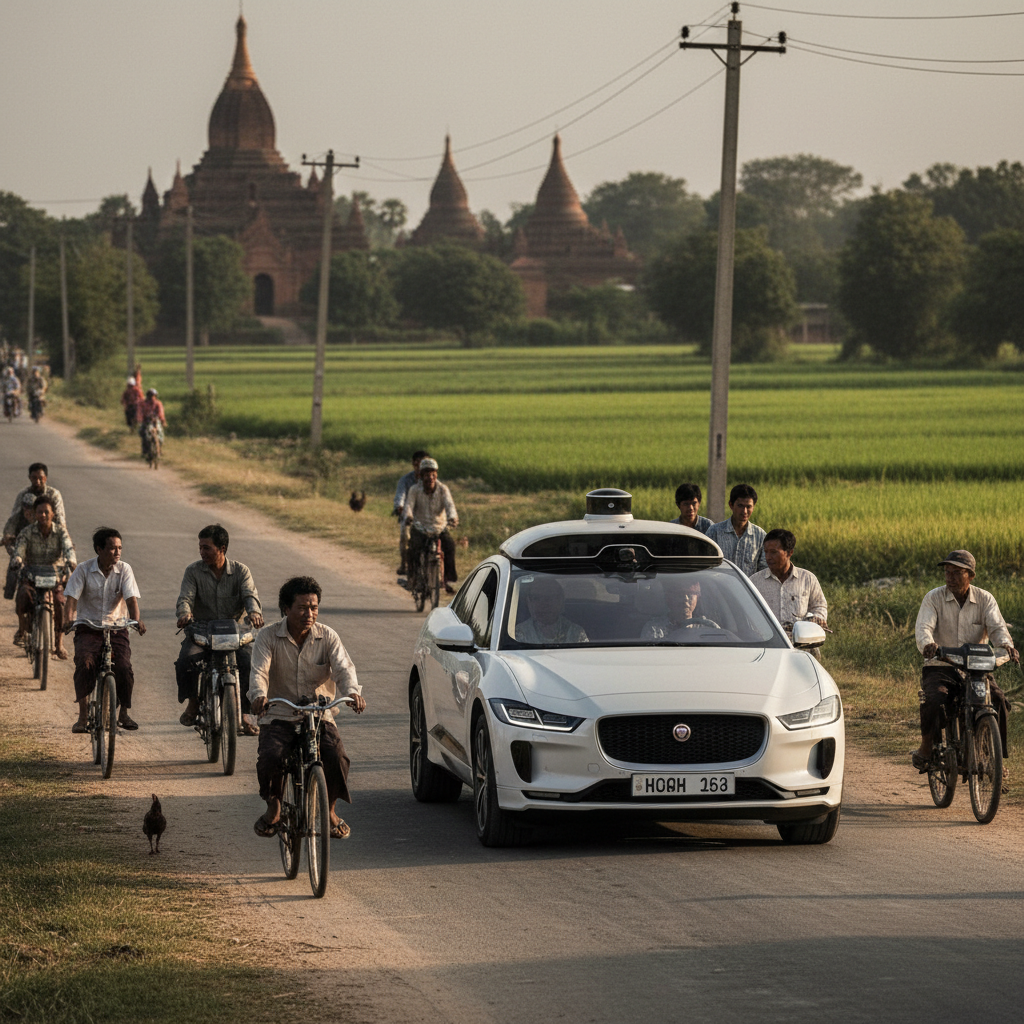

The rumble of a taxi is a familiar sound in cities across the globe, a constant backdrop to our lives. In places like Yangon, it is often a symphony of old engines, honking horns, and the lively chatter of passengers and drivers. Now, imagine that sound, but without the driver. Imagine a vehicle that navigates the chaotic dance of traffic with a silent, digital brain. This is not science fiction anymore, it is the reality of autonomous taxis, and Google's Waymo is leading the charge, expanding its footprint far beyond its Californian origins. But what exactly are these self-driving cars, and why should we, especially those of us watching from places like Myanmar, pay close attention?
What is an Autonomous Taxi?
At its core, an autonomous taxi, often called a robotaxi, is a vehicle capable of operating without human intervention. Think of it as a car that can see, think, and act on its own, picking up passengers and dropping them off at their destinations, all powered by artificial intelligence and an array of sophisticated sensors. Companies like Waymo, a subsidiary of Alphabet, Google's parent company, are not just building self-driving cars, they are building entire self-driving services. You summon one with an app, much like a traditional ride-hailing service, and it arrives, ready to take you where you need to go, driverless.
This is not merely an upgrade to cruise control. This is a complete paradigm shift in how we conceive of transportation. It is about a vehicle understanding its environment, predicting the movements of other cars and pedestrians, and making split-second decisions, all while adhering to traffic laws and ensuring passenger safety. It is a complex dance between hardware, software, and real-world unpredictability.
Why Should You Care? The Stakes Beyond Convenience
For many in the developed world, autonomous taxis are discussed in terms of convenience, efficiency, or perhaps the novelty of a driverless ride. However, in Myanmar, the stakes are different. Here, where infrastructure can be fragile, and access to reliable, safe transportation is not always guaranteed, the potential impact of such technology is profound.
Imagine a future where essential goods can be transported more reliably to remote villages, where medical supplies reach those in need without human error or delay, or where public transport becomes safer and more accessible for everyone, including those with disabilities. This is about survival, not convenience. The promise of fewer accidents, reduced traffic congestion, and more equitable access to mobility could reshape our communities in ways we can only begin to imagine. For countries grappling with development challenges, this technology is not just a luxury, it can be a lifeline. It offers a glimpse into a future where logistical hurdles might be overcome, connecting people and resources in unprecedented ways.
How Did It Develop? A Journey from Labs to City Streets
The idea of self-driving cars has been a dream for decades, appearing in science fiction long before it became a research project. Early efforts in the 1980s and 90s focused on automating specific functions, but the real breakthrough came with advancements in AI, particularly machine learning and computer vision, coupled with more powerful and miniaturized sensors. Google's journey into self-driving cars began in 2009 with its secretive Project Chauffeur, which later spun out into Waymo in 2016.
Their approach has been methodical, focusing on extensive testing in controlled environments and then gradually expanding into complex urban settings. They started in relatively predictable areas like Phoenix, Arizona, slowly adding more challenging scenarios. The development has been an iterative process, learning from every mile driven, every unexpected obstacle encountered. This rigorous testing, accumulating millions of real-world and billions of simulated miles, has been crucial in building the robust systems we see today. Other companies like Cruise, owned by General Motors, and even Tesla, with its