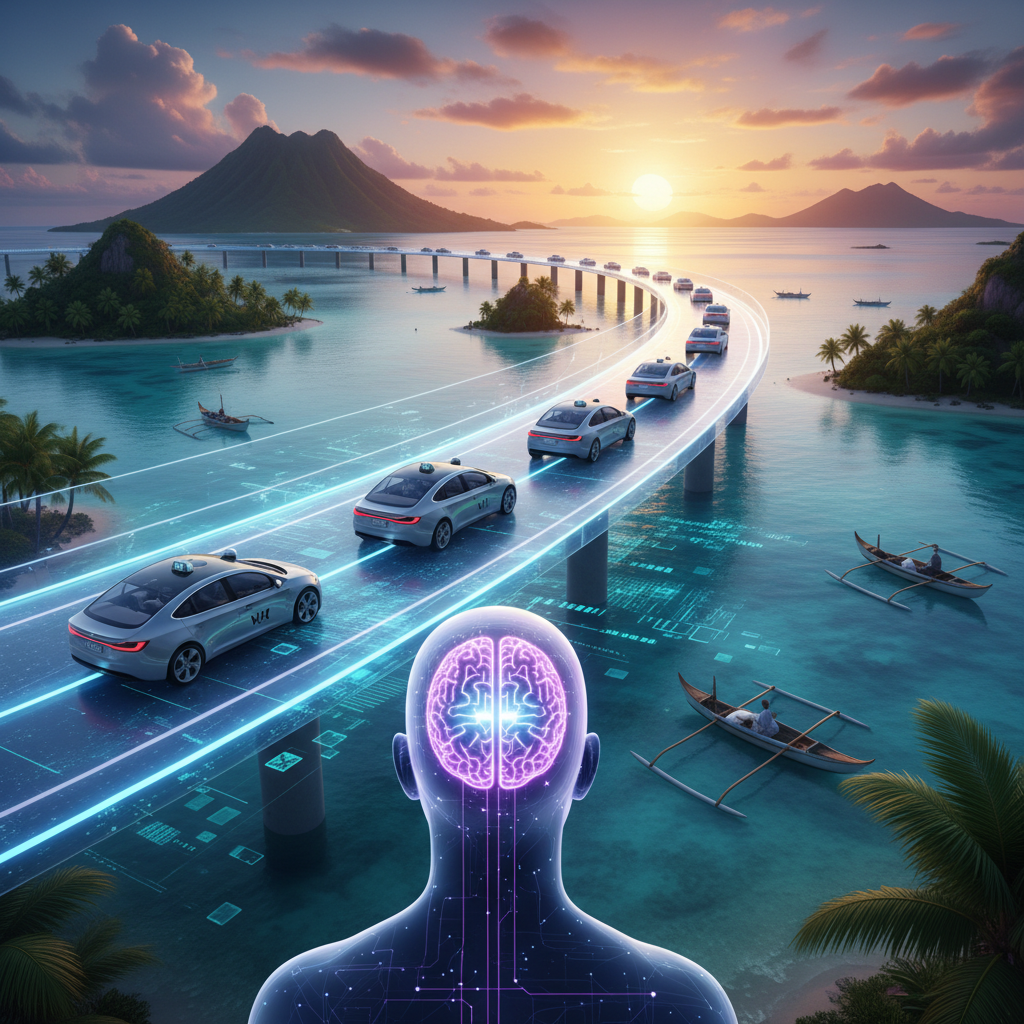

The sun dips low over Moorea, painting the sky in hues of orange and violet, a sight that never gets old. Here, life moves to the rhythm of the ocean, a gentle sway that embraces both tradition and the quiet hum of progress. But lately, there’s a new kind of hum on the horizon, one that comes not from a boat engine, but from the silent promise of autonomous vehicles. Google’s Waymo, a name synonymous with self-driving cars, is expanding its reach worldwide, and while our motu, our small islands, might seem far removed from the bustling streets of Phoenix or San Francisco, the psychological ripples of such technology are already reaching our shores.
Imagine a tomorrow where your ride to the Papeete market, or even a trip across the island, is handled not by a familiar face, but by an unseen algorithm. For many, this conjures images of efficiency, convenience, and perhaps a touch of science fiction. But what does it do to us, deep down, when the act of driving, a skill ingrained in our modern lives, is outsourced to a machine? In the Pacific, technology takes a different form; it often adapts to our needs, our landscapes, and our cultural values. The idea of a car without a driver, however, challenges some fundamental aspects of our human experience.
I spoke with Teiki, a taxi driver in Papeete for over twenty years, about this very idea. His laugh was hearty, a sound as warm as the Tahitian breeze. “A car without a driver? Who would tell me about the best ma’a on the island, or where the waves are good today?” he asked, shaking his head. “My customers, they are my friends. We talk story. This is not just a ride, it is a connection.” Teiki’s sentiment echoes a deep-seated human need for social interaction, a need that autonomous technology, by its very design, tends to minimize.
Research from institutions like MIT Technology Review has begun to explore the cognitive and emotional impacts of interacting with autonomous systems. Studies suggest that while people initially feel a sense of novelty and even excitement, prolonged reliance on AI-driven services can lead to a phenomenon known as 'automation complacency.' This isn't just about losing a skill; it’s about a subtle shift in our mental landscape. When we are constantly ferried around, our spatial awareness, our decision-making faculties in complex environments, and even our sense of personal responsibility can begin to atrophy. For islanders, whose lives are often intimately tied to navigation and an acute awareness of their surroundings, this could be particularly profound.
Dr. Manutea Tefaaroa, a cultural anthropologist at the University of French Polynesia, shared his concerns. “Our relationship with our environment is active. We navigate by the stars, by the currents, by the landmarks passed down through generations. Driving, even modern driving, retains some of that active engagement. When that becomes passive, when we are merely passengers in a metal shell, what does that do to our connection to the land and the sea?” He noted that the very act of driving, for many, is a moment of independence, a space for contemplation, or a shared experience with loved ones. Removing the human element from this equation could subtly erode these social and cognitive functions.
Moreover, the introduction of autonomous vehicles raises questions about trust and control. How do we, as humans, adapt to relinquishing control to an algorithm, especially in situations where safety is paramount? A recent report by Reuters highlighted ongoing debates in various cities regarding the safety records of Waymo and other autonomous vehicle companies, particularly concerning unexpected stops or interactions with human-driven vehicles. While the technology promises to reduce human error, the psychological barrier of trusting a machine with our lives is significant. This is not just a technological hurdle; it is a profound psychological one. Our brains are wired for human-to-human interaction, for reading intentions and predicting behaviors based on social cues. An AI, no matter how advanced, operates on a different logic, one that our ancient brains are still learning to process.
Consider the broader societal implications for our islands. Our small communities thrive on close-knit relationships. The taxi driver, the bus driver, the person who gives you a ride to the next village, these are often familiar faces, part of the social fabric. What happens when these roles are replaced by impersonal machines? The economic impact on local livelihoods is one thing, but the erosion of those everyday human connections is another entirely. The ocean connects us and so does AI, but the nature of that connection is changing. Will it be a connection that strengthens our communities, or one that subtly isolates us within our digital cocoons?
This is a story about paradise and pixels, about the delicate balance between progress and preservation. As Google’s Waymo and other autonomous technologies inch closer to becoming a global reality, we must ask ourselves not just if the technology works, but how it reshapes us. How does it alter our perception of risk, our sense of agency, and our capacity for human connection? These are not questions for engineers alone; they are questions for psychologists, for cultural leaders, and for every person who will eventually step into an autonomous vehicle.
For those of us living in these beautiful islands, where the pace of life often allows for more reflection, the arrival of such technology presents a unique opportunity. We can observe, we can adapt, and we can choose how we integrate these advancements into our lives. Perhaps, instead of full automation, we might find hybrid models that retain the human touch, ensuring that our journeys remain not just efficient, but also rich with interaction and meaning. We must be mindful that technology should serve humanity, not the other way around. The challenge, and the opportunity, lies in ensuring that as our world becomes more automated, we do not lose the very essence of what makes us human. We need to actively shape this future, rather than passively accept it, ensuring that our cognitive and social well-being remain at the heart of innovation. The conversations we have today, about trust, control, and connection, will define the psychological landscape of tomorrow’s automated world.