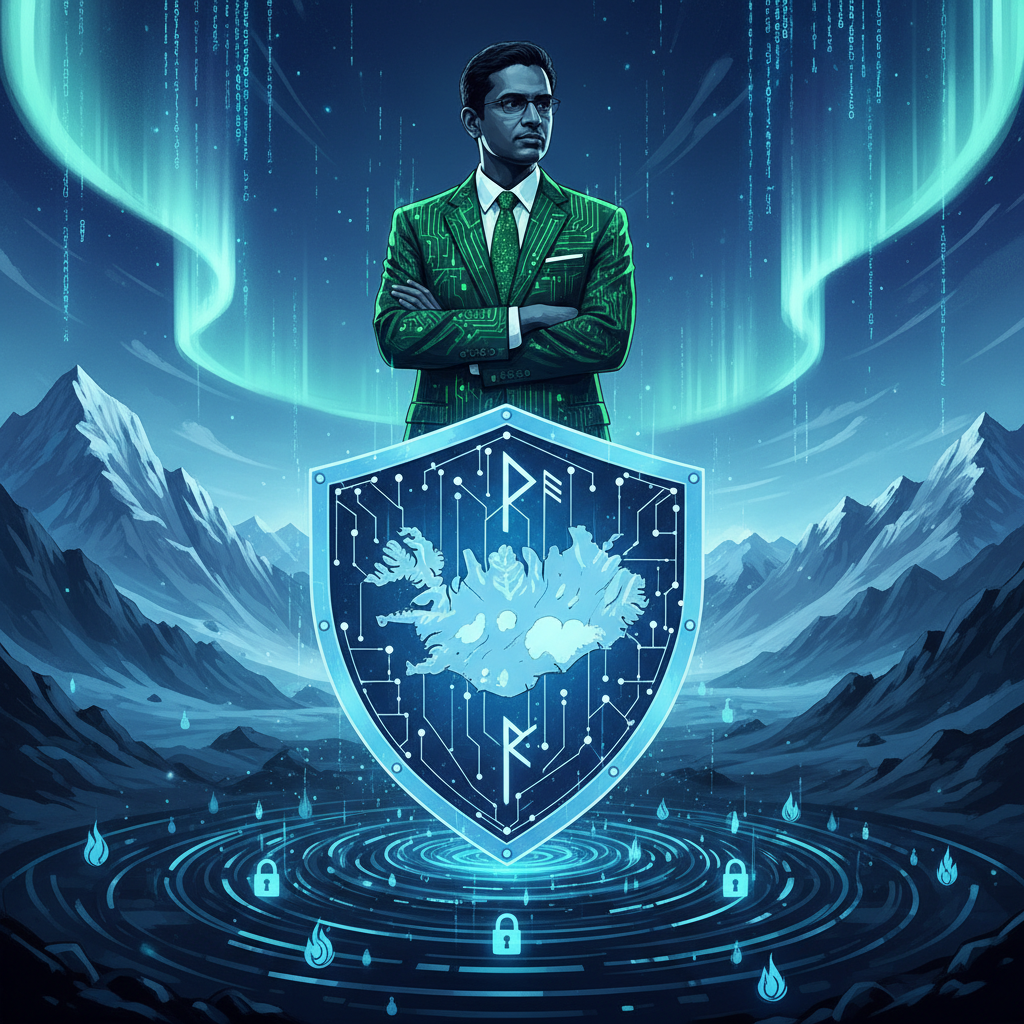
The wind howls outside my window, a familiar symphony against the rugged Icelandic landscape. It is April, and while the days are getting longer, there is still that crisp bite in the air, a reminder of nature's relentless power. But today, my thoughts are not on the glaciers or the geothermal vents, but on something far more insidious, yet equally invisible: the digital threats that stalk our networks, our businesses, and our very way of life. We are talking about AI-powered cybersecurity, a topic that often feels abstract, buried in data centers and code, yet impacts every single one of us.
For years, the narrative around cybersecurity has been one of an arms race, a constant battle between faceless attackers and weary defenders. Enterprises, big and small, pour billions into firewalls, intrusion detection systems, and human analysts, yet the breaches keep coming. It feels like trying to stop a tidal wave with a bucket. But what if there was a different way? What if the answer lay not just in bigger buckets, but in a deeper understanding, a more intuitive, almost human, approach to threat detection, powered by artificial intelligence?
My argument is simple, yet provocative: the current, largely reactive, cybersecurity model employed by many large corporations, including tech behemoths, is fundamentally flawed. It is a game of whack-a-mole, and the moles are evolving faster than we can swing the hammer. AI, when implemented with a human-centric, proactive philosophy, offers not just incremental improvement, but a paradigm shift. It is about understanding the intent behind the anomaly, not just flagging the anomaly itself. And in this, Iceland, with its unique blend of close-knit trust and technological agility, has some surprising lessons to offer the world, even to giants like Microsoft and its CEO, Satya Nadella.
Think about it: in a country of just under 400,000 people, trust is a foundational element. We know our neighbors, often literally. This translates into a different approach to digital security. We cannot afford to be anonymous, nor can we afford to be complacent. When a threat emerges, it is not just an abstract data point; it is a potential threat to our community, our infrastructure, our very identity. This mindset, I believe, is crucial for effective AI in cybersecurity.
AI's promise here is immense. It can sift through petabytes of network traffic in real-time, identifying patterns that no human analyst, however skilled, could ever hope to spot. It can learn what 'normal' looks like for a specific network, a specific user, or even a specific application, and then flag deviations with astonishing accuracy. Imagine an AI that learns the subtle cadence of your company's financial transactions, the typical login times of your employees, or the usual data flows between your servers. When something deviates, even slightly, it is not just a statistical outlier, but a potential harbinger of a sophisticated attack. This is where AI moves beyond simple rule-based detection and into true predictive intelligence.
Companies like Darktrace, for instance, have been pioneers in this space, using unsupervised machine learning to build a 'self-learning AI' that understands the unique 'pattern of life' for every user and device on a network. Their approach, which they call 'immune system technology,' is about detecting novel threats that have never been seen before, rather than relying on signatures of known attacks. This proactive, adaptive defense is precisely what enterprises need. As Marcus Fowler, CEO of Darktrace Federal, recently stated, "The threat landscape is constantly evolving, and signature-based detection is no longer sufficient. AI allows us to detect and respond to threats that are truly unknown and sophisticated, before they cause significant damage." This is not just about speed; it is about foresight.
Now, I hear the counterarguments already. Many will say, 'But Sigríður, AI is just another tool. It is only as good as the data it is fed, and it can be fooled. What about AI bias? What about false positives that overwhelm security teams?' These are valid concerns, and I do not dismiss them. AI is not a silver bullet. It is a powerful ally, but it needs careful handling, constant training, and, crucially, human oversight.
My rebuttal is this: the 'human in the loop' is not just a nice-to-have, it is essential. The AI should not replace the human cybersecurity expert, but augment them, freeing them from the mundane, repetitive tasks of sifting through logs, allowing them to focus on the truly complex, strategic challenges. Think of it like a skilled Icelandic fisherman using modern sonar. The sonar does not catch the fish, but it guides the fisherman to where the fish are, making their work far more efficient and effective. The AI provides the insights, the human provides the judgment and the strategic response.
Furthermore, the concern about AI bias or 'hallucinations' is often overstated in the context of enterprise cybersecurity. Unlike generative AI models that create text or images, the AI used in threat detection is typically designed for anomaly detection and pattern recognition in structured data. Its 'creativity' is not in generating new content, but in identifying deviations from established norms. The data it learns from is the network's own traffic, not a vast, potentially biased internet corpus. Companies like CrowdStrike, a leader in endpoint security, have integrated AI and machine learning deeply into their Falcon platform to analyze billions of events daily, focusing on behavioral patterns rather than just signatures. George Kurtz, CEO of CrowdStrike, has often emphasized the importance of a cloud-native, AI-driven approach for speed and scale in threat detection, stating, "You can't fight tomorrow's threats with yesterday's technology. AI is fundamental to staying ahead of adversaries." This is not about abstract conversations; it is about concrete, real-time protection.
Iceland's story is unique. Our small size means that collaboration is not just a buzzword, but a necessity. Our critical infrastructure, our financial institutions, our very digital fabric, are all interconnected. A breach in one area can quickly ripple through the entire system. This forces a holistic view of cybersecurity, one that embraces shared intelligence and collective defense. Perhaps this is what Satya Nadella and other tech leaders need to consider: not just building more powerful AI, but building AI that fosters a sense of collective responsibility and understanding, much like our small, resilient nation.
We are already seeing this in action. Our national Cert, Cert-is, works closely with private enterprises, sharing threat intelligence and best practices. This collaborative spirit, combined with the power of AI to analyze vast datasets, creates a formidable defense. In the land of fire and ice, AI takes a different form; it is not just a cold algorithm, but a tool woven into the fabric of our community, helping us protect what we value most. It is about understanding the human element behind every digital interaction, every potential threat.
The future of enterprise cybersecurity is not just about more AI, but about smarter AI, AI that learns from context, from behavior, and from the collective wisdom of a community. It is about moving from a reactive posture to a proactive, predictive one. It is about empowering human experts, not replacing them. And for that, perhaps the biggest lessons will not come from the sprawling campuses of Silicon Valley, but from the quiet, resilient innovation happening in places like Iceland, where every digital thread is connected to a real person, a real business, and a real community. It is time for the industry to look beyond the immediate firewalls and embrace a more profound, human-aware approach to digital defense, guided by intelligent systems. The future of our digital safety depends on it. For more insights into how AI is reshaping industries, you can often find compelling analyses on MIT Technology Review. The conversation around AI's practical applications is constantly evolving, and staying informed is key. For a broader view on AI in business, Bloomberg Technology also offers extensive coverage. This is not just a technological challenge, but a deeply human one, and our approach must reflect that complexity.