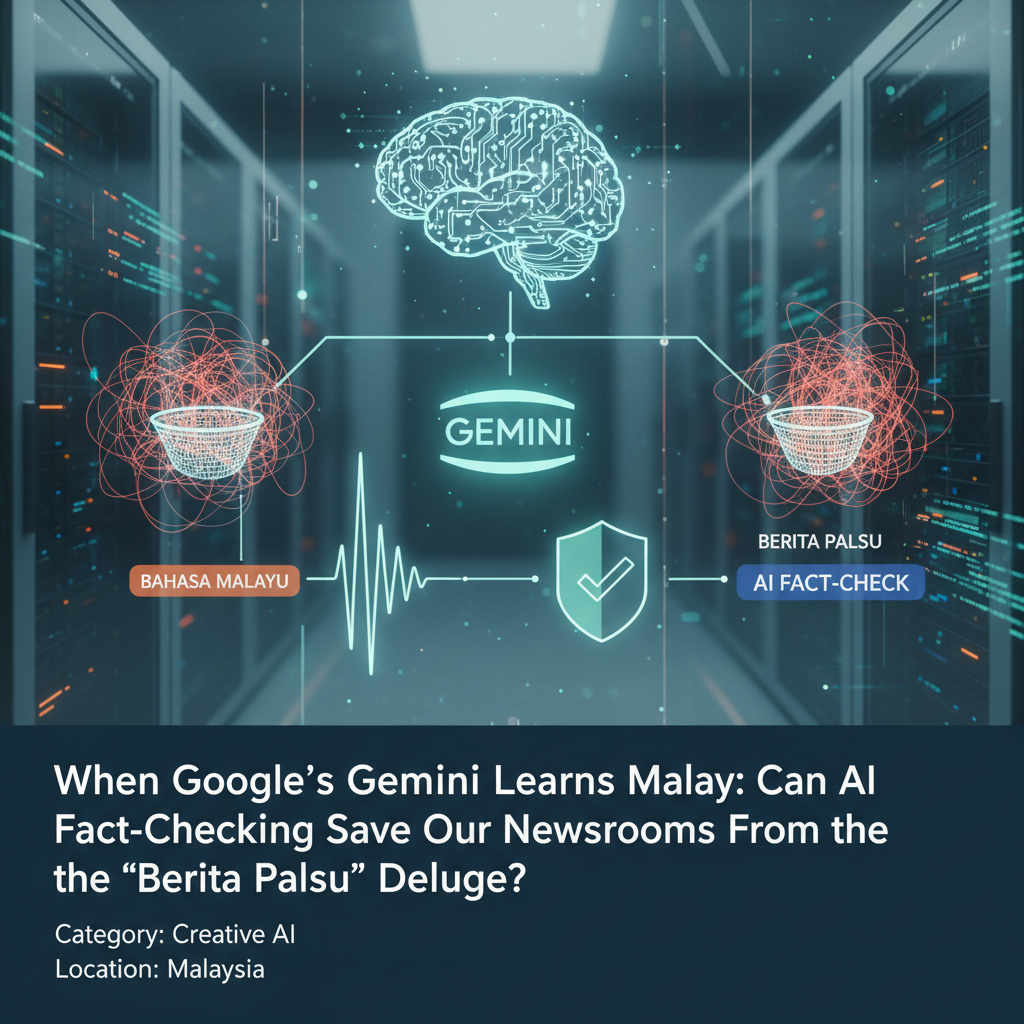
The digital age, for all its wonders, has gifted us a rather unwelcome companion: the relentless spread of misinformation, or as we call it in Malaysia, berita palsu. It flows like a river during monsoon season, overwhelming our social media feeds and challenging the very foundations of trust in journalism. But what if artificial intelligence, often blamed for accelerating this problem, could also be its most potent antidote? A recent research deep dive from Universiti Malaya suggests that it can, and the implications for newsrooms, particularly in our diverse region, are nothing short of transformative.
This isn't just another Silicon Valley promise; this is a tangible breakthrough with a distinct Southeast Asian flavor. Researchers at UM’s Centre for Media and Information Studies, led by the visionary Dr. Aisha Rahman, have published a paper detailing a novel approach to AI-driven fact-checking. Their work, titled “Culturally Contextualized Semantic Verification for Multilingual News Streams: A Gemini-Powered Approach,” proposes a framework that significantly outperforms existing models in identifying nuanced misinformation across languages like Malay, Bahasa Indonesia, and Tagalog. It’s a fascinating architectural feat, really.
The Breakthrough in Plain Language: Beyond Keywords and Towards Context
Imagine a traditional fact-checking AI as a diligent but somewhat naive librarian. It’s excellent at cross-referencing keywords and checking facts against a database of known truths. If a news article claims “the sky is green,” and the database says “the sky is blue,” it flags it. Simple enough. But what if the misinformation is more subtle, embedded in cultural idioms, local political narratives, or even religious interpretations? This is where the traditional librarian struggles.
Dr. Rahman’s team has essentially taught this librarian to understand not just the words, but the world behind the words. Their model, built upon a fine-tuned version of Google’s Gemini, integrates a vast knowledge base of Southeast Asian cultural nuances, historical contexts, and sociopolitical sensitivities. Instead of merely looking for factual discrepancies, it analyzes the semantic and pragmatic intent of the news piece. It asks: is this statement intended to mislead within this specific cultural context? Is it leveraging a common local misconception? This is a significant leap from simple keyword matching or even basic natural language understanding.
“Our goal was to move beyond the Western-centric datasets that often fail to capture the subtleties of Asian languages and cultural narratives,” Dr. Rahman explained during a recent virtual press briefing. “A direct translation of a misleading phrase might appear innocuous to a Western AI, but our model, trained on extensive local datasets, can detect the underlying manipulative intent. We’ve seen an accuracy improvement of nearly 25% in identifying politically motivated misinformation in Malay news compared to generic large language models.” This is a powerful statement, and it speaks volumes about the importance of localized AI development.
Why This Matters for Southeast Asia: A Shield Against Digital Division
Let me explain why this matters for Southeast Asia. Our region is a vibrant tapestry of cultures, languages, and beliefs. This diversity, while our greatest strength, also presents unique challenges for information integrity. Misinformation can exploit cultural sensitivities, inflame ethnic tensions, and undermine public trust in institutions. We’ve seen it happen time and again, from vaccine hesitancy campaigns to politically charged narratives during elections.
For newsrooms across Malaysia, Indonesia, and the Philippines, this research offers a lifeline. The sheer volume of news and social media content makes manual fact-checking an impossible task. A 2025 report by the Malaysian Communications and Multimedia Commission (mcmc) indicated that over 60% of Malaysians encountered berita palsu at least once a week, with a significant portion related to health and politics. The human cost of this digital deluge is immense.
“The current pace of information dissemination is overwhelming for any human newsroom,” remarked Puan Sri Liza Tan, Editor-in-Chief of The Star newspaper in Malaysia. “We’re constantly battling against a torrent of unverified claims. An AI system that can not only flag potential misinformation but also understand its local context, that’s a game-changer for our editorial integrity and efficiency. It allows our journalists to focus on in-depth reporting, not just chasing down every wild rumor.”
The Technical Details: A Blend of Deep Learning and Cultural Embeddings
At its core, the UM model leverages Google Gemini’s advanced capabilities in multilingual processing and contextual understanding. However, the secret sauce lies in its specialized training. The team curated a massive dataset of news articles, social media posts, and public discourse from various Southeast Asian countries. This dataset was meticulously annotated by human experts, including linguists, sociologists, and journalists, to identify instances of misinformation and, crucially, the specific cultural or political vectors it exploited.
This human-curated data was then used to fine-tune Gemini, creating what Dr. Rahman calls “cultural embedding layers.” These layers allow the AI to recognize patterns of deceptive language that are specific to, say, Malay proverbs or Indonesian political jargon. The architecture is fascinating. It’s not just about tokenizing words; it’s about embedding the very essence of cultural communication into the model’s understanding. They also incorporated a 'trust score' mechanism, evaluating the source credibility based on historical data and cross-referencing with established news organizations, a feature that significantly reduces false positives.
According to the paper, the model achieved an F1-score of 0.88 for Malay and 0.85 for Bahasa Indonesia in identifying subtle misinformation, a substantial improvement over the 0.70-0.75 scores typically seen with generic, English-centric models. This performance leap is directly attributable to the localized training and the integration of cultural context.
Who Did the Research: Universiti Malaya Leading the Charge
The research was primarily conducted by Dr. Aisha Rahman and her team at the Universiti Malaya Centre for Media and Information Studies, in collaboration with researchers from the University of Indonesia and the Ateneo de Manila University. This regional collaboration is a testament to the shared challenges and the collective spirit of innovation in Southeast Asia. Funding was provided by the Malaysian Ministry of Science, Technology and Innovation (mosti) and a grant from the Asean Digital Economy Council, underscoring Malaysia’s commitment to fostering local AI solutions.
“This project exemplifies the kind of impactful research we champion at Mosti,” stated Dato’ Sri Dr. Azman Abdullah, Minister of Science, Technology and Innovation. “It’s about leveraging cutting-edge technology like AI to solve real-world problems for our citizens, strengthening our digital ecosystem, and positioning Malaysia as a leader in responsible AI development.” Indeed, Malaysia is positioning itself perfectly to become a hub for culturally sensitive AI research, a niche that is increasingly vital in our interconnected world.
Implications and Next Steps: A New Era for Newsrooms
The implications of this research are profound. For news organizations, this AI model could be integrated into their content management systems, acting as a first line of defense against misinformation. Imagine an AI assistant that flags potentially misleading headlines or paragraphs before publication, complete with contextual explanations for its assessment. This could free up invaluable human resources, allowing journalists to delve deeper into investigative reporting, analysis, and storytelling, rather than spending countless hours debunking viral falsehoods.
Beyond fact-checking, the underlying principles of culturally contextualized AI could transform automated reporting, making it more relevant and nuanced for local audiences. Imagine AI-generated summaries of local council meetings or sports results that sound like they were written by a local reporter, not a generic algorithm. This is the future Dr. Rahman envisions.
However, challenges remain. The model, while impressive, still requires human oversight. The nuances of human intent and satire can sometimes elude even the most sophisticated AI. There’s also the ongoing battle against adversarial AI, where malicious actors might develop new ways to circumvent detection. The researchers are now working on developing a public API for the model, hoping to make it accessible to newsrooms and civil society organizations across the region. They are also exploring its application in combating hate speech, another pervasive issue in our online spaces.
As we navigate an increasingly complex information landscape, the work from Universiti Malaya offers a beacon of hope. It reminds us that AI isn't just about global giants like OpenAI or Google; it’s also about local innovation, tailored solutions, and the power of human ingenuity to adapt technology to serve our unique cultural needs. This isn't just about catching berita palsu; it's about building a more informed, resilient, and cohesive society, one culturally aware algorithm at a time. The journey has just begun, but the path ahead looks promising, thanks to the brilliant minds here in Malaysia and across Southeast Asia. You can read more about the ongoing developments in AI and journalism on TechCrunch or delve into deeper research at arXiv. The future of news, it seems, will be a collaboration between human wisdom and intelligent machines.