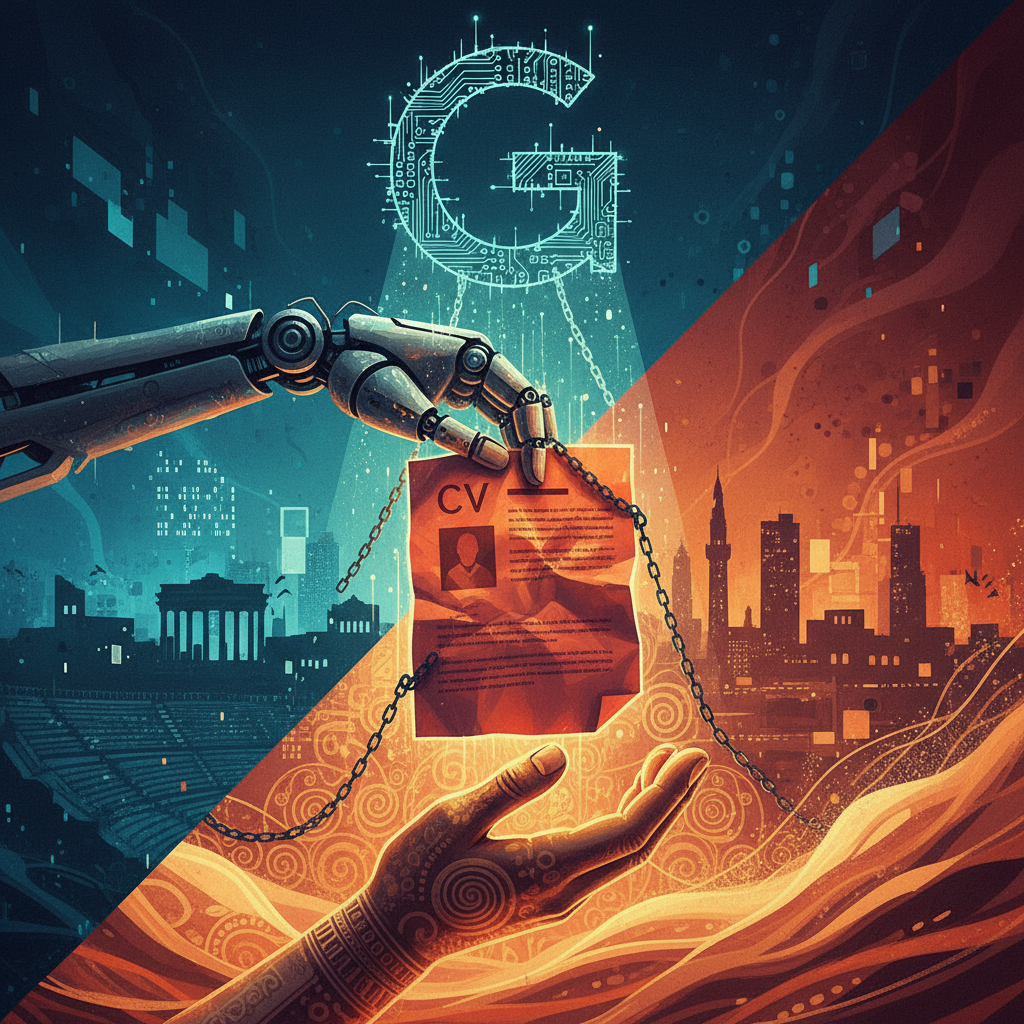
The global tech industry, particularly its Western architects, seems hell-bent on automating every conceivable human process. Hiring, that most delicate dance of human judgment and intuition, is no exception. Companies, from the smallest startup to giants like Google and Microsoft, are increasingly turning to artificial intelligence to sift through resumes, conduct initial screenings, and even analyze video interviews. They promise efficiency, reduced bias, and a wider talent pool. But from my vantage point here in Amman, I see a different, more troubling picture emerging: a landscape littered with lawsuits, regulatory headaches, and a profound misunderstanding of what truly constitutes fairness in opportunity.
Let us not mince words. The West has it backwards. Their headlong rush into AI-driven hiring, fueled by the siren song of 'optimization,' is creating a system that often exacerbates existing biases rather than eliminating them. We are witnessing a parade of incidents where these supposedly neutral algorithms discriminate against women, minorities, and older candidates. The technical explanation is straightforward enough: AI models learn from historical data. If that historical data reflects past human biases in hiring, the AI will not only replicate those biases but often amplify them, encoding systemic discrimination into its very core. It is a digital mirror reflecting humanity's ugliest tendencies, only faster and at scale.
Consider the now infamous case of Amazon's experimental recruiting tool, revealed years ago, which reportedly showed bias against women. The system, trained on a decade of hiring data, penalized resumes that included the word 'women's' as in 'women's chess club captain' and down-ranked graduates from all-women colleges. Amazon eventually scrapped the project, but the damage to trust and the stark illustration of algorithmic prejudice remain. This was not an isolated incident. Similar concerns have been raised about facial analysis tools used in video interviews, which have been shown to perform poorly across different demographics, and natural language processing models that can inadvertently favor certain linguistic styles or educational backgrounds common in dominant groups.
Dr. Ifeoma Ajunwa, a leading scholar on AI and employment at the University of North Carolina, has frequently highlighted this issue. She stated, "When we automate bias, we do not eliminate it; we merely scale it and make it harder to detect and challenge." Her work underscores that the opacity of many proprietary algorithms makes it incredibly difficult for job applicants to understand why they were rejected, let alone prove discrimination. This lack of transparency is a critical flaw, transforming the hiring process into a black box where fairness is an illusion.
Regulators are finally catching up, albeit slowly. New York City, for instance, implemented a law in 2023 requiring independent bias audits for automated employment decision tools. The European Union's proposed AI Act also includes stringent requirements for high-risk AI systems, which would certainly encompass hiring tools, demanding transparency, human oversight, and robust risk management. These are steps in the right direction, but they are reactive, not proactive. They are attempts to patch holes in a sinking ship, rather than redesigning the vessel entirely.
Here in Jordan, our approach, while perhaps less technologically advanced in this specific domain, makes more sense than Silicon Valley's. We value personal connection, community reputation, and a more holistic understanding of an individual. While we certainly embrace technology for efficiency, the idea of handing over such a critical decision as employment to an unfeeling algorithm, particularly one trained on data that may not even reflect our diverse society, is met with considerable skepticism. Our cultural emphasis on family, social networks, and direct human interaction in professional settings means that a purely algorithmic approach to hiring would likely be seen as cold, impersonal, and deeply flawed. We understand that a CV is just one piece of the puzzle; character, work ethic, and cultural fit are often discerned through conversation, not code.
Consider our burgeoning tech sector in Amman, with companies like Mawdoo3 and Akhtaboot. While they leverage technology for reach and initial filtering, the final stages almost invariably involve multiple rounds of human interviews and assessments. This is not merely due to a lack of advanced AI tools; it is a conscious choice rooted in a belief that human judgment, with all its imperfections, is still superior when assessing human potential. We understand that nuance, empathy, and the ability to read between the lines are qualities that current AI simply cannot replicate, especially when cultural context is paramount. An algorithm trained on Western data might struggle to interpret the subtle strengths of a candidate from a different cultural background, potentially overlooking highly qualified individuals.
This is not to say that Jordan is immune to bias; far from it. Human biases are universal. However, when bias occurs through human decision-making, there is at least a path for dialogue, for explanation, and for recourse. When an algorithm makes the decision, the path to understanding, let alone challenging, is often obscured by proprietary code and technical jargon. This is why the push for explainable AI, or XAI, is so crucial, but even that is a nascent field with significant limitations.
So, what should be done? First, a moratorium on the widespread deployment of AI in high-stakes hiring decisions until robust, independently verifiable bias audits become standard, not optional. Second, a shift in focus from merely detecting bias to actively designing for fairness from the ground up, incorporating diverse datasets and ethical AI principles at every stage of development. Third, greater legal accountability for companies deploying these tools. If an algorithm discriminates, the company that developed or deployed it must be held responsible, much like any other product that causes harm. The notion that AI is somehow a neutral arbiter is a dangerous fantasy.
Finally, we must remember that AI is a tool, not a replacement for human wisdom. In Jordan, we have a saying, 'اليد الواحدة لا تصفق' meaning 'one hand cannot clap alone.' It speaks to collaboration and the need for human connection. In the context of AI in hiring, it means that while technology can assist, the ultimate decision, the final 'clap' of approval, must remain firmly in human hands. Only then can we hope to build a future where opportunity is truly equitable, not just algorithmically efficient. The global conversation around AI bias needs more voices from places like Amman, voices that prioritize human dignity and cultural context over unchecked technological zeal. It is time for a more balanced perspective, one that recognizes the profound limitations of algorithms when they attempt to judge the boundless potential of a human being. Read more about the ongoing debate around AI ethics on MIT Technology Review and Wired. The conversation around ethical AI governance is a critical one, and one that Elon Musk's OpenAI lawsuit also brought to the forefront, as discussed in Elon Musk's OpenAI Lawsuit: A Billionaire's Grievance or a Clarion Call for Ethical AI Governance? [blocked].