The dream of harnessing a miniature sun on Earth, providing clean and virtually limitless energy, has long captivated humanity. For decades, nuclear fusion research has grappled with the immense challenge of containing plasma, a superheated state of matter, at temperatures exceeding those found in the sun's core. Now, a significant leap forward is being made, not just through traditional physics, but through the sophisticated algorithms of artificial intelligence, particularly in a collaboration that brings together global AI powerhouses and South Korea's pioneering fusion efforts.
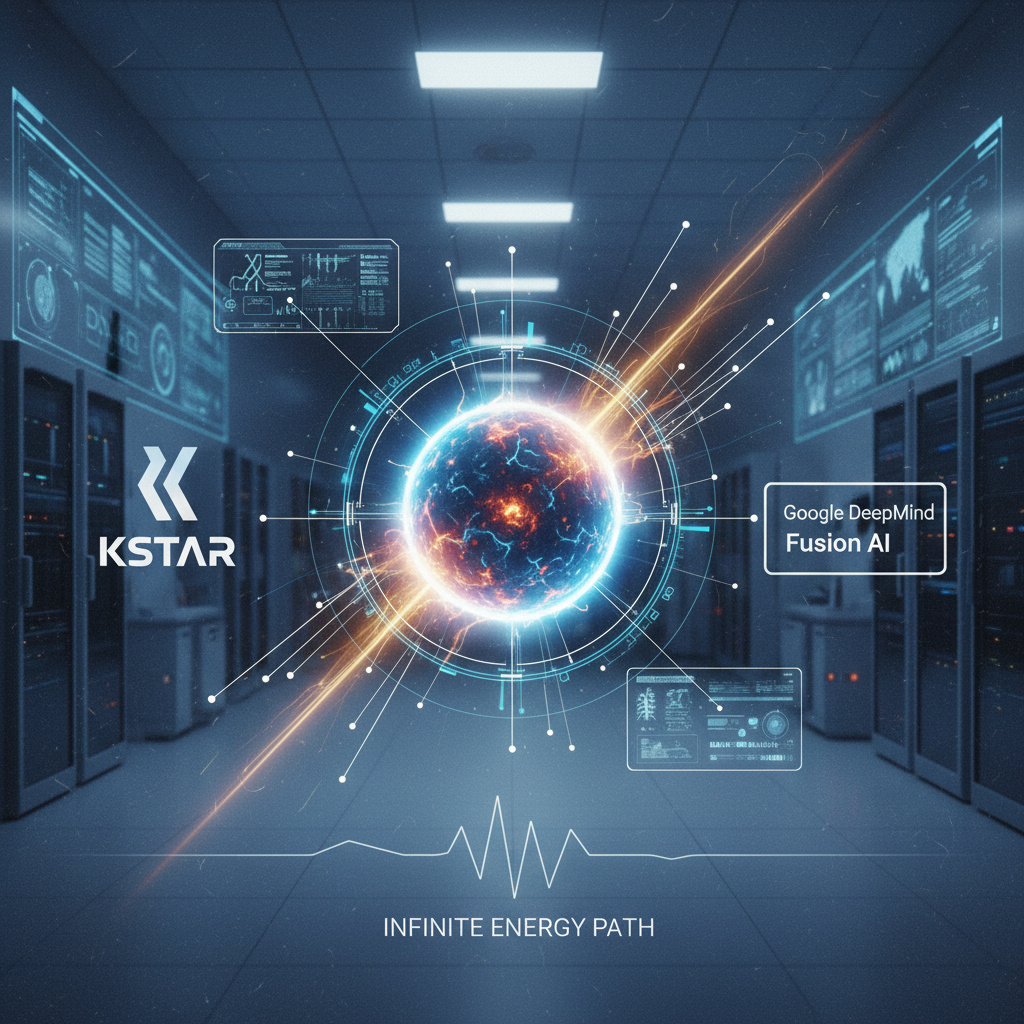
At the heart of this advancement is the recent work published in Nature by researchers from Google DeepMind, in partnership with the Swiss Plasma Center at Epfl, and critically, the Korea Superconducting Tokamak Advanced Research facility, known as Kstar. This research details the successful application of deep reinforcement learning to control plasma in a tokamak, a donut-shaped magnetic confinement device. The breakthrough, in plain language, is that AI can now autonomously manipulate the extremely volatile plasma within these reactors with unprecedented precision, maintaining stability and optimizing conditions for fusion reactions. This is akin to teaching a child to juggle fire while simultaneously solving complex differential equations, all without dropping a single flame.
Why does this matter so profoundly? Because plasma, at millions of degrees Celsius, is notoriously difficult to control. Any instability can lead to a 'disruption,' an event where the plasma rapidly collapses, potentially damaging the reactor and halting the fusion process. For fusion to become a viable energy source, these disruptions must be minimized, and the plasma must be held stable for extended periods. Traditional control systems, relying on pre-programmed physics models, often struggle with the dynamic and unpredictable nature of plasma. Imagine trying to steer a high-speed bullet train through a constantly shifting landscape using only a static map; it is an exercise in futility. AI, specifically deep reinforcement learning, offers a dynamic, adaptive solution, learning from real-time data and adjusting magnetic fields with millisecond precision.
Here's the technical breakdown: the Google DeepMind team, led by Dr. Martin Keck and Dr. Federico Felici, developed a deep reinforcement learning agent. This agent was trained in a simulated environment, learning to apply magnetic fields to shape and control the plasma. The 'reward' for the AI was maintaining plasma stability and achieving desired configurations. Once trained, this AI agent was then deployed on actual tokamaks. At Kstar, known for its ability to sustain high-performance plasma for long durations, the AI demonstrated its prowess by controlling various plasma shapes and currents, including advanced configurations that are challenging for human operators and traditional controllers. This is not merely an incremental improvement; it is a paradigm shift in how we approach fusion control, moving from reactive measures to predictive and proactive management.
The Korean approach to AI is fundamentally different in its integration with hardware and its emphasis on practical, industrial applications. South Korea, with its robust manufacturing and engineering backbone, has always understood that software innovations must walk hand in hand with hardware excellence. Kstar, often dubbed the 'artificial sun,' is a testament to this philosophy. It holds world records for maintaining high-temperature plasma, achieving 100 million degrees Celsius for 48 seconds in 2021, and pushing towards 300 seconds by 2026. This sustained performance provides an ideal real-world laboratory for AI agents to learn and refine their control strategies, something many other facilities cannot offer. Dr. Yoon-Su Na, a leading researcher at the National Fusion Research Institute (nfri) which operates Kstar, has emphasized the crucial role of AI. “The complexity of plasma physics demands advanced computational methods,” he stated in a recent symposium. “Our collaboration with DeepMind allows us to leverage cutting-edge AI to unlock new operational regimes for Kstar, pushing us closer to commercial fusion.”
The implications of this research are profound. First, it significantly accelerates the timeline for achieving sustained fusion. By reducing disruptions and optimizing plasma parameters, AI can help researchers gather more data, run more experiments, and ultimately, design more efficient reactors. It is like having an infinitely patient and hyper-intelligent assistant in the control room, constantly learning and improving. Second, it paves the way for more robust and reliable fusion power plants. If fusion is to become a global energy solution, it must be dependable. AI control systems offer a pathway to that dependability.
This is where Samsung's latest move reveals a deeper strategy in the broader energy landscape. While not directly involved in this specific DeepMind-KSTAR project, Samsung, along with other Korean conglomerates like Hyundai, has been quietly investing in advanced materials science and high-performance computing necessary for future energy infrastructure. Their long-term vision extends beyond consumer electronics to foundational technologies that will power the next century. The development of advanced superconducting magnets, high-power electronics, and sophisticated sensor arrays, areas where Samsung and LG excel, are all critical components for future fusion reactors. This synergy between cutting-edge AI research and advanced hardware manufacturing positions South Korea as a pivotal player in the global energy transition.
What comes next? The immediate goal is to further refine these AI models, testing them under even more extreme conditions and integrating them with other control systems. The Iter project, a massive international tokamak currently under construction in France, will be the ultimate testbed for these technologies. The lessons learned from Kstar and DeepMind's collaboration will directly inform the operational strategies for Iter, which aims to produce 500 MW of fusion power. Beyond Iter, the focus will shift to designing commercial fusion power plants. AI will not only control the plasma but also optimize reactor design, predict maintenance needs, and manage the entire energy grid integration.
This journey towards fusion energy is a marathon, not a sprint, but AI is providing a much-needed acceleration. As Dr. Bernard Bigot, the late Director-General of Iter, once remarked, “Fusion is not a dream, it is a scientific and engineering challenge.” With AI now stepping into the control room, that challenge feels a little less daunting, and the promise of a clean energy future, powered by an artificial sun, shines a little brighter. For more on the technical aspects of AI in scientific discovery, consider exploring resources like MIT Technology Review. The convergence of AI and hard science, particularly in fields as complex as nuclear fusion, represents a new frontier for innovation, one where South Korea is clearly aiming to lead. For further academic insights into recent AI advancements, arXiv provides a wealth of pre-print research papers.