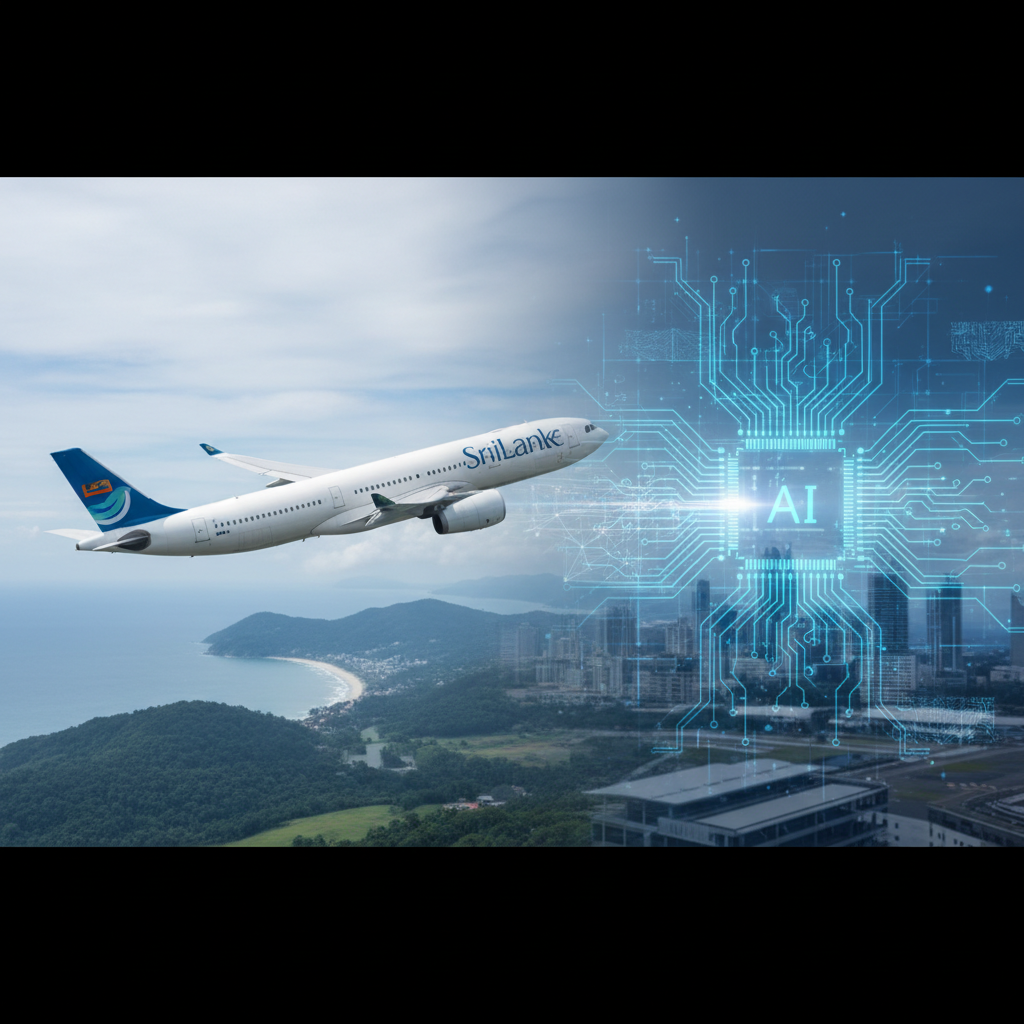

The roar of a jet engine is a familiar sound above Sri Lanka, a constant reminder of our island nation's critical link to the global economy. Yet, beneath the thrum of those engines, a silent revolution, or perhaps a grand experiment, is underway: the integration of artificial intelligence into every facet of aviation. From meticulously planning flight paths to anticipating component failures and orchestrating the ballet of air traffic, AI promises unprecedented efficiency and safety. But as a journalist who has spent years sifting through the digital dust of technological hype, I must ask: do these promises match the reality on the ground, or more accurately, in the air?
The technical challenges in aviation are immense, a complex interplay of physics, logistics, and human factors. We are not merely talking about optimizing a delivery route on a city map; we are discussing the safe passage of hundreds of lives across continents. The core problems AI aims to address are compelling: reducing fuel consumption through dynamic flight path optimization, minimizing costly and dangerous unscheduled maintenance via predictive analytics, and enhancing the safety and throughput of air traffic control (ATC) systems. For a nation like Sri Lanka, with its burgeoning tourism sector and strategic geographical position, even marginal gains in these areas could translate into significant economic benefits and improved operational resilience.
Architecture Overview: The Digital Nervous System of Flight
Implementing AI in aviation demands a robust, distributed architecture capable of ingesting and processing vast streams of real-time data. Think of it as building a digital nervous system for the entire aviation ecosystem. At a high level, such a system typically comprises several interconnected components:
-
Data Ingestion Layer: This is the entry point for diverse data sources. For flight optimization, this includes real-time weather data (wind speed, direction, turbulence), NOTAMs (Notices to Airmen), air traffic restrictions, aircraft performance characteristics, and fuel prices. For predictive maintenance, it involves telemetry data from hundreds of sensors on engines, avionics, landing gear, and other critical components, often transmitted via Acars (Aircraft Communications Addressing and Reporting System) or satellite links. ATC systems feed in radar data, flight plans, and controller instructions.
-
Data Processing and Storage Layer: Raw data is often noisy, incomplete, and high-volume. This layer uses technologies like Apache Kafka for real-time stream processing and distributed data stores such as Apache Cassandra or Google Cloud Spanner for scalable storage. Data lakes built on object storage (e.g., Amazon S3, Google Cloud Storage) are common for housing historical data used in model training.
-
ai/ml Model Training and Inference Layer: This is the brain of the operation. It leverages powerful computational resources, often NVIDIA GPUs, to train complex machine learning models. For flight optimization, this might involve reinforcement learning or deep neural networks. Predictive maintenance often uses recurrent neural networks (RNNs) or transformer models for time-series analysis. ATC systems could employ graph neural networks for spatial-temporal reasoning. Model inference, the application of trained models to new data, must occur with extremely low latency, especially for ATC and real-time flight adjustments.
-
Decision Support and Human-in-the-Loop Interface: AI in aviation is rarely fully autonomous. Instead, it acts as a sophisticated decision support system. Pilots, maintenance engineers, and air traffic controllers interact with intuitive dashboards that present AI-generated insights, recommendations, and predictions. This interface must be designed for clarity, trust, and error tolerance, allowing human operators to override or validate AI suggestions. This is particularly crucial in safety-critical domains.
-
Security and Compliance Layer: Given the sensitive nature of aviation data and operations, robust cybersecurity measures and adherence to strict regulatory frameworks (e.g., Easa, FAA, Caasl in Sri Lanka) are paramount. Data encryption, access controls, and auditable logging are non-negotiable.
Key Algorithms and Approaches: Beyond the Hype
Let us delve into the technical heart of these applications:
Flight Optimization: The goal is to find the optimal trajectory that minimizes fuel burn, flight time, or a combination thereof, while adhering to safety regulations, air traffic constraints, and weather conditions. Traditional methods rely on deterministic algorithms and pre-computed flight plans. AI brings dynamic, adaptive optimization.
- Reinforcement Learning (RL): An RL agent, acting as a virtual pilot, can learn optimal flight policies by interacting with a simulated environment. The state space includes aircraft position, velocity, fuel, and environmental factors like wind and restricted airspace. Actions involve changes in heading, altitude, and speed. The reward function is designed to penalize fuel consumption and delays, while heavily penalizing safety violations. Deep Q-Networks (DQNs) or Proximal Policy Optimization (PPO) are common algorithms. The challenge lies in creating realistic and high-fidelity simulation environments that capture the complexities of real-world atmospheric conditions and ATC interactions. Google DeepMind has explored similar concepts in other domains.
Conceptual Pseudocode for RL-based Flight Path Optimization:
 Initialize PolicyNetwork (e.g., PPO or DQN) with random weights
 Initialize Environment (simulator with aircraft dynamics, weather, ATC rules)

For episode = 1 to MaxEpisodes:
 State = Environment.reset() # Initial aircraft state
 Done = False
 While not Done:
 Action = PolicyNetwork.choose_action(State) # e.g., change heading, altitude
 NextState, Reward, Done, Info = Environment.step(Action)
 Store (State, Action, Reward, NextState, Done) in ReplayBuffer
 State = NextState

If ReplayBuffer is full and sufficient experience:
 Update PolicyNetwork using samples from ReplayBuffer
 Initialize PolicyNetwork (e.g., PPO or DQN) with random weights
 Initialize Environment (simulator with aircraft dynamics, weather, ATC rules)

For episode = 1 to MaxEpisodes:
 State = Environment.reset() # Initial aircraft state
 Done = False
 While not Done:
 Action = PolicyNetwork.choose_action(State) # e.g., change heading, altitude
 NextState, Reward, Done, Info = Environment.step(Action)
 Store (State, Action, Reward, NextState, Done) in ReplayBuffer
 State = NextState

If ReplayBuffer is full and sufficient experience:
 Update PolicyNetwork using samples from ReplayBuffer
Predictive Maintenance: Instead of fixed schedules or reactive repairs, AI predicts when a component is likely to fail, allowing for proactive maintenance. This reduces downtime, prevents in-flight failures, and optimizes spare parts inventory.
- Time-Series Forecasting with RNNs/Transformers: Sensor data from engines (temperature, pressure, vibration), hydraulics, and avionics forms multivariate time series. Recurrent Neural Networks, particularly LSTMs (Long Short-Term Memory) or GRUs (Gated Recurrent Units), are adept at capturing temporal dependencies. More recently, Transformer architectures, initially popularized in natural language processing, are gaining traction due to their ability to model long-range dependencies and parallelize computations. The model learns patterns indicative of impending failure, such as deviations from normal operating ranges or accelerating degradation trends.
Conceptual Example for Predictive Maintenance (lstm):
 Input: Time-series sensor data (e.g., engine vibration, temperature) for N components over T timesteps.
 Output: Probability of failure within next K flight hours for each component.

Model Architecture:
 Input_Layer (T timesteps, M sensor features)
 LSTM_Layer (e.g., 128 units, return_sequences=True)
 Dropout_Layer (e.g., 0.2)
 LSTM_Layer (e.g., 64 units)
 Dense_Layer (e.g., 32 units, ReLU activation)
 Output_Layer (1 unit, Sigmoid activation) # Probability of failure

Training:
 Loss_Function = BinaryCrossentropy
 Optimizer = Adam
 Target = 1 if component failed within K hours after observation, 0 otherwise.
 Input: Time-series sensor data (e.g., engine vibration, temperature) for N components over T timesteps.
 Output: Probability of failure within next K flight hours for each component.

Model Architecture:
 Input_Layer (T timesteps, M sensor features)
 LSTM_Layer (e.g., 128 units, return_sequences=True)
 Dropout_Layer (e.g., 0.2)
 LSTM_Layer (e.g., 64 units)
 Dense_Layer (e.g., 32 units, ReLU activation)
 Output_Layer (1 unit, Sigmoid activation) # Probability of failure

Training:
 Loss_Function = BinaryCrossentropy
 Optimizer = Adam
 Target = 1 if component failed within K hours after observation, 0 otherwise.
Air Traffic Control (ATC): AI can assist controllers by predicting potential conflicts, optimizing runway usage, and managing complex traffic flows in congested airspace. This is perhaps the most safety-critical application.
- Conflict Detection and Resolution with Graph Neural Networks (GNNs): Airspace can be modeled as a dynamic graph where aircraft are nodes and potential conflicts are edges. GNNs can process this spatial-temporal graph data to identify potential collision courses or airspace violations far in advance. They can learn complex interaction patterns between multiple aircraft that might be difficult for human controllers to spot quickly. Algorithms like Graph Convolutional Networks (GCNs) or Graph Attention Networks (GATs) can be adapted for this purpose. The output would be alerts and suggested avoidance maneuvers.
Implementation Considerations: The Sri Lankan Context
For a nation like Sri Lanka, the path to implementing these advanced AI systems is fraught with practical considerations. First, data infrastructure. While major airlines like Emirates or Singapore Airlines have decades of meticulously collected flight data, smaller carriers or national aviation authorities might lack the volume and quality of data needed to train sophisticated models effectively. Data governance, standardization, and secure sharing protocols are crucial.
Second, computational resources and expertise. Training large-scale deep learning models requires significant GPU clusters and skilled data scientists, resources that are often scarce and expensive. We have brilliant minds in our universities, such as the University of Moratuwa, but retaining them in the face of global competition is a constant battle. Partnerships with global tech giants or specialized AI firms become essential, but also raise questions of data sovereignty and vendor lock-in.
Third, regulatory frameworks. Aviation is a heavily regulated industry for good reason. Introducing AI into safety-critical functions demands rigorous testing, validation, and certification processes. Regulators need to develop new standards for AI model explainability, robustness, and ethical considerations. The Civil Aviation Authority of Sri Lanka (caasl) would face a monumental task in adapting its regulations to this new paradigm.
Benchmarks and Comparisons: A Sobering Look
Compared to traditional deterministic optimization algorithms, AI offers the promise of handling non-linear relationships and adapting to dynamic, unpredictable environments. For instance, a traditional flight management system might use a fixed performance model, while an AI system could learn nuanced performance degradation over time for a specific aircraft tail number. In predictive maintenance, AI can move beyond simple threshold-based alerts to identify complex multivariate patterns that precede failure, often extending component life and reducing unscheduled maintenance by reported figures of 10-20% for some early adopters. However, the black-box nature of some deep learning models presents a challenge for certification, where interpretability is often a regulatory requirement.
Code-Level Insights: Tools of the Trade
Developers and data scientists working in this domain would typically leverage Python and its rich ecosystem. Libraries like TensorFlow or PyTorch are indispensable for building and training deep learning models. For data processing, Apache Spark or Dask can handle large datasets. Time-series specific libraries like Prophet or GluonTS are useful for forecasting. For graph-based problems, PyTorch Geometric or DGL (Deep Graph Library) provide the necessary tools. Deployment often involves containerization with Docker and orchestration with Kubernetes, potentially on cloud platforms like AWS, Azure, or Google Cloud Platform, which offer managed services for ML operations (MLOps).
Real-World Use Cases: Glimmers of Progress
- GE Aviation's Predix Platform: GE has been a pioneer in using AI for predictive maintenance on its jet engines. By analyzing sensor data from thousands of flights, Predix can predict engine component wear and recommend maintenance schedules, reportedly saving airlines millions in operational costs annually. This is a testament to long-term data collection and domain expertise.
- Airbus's Skywise Platform: Airbus's open data platform, Skywise, collects operational data from various airlines and uses AI to provide insights into fleet performance, maintenance, and flight operations. It aims to create a collaborative data ecosystem for the industry, allowing airlines to benchmark and optimize their operations.
- NASA's Airspace Technology Demonstrations: NASA has been researching AI for next-generation air traffic management, including systems that can dynamically re-route aircraft to avoid congestion or adverse weather, significantly reducing delays. While still largely experimental, these projects highlight the long-term vision.
- Optimal Aircraft Routing by Ambitious Startups: Smaller firms, often leveraging cloud computing, are offering AI-powered flight planning services that go beyond traditional EFB (Electronic Flight Bag) systems. These services dynamically adjust routes based on real-time wind forecasts and airspace restrictions, promising fuel savings often in the range of 1-3% per flight, which adds up significantly for large fleets. I've been tracking this for months, and the results, while promising, are still heavily dependent on data quality and integration with existing airline systems.
Gotchas and Pitfalls: The Turbulence Ahead
Beyond the technical marvels, several critical pitfalls await. Data quality and bias are paramount; garbage in, garbage out. If training data reflects historical biases in flight operations or maintenance practices, the AI will perpetuate them. Model explainability remains a significant hurdle for regulatory approval, especially for deep learning models. A human controller or pilot needs to understand why an AI made a particular recommendation. Cybersecurity threats are amplified; an AI system controlling critical flight functions becomes a prime target for malicious actors. Finally, integration with legacy systems is a massive undertaking. Many existing aviation systems are decades old, built on proprietary technologies, and not designed for seamless AI integration.
For Sri Lanka, the challenge is not just adopting these technologies, but adapting them to our specific operational scale and resource constraints. We must be wary of simply importing solutions without critical evaluation. The cost of failure, both in terms of human lives and economic impact, is astronomical.
Resources for Going Deeper: Charting the Course
For those looking to dive deeper, I recommend exploring research papers on reinforcement learning in control systems, particularly from institutions like MIT and Stanford. The MIT Technology Review often publishes excellent analyses on AI applications in critical infrastructure. For practical implementation, documentation from cloud providers on MLOps best practices and case studies from major aerospace companies like Boeing and Airbus offer valuable insights. Academic repositories such as arXiv are also excellent sources for the latest research in areas like graph neural networks for traffic management. Furthermore, publications from regulatory bodies like Easa and FAA on AI certification guidelines are essential reading for anyone serious about deploying these systems.
The promise of AI in aviation is undeniable, a vision of safer, more efficient skies. Yet, as we stand at this technological crossroads, particularly in nations like Sri Lanka, we must approach it with a healthy dose of skepticism, rigorous technical scrutiny, and an unwavering commitment to safety and ethical deployment. The journey will be complex, but the potential rewards, if navigated wisely, are immense.