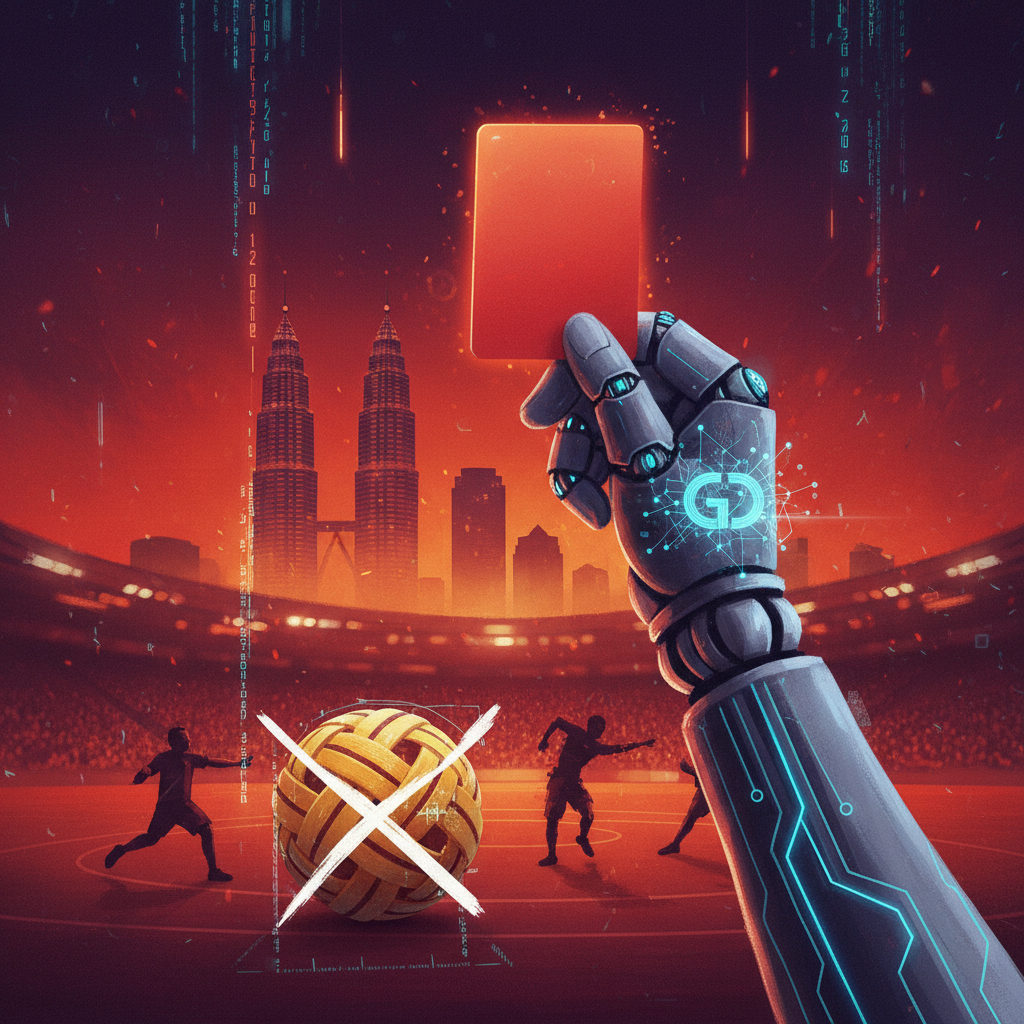

The roar of the crowd, the precision of a perfectly executed pass, the sheer athleticism that defines sports. For generations, these moments have been driven by human grit, instinct, and countless hours of training. But now, a new player has entered the arena: Artificial Intelligence. From optimizing player performance to predicting injuries and even shaping fan engagement, AI is rapidly transforming the sporting landscape. Yet, as we embrace this technological leap, a crucial question emerges: are we fully prepared for the risks it introduces, particularly in a culturally rich and data-sensitive region like Malaysia?
Consider the scenario: a young, promising Malaysian footballer, let us call him Arif, is on the cusp of a major contract. His club, eager to leverage every advantage, employs an advanced AI system, perhaps something akin to what Google DeepMind or even smaller, specialized firms like Catapult Sports offer. This system analyzes every touch, every sprint, every micro-movement during training and matches. It crunches biometric data from wearables, sleep patterns, nutritional intake, and even social media sentiment. The AI then spits out a 'performance risk score' and an 'injury probability index.' What if, based on this opaque algorithmic assessment, Arif is deemed too high a risk, his career trajectory altered before it truly begins? This is not science fiction; it is the very real potential consequence of unchecked AI in sports analytics.
The Architecture is Fascinating, The Implications are Profound
At its core, AI in sports analytics relies on machine learning models, often deep neural networks, trained on vast datasets. For player performance, these models ingest kinematic data from optical tracking systems, GPS trackers, and inertial measurement units. They learn to identify patterns associated with peak performance, fatigue, and suboptimal technique. For injury prediction, the models correlate biomechanical loads, recovery metrics, historical injury data, and even genetic predispositions to forecast potential breakdowns. Fan engagement AI, on the other hand, analyzes social media trends, ticket sales, merchandise purchases, and viewing habits to personalize content, optimize marketing campaigns, and even predict crowd behavior.
The technical explanation involves several layers. Data collection is the first step, often through an array of sensors that would make a Formula One car blush. Think of high-resolution cameras tracking every player on a football pitch, GPS units in vests monitoring speed and distance, and wearables measuring heart rate variability and sleep quality. This raw data, often terabytes per game or training session, is then fed into sophisticated algorithms. Supervised learning models are common for predictive tasks, where historical data with known outcomes (e.g., a player got injured after exhibiting certain movement patterns) is used to train the AI. Reinforcement learning might be used to optimize game strategies, where an AI agent learns by trial and error in simulated environments, much like how AlphaGo mastered the game of Go. The output is then presented as actionable insights for coaches, medical staff, and marketing teams.
Expert Debate: The Promise Versus the Peril
While the benefits are clear, the expert community is deeply divided on the ethical guardrails. Dr. Lim Wei Ling, a prominent data ethics researcher at Universiti Malaya, recently articulated her concerns. "The black box nature of many advanced AI models means we often cannot fully explain why a particular prediction was made," she stated in a recent symposium. "This lack of interpretability is a significant problem when it impacts a person's livelihood or health. We need transparency, accountability, and explainable AI, especially when dealing with sensitive personal data." Her point echoes sentiments from global bodies. The European Union's AI Act, for instance, classifies AI systems used for employment and worker management as 'high-risk,' demanding stringent compliance and human oversight.
Conversely, proponents argue that AI is an indispensable tool for athlete welfare and competitive advantage. "AI allows us to move beyond anecdotal evidence and gut feelings," says Mark O'Connell, CEO of Catapult Sports, a leading provider of sports analytics technology. "We can identify subtle changes in an athlete's physiology or movement that a human eye might miss, potentially preventing career-ending injuries. The goal is to empower, not replace, human decision-makers." He suggests that the focus should be on robust data governance and ethical implementation, rather than shying away from innovation.
Yet, the debate extends beyond injury. What about the potential for algorithmic bias? If an AI system is predominantly trained on data from male athletes in Western countries, how accurately will it predict performance or injury risk for a female badminton player in Malaysia, whose biomechanics, training regimen, and cultural context might differ significantly? This is a critical blind spot, and one that could perpetuate existing inequalities. "The data we feed these algorithms shapes their worldview," explains Dr. Aisha Rahman, a sociologist specializing in technology and society at the National University of Singapore. "If that data is not diverse and representative, the AI will simply amplify existing biases, leading to unfair outcomes for athletes from underrepresented groups or regions. This is why local context is paramount." MIT Technology Review has extensively covered this issue, highlighting how biased datasets can lead to discriminatory outcomes across various AI applications.
Real-World Implications for Malaysia
Let me explain why this matters for Southeast Asia, and specifically for Malaysia. Our nation, with its vibrant sporting culture from football to badminton, is increasingly investing in sports technology. The National Sports Council and various state sports bodies are exploring AI solutions to elevate athlete performance and ensure athlete longevity. This is a commendable ambition, but it comes with responsibilities.
Firstly, data privacy and sovereignty are paramount. Player data, especially biometric and health information, is incredibly sensitive. Who owns this data? How is it stored, secured, and shared? Malaysian data protection laws, while robust, need to be rigorously applied to these new AI contexts. Imagine a scenario where a player's injury history, predicted by AI, is leaked or sold, impacting their future contract negotiations or even their personal insurance premiums. This is a tangible risk.
Secondly, fairness and equity. As Dr. Rahman noted, if AI systems are not culturally and demographically sensitive, they could disadvantage Malaysian athletes. A system trained on European football data might misinterpret the movement patterns or recovery needs of a player accustomed to the tropical climate and different training methodologies prevalent here. Ensuring local data representation and model validation is crucial.
Thirdly, the human element. While AI provides insights, the final decision must rest with human coaches, doctors, and sports psychologists. Over-reliance on AI could diminish the art of coaching, the nuanced understanding of an athlete's mental state, or the intuitive judgment of an experienced medical professional. A coach might bench a player based solely on an AI's 'high injury risk' flag, overlooking the player's current psychological readiness or unique physical resilience. We must ensure AI remains a powerful assistant, not an infallible oracle.
Finally, fan engagement. While AI can personalize experiences, there's a fine line between tailored content and intrusive surveillance. Analyzing social media posts to gauge fan sentiment is one thing, but using facial recognition at stadiums to identify 'disruptive' fans or tracking individual viewing habits to manipulate emotional responses raises significant ethical questions. The balance between enhancing experience and eroding privacy is a delicate one. The Verge has covered several instances where AI-powered fan engagement tools have sparked privacy concerns.
What Should Be Done?
Malaysia is positioning itself perfectly to be a leader in ethical AI adoption, and this extends to sports. Here are some steps we should consider:
- Develop National Guidelines: The Ministry of Youth and Sports, in collaboration with the Ministry of Science, Technology, and Innovation, should establish clear national guidelines for the ethical deployment of AI in sports. These guidelines should cover data governance, algorithmic transparency, bias mitigation, and human oversight.
- Invest in Local AI Talent and Data: We need more Malaysian AI researchers and engineers specializing in sports analytics. This will ensure that models are developed with local contexts and data in mind, reducing reliance on potentially biased external systems. Collaboration between universities like Universiti Malaya and sports institutions is key.
- Mandate Explainable AI (XAI): For high-stakes decisions like player health or career progression, AI systems should be designed to provide understandable explanations for their predictions. This allows human experts to critically evaluate the AI's recommendations.
- Prioritize Data Security and Privacy: Implement robust cybersecurity measures and adhere strictly to personal data protection acts. Athletes must have clear rights regarding their data, including the right to access, correct, and potentially delete it.
- Foster a Culture of Critical Evaluation: Coaches, athletes, and sports administrators need training on both the capabilities and limitations of AI. They should be encouraged to use AI as a tool for informed decision-making, not as a replacement for human judgment.
The integration of AI into sports is inevitable, and its potential to revolutionize performance and engagement is immense. However, like a powerful keris, it must be wielded with skill, respect, and a deep understanding of its double-edged nature. For Malaysia, embracing AI in sports means not just chasing medals, but also safeguarding the integrity, privacy, and well-being of our athletes and fans. The game is changing, and we must ensure it changes for the better, for everyone involved.