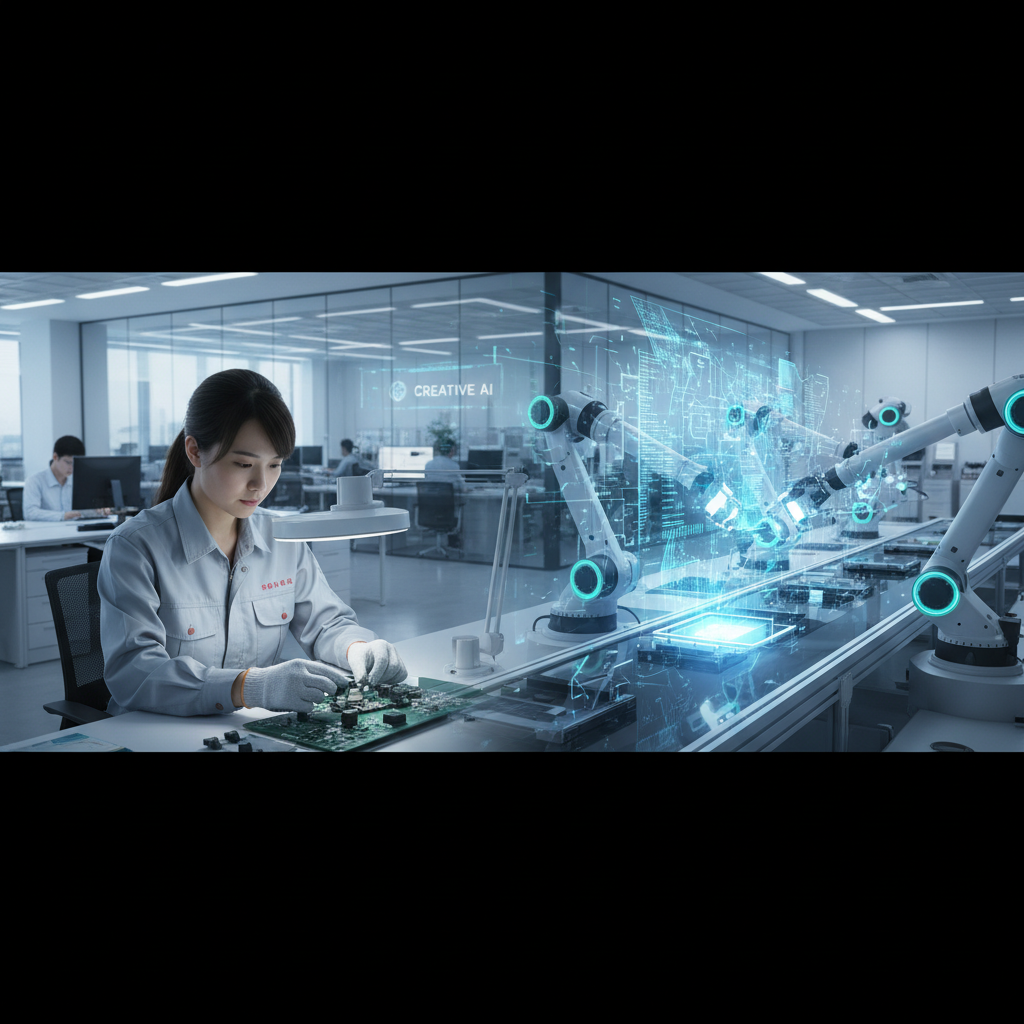

The rhythmic hum of machinery at a Foxconn facility in Tucheng, New Taipei City, once defined the pinnacle of manufacturing efficiency. Today, however, that hum is increasingly orchestrated by an invisible conductor: artificial intelligence. Chen Wei-Liang, a 48-year-old production line supervisor with two decades of experience, watches a bank of monitors displaying real-time analytics. A red alert flashes, indicating a potential anomaly in a surface-mount technology machine. Before Chen can dispatch a technician, an automated work order is already generated, predicting the exact component likely to fail within the next 48 hours. This is not science fiction; this is the reality of AI-driven predictive maintenance transforming Taiwan's industrial backbone.
For years, the narrative surrounding AI in manufacturing has been dominated by promises of lights-out factories and exponential productivity gains. But as a journalist based in Taiwan, a nation whose economic identity is inextricably linked to its manufacturing prowess, I find it imperative to ask: does this actually work? Let's separate fact from narrative and examine the tangible impact on businesses and workers here.
The Data Tells a More Nuanced Story
While the allure of AI is undeniable, its widespread adoption in Taiwan's manufacturing sector, particularly among small and medium-sized enterprises (SMEs), remains a work in progress. A recent survey conducted by the Taiwan Institute of Economic Research (tier) in late 2025 indicated that approximately 38% of large manufacturers, like Tsmc and Foxconn, have implemented some form of AI in their production processes, primarily for predictive maintenance and quality control. This figure drops sharply to just 12% for SMEs with fewer than 200 employees. The primary barriers cited were high initial investment costs (65%), lack of skilled AI talent (58%), and concerns about data security (45%).
Yet, for those who have embraced it, the returns are compelling. Delta Electronics, a prominent power management solutions provider, reported a 15% reduction in equipment downtime across its smart factories in Taoyuan and Tainan within 18 months of deploying an NVIDIA-powered AI system for anomaly detection. "Our AI models, running on NVIDIA Jetson edge devices, analyze terabytes of sensor data daily, identifying subtle deviations that human eyes would miss," stated Dr. Lin Chien-Hua, Delta's Head of Smart Manufacturing Initiatives. "This proactive approach has not only saved us millions in potential repair costs but has also significantly improved our product quality consistency." Such successes are driving further investment, with projected AI spending in Taiwan's manufacturing sector expected to grow by 25% annually through 2028, according to IDC reports.
Winners and Losers in the AI Race
The landscape of AI adoption is creating clear distinctions between industry players. Large conglomerates with substantial capital and R&D budgets are emerging as early winners. Tsmc, for instance, has been a pioneer, leveraging AI to optimize its complex semiconductor fabrication processes, from wafer inspection to yield prediction. Their internal AI division, collaborating with academic institutions like National Taiwan University, has developed proprietary algorithms that contribute directly to their competitive edge. This is not merely about efficiency; it is about maintaining global leadership in a fiercely contested market.
Conversely, many traditional SMEs, often operating on razor-thin margins, struggle to justify the upfront investment. "We understand the benefits of AI, but a comprehensive system can cost millions of NT dollars, a sum simply out of reach for many of us," explained Ms. Huang Mei-Ling, CEO of a precision parts manufacturer in Taichung. "We are looking for more affordable, modular solutions, perhaps something offered as a service rather than a full-scale integration." This highlights a critical gap in the market, one that Taiwanese AI startups like Appier and AetherAI are beginning to address with cloud-based, subscription-model AI services tailored for smaller businesses. However, widespread adoption still requires significant government incentives and educational outreach.
Worker Perspectives: Adaptation, Not Replacement, So Far
Perhaps the most contentious aspect of AI integration is its impact on the workforce. The fear of job displacement is palpable, a concern not unique to Taiwan. However, the experience of workers like Chen Wei-Liang suggests a more nuanced reality. "My job hasn't disappeared, but it has changed," Chen reflected. "Instead of constantly reacting to breakdowns, I now focus on interpreting the AI's predictions, optimizing maintenance schedules, and training new staff on these advanced systems. It demands a different skill set, more analytical and less purely manual." This shift requires continuous learning, a cultural emphasis in Taiwan that has historically facilitated industrial transitions.
According to a survey by the Ministry of Labor, approximately 60% of manufacturing workers in AI-integrated factories reported undergoing reskilling or upskilling programs in the past two years. These programs often focus on data interpretation, AI system monitoring, and collaborative robotics. "We're not looking to replace our experienced technicians; we're empowering them with better tools," commented Mr. Chang Chun-Kai, HR Director at a major electronics assembly firm. "The challenge is ensuring that our older workforce, who possess invaluable institutional knowledge, can also adapt to these new technologies." This is where government-backed initiatives, such as the 'Digital Transformation for Industry 4.0' program, play a crucial role, offering subsidies for training and technology adoption.
Expert Analysis: The Path Forward
Dr. Lee Ming-Chieh, a professor of Industrial Engineering at National Tsing Hua University, offers a pragmatic view. "Taiwan's position is more complex than headlines suggest. We are not just adopting AI; we are also developing it. Our strength lies in our robust hardware ecosystem and our ability to integrate complex systems. The next phase involves democratizing AI, making it accessible and affordable for our vast network of SMEs." He points to the potential of open-source AI frameworks and specialized Taiwanese AI chips, like those being developed by companies leveraging TSMC's advanced processes, to drive this democratization.
However, Dr. Lee also cautions against complacency. "While predictive maintenance and quality control are low-hanging fruit, true smart factory transformation requires a holistic approach, integrating AI across the entire value chain, from supply chain optimization to personalized production. This necessitates significant investment in data infrastructure and cybersecurity, areas where many Taiwanese companies still have room for improvement." The reliance on external AI platforms, such as Google's Vertex AI or Microsoft's Azure AI, while providing immediate benefits, also raises questions about data sovereignty and long-term strategic independence. This is a topic I have explored in depth previously, particularly concerning the broader implications of global tech giants' influence on local innovation. You can read more about this dynamic in our analysis of regional AI development.
What's Coming Next: Hyper-Personalization and Sovereign AI
The trajectory for AI in Taiwan's manufacturing is clear: deeper integration, greater autonomy, and a move towards hyper-personalized production. Imagine factories that can dynamically reconfigure production lines based on real-time market demand, or machines that self-optimize their performance without human intervention. This vision, often termed Industry 5.0, emphasizes human-machine collaboration, where AI handles repetitive tasks, freeing human workers for creativity and complex problem-solving.
Furthermore, the geopolitical landscape, particularly the ongoing chip wars, is accelerating Taiwan's drive towards developing its own sovereign AI capabilities. Companies are increasingly investing in local AI research and development, aiming to reduce reliance on foreign technologies and ensure the security of their intellectual property. The government's 'Taiwan AI Action Plan 2.0' explicitly prioritizes fostering domestic AI talent and building indigenous AI platforms. This strategic imperative, driven by both economic competitiveness and national security, will undoubtedly shape the next decade of AI adoption in Taiwan.
Ultimately, the integration of AI into Taiwan's manufacturing is not merely a technological upgrade; it is a profound societal shift. It demands not just smarter machines, but smarter policies, a more adaptive workforce, and a clear national vision. The data shows progress, but also highlights the persistent challenges. The journey towards truly intelligent manufacturing is far from over, and its success will hinge on Taiwan's ability to balance innovation with inclusivity, ensuring that the benefits of AI are shared across all segments of its industrial ecosystem. For further insights into how global tech trends are impacting local economies, Reuters provides extensive coverage. The future of Taiwan's manufacturing, much like its political future, remains a delicate balance of internal strength and external pressures, a narrative I will continue to scrutinize with a critical eye. For more on the technical underpinnings of these advancements, Ars Technica offers detailed analyses.