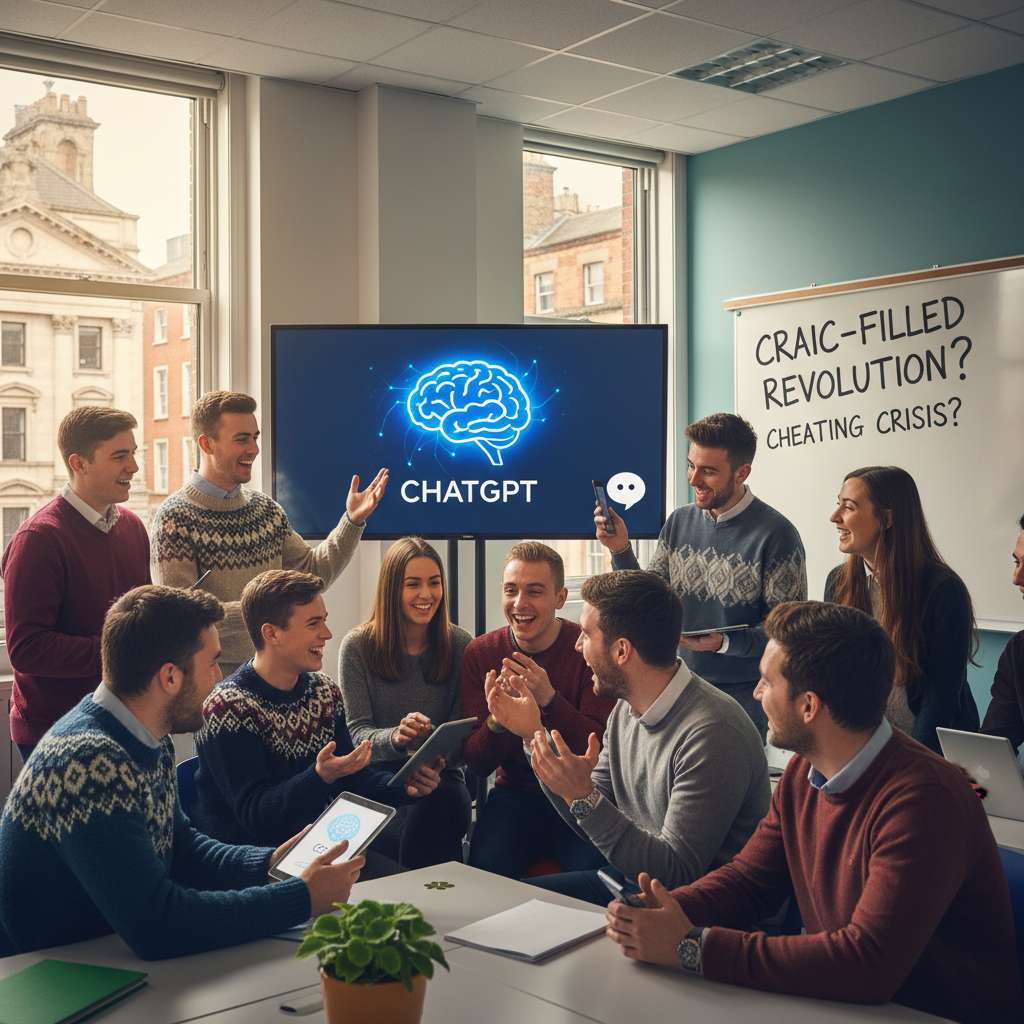

Right, let's get one thing straight from the off. The moment OpenAI's ChatGPT burst onto the scene, the collective gasp from educators across the globe was almost audible. Suddenly, every essay, every homework assignment, every carefully crafted paragraph was under suspicion. Was it little Seánnie's own brilliant prose, or had he simply asked a bot to do the heavy lifting? It's a question that has haunted staff rooms from Cork to California, and it's certainly got the chat going in Ireland. Is this a cheating crisis of epic proportions, or are we on the cusp of an educational revolution, one where the craic is mighty in Irish AI classrooms?
What Exactly Are AI Chatbots in Schools?
At its simplest, an AI chatbot, like Google's Gemini or Anthropic's Claude, is a computer program designed to simulate human conversation. They are powered by large language models, or LLMs, which have been trained on truly colossal amounts of text data from the internet. Think of it like this: these bots have read more books, articles, and websites than any human could in a thousand lifetimes. When you ask them a question or give them a prompt, they use all that accumulated knowledge to generate a coherent, contextually relevant, and often surprisingly human-like response. In a school setting, this means they can write essays, solve maths problems, summarise complex texts, and even generate creative stories. They are, in essence, incredibly sophisticated digital assistants, always on, always ready to churn out text at lightning speed.
Why Should You Care? Because Your Kids Are Already Using Them, Probably.
If you're a parent, a teacher, or even just someone who occasionally interacts with a young person, you should care deeply about this. These tools aren't some futuristic fantasy, they're here, now, and they're incredibly accessible. A quick search on a phone, a few taps, and poof, a perfectly structured essay appears. For students, it's a tempting shortcut, a way to bypass the arduous process of research, critical thinking, and writing. For teachers, it's a nightmare scenario, undermining the very foundations of assessment and learning. But it's not all doom and gloom, mind you. There's a flip side, a potential for these tools to become powerful allies in the learning process, if we're smart enough to figure out how.
How Did We Get Here? A Brief, Blistering History.
AI, in some form, has been around for decades, but the current wave of generative AI, particularly large language models, really hit its stride in the last few years. Companies like OpenAI, backed by Microsoft, and Google's DeepMind have poured billions into training these models. The release of ChatGPT in late 2022 was a watershed moment, making this powerful technology available to the public for free. Before that, AI was largely in the realm of researchers and big tech companies. Suddenly, your average teenager with a smartphone could access a tool that could write poetry or explain quantum physics. The speed of adoption has been breathtaking, leaving educational institutions scrambling to catch up. It's like trying to put the genie back in the bottle, only the genie is now on TikTok and has a million followers.
How Do They Work in Simple Terms? Think of a Super-Smart Guessing Game.
Imagine you're playing a game where you have to predict the next word in a sentence. Now imagine you've read every book ever written, and you're incredibly good at statistical probability. That's essentially what an LLM does. When you give it a prompt, it breaks it down, analyses the patterns it's learned from its vast training data, and then predicts the most probable sequence of words to form a coherent response. It doesn't understand in the human sense, it doesn't have consciousness or opinions, but it's incredibly adept at mimicking human language and thought processes. It's a master of pattern recognition, not a sentient being. So, when it writes an essay, it's not forming original thoughts, it's assembling information and phrasing it in a way that looks like original thought, based on what it's seen before. It's a bit like a very talented mimic, really.
Real-World Examples: Beyond the Cheating Scares.
While the cheating aspect grabs headlines, the potential applications of AI chatbots in education are far broader. Here are a few:
- Personalised Tutoring: Imagine a bot that can explain a complex maths concept in five different ways until it clicks for a student, or provides instant feedback on a draft essay. Companies like Khan Academy are already experimenting with AI tutors, offering tailored learning experiences. This could be a game-changer for students who struggle in traditional classroom settings.
- Language Learning: AI chatbots are fantastic for practicing conversational skills, correcting grammar, and expanding vocabulary in a new language. They offer a non-judgmental space for learners to make mistakes and improve.
- Research Assistance: Instead of sifting through countless articles, students can use chatbots to quickly summarise key points, identify relevant sources, and brainstorm research questions. This frees up time for deeper analysis and critical thinking, rather than just information retrieval.
- Creative Writing Prompts and Brainstorming: For those moments when writer's block hits, an AI can generate ideas, plot twists, or even character descriptions, sparking creativity rather than stifling it. It's a tool for inspiration, not replacement.
Common Misconceptions: It's Not Magic, and It's Not Always Right.
One of the biggest misconceptions is that AI chatbots are infallible or always correct. Far from it. They can