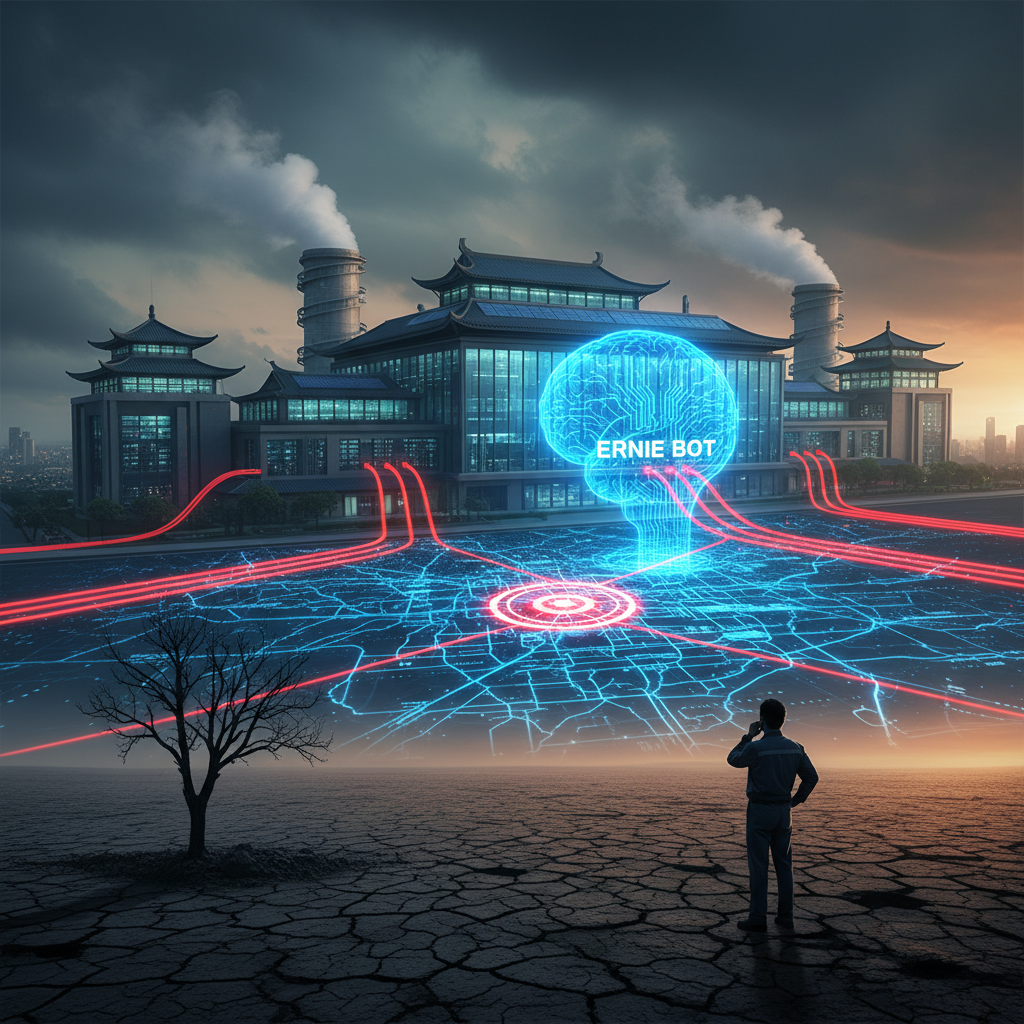

The hum of servers, a constant thrum beneath the veneer of our digital lives, is growing louder, more demanding. It is a sound that, to an investigative journalist like me, signals a deeper, more troubling reality: the AI energy crisis. We talk about processing power, about teraflops and petabytes, but rarely about the raw, physical energy that fuels these digital behemoths. Yet, the numbers are stark, and in China, where the ambition for AI leadership is unparalleled, this issue is becoming impossible to ignore.
Consider Baidu's Ernie Bot, a large language model that has captured significant attention. Its training and inference operations, along with those of its peers from Tencent, Alibaba, and SenseTime, demand colossal amounts of electricity. Some estimates suggest that a single large language model training run can consume as much energy as hundreds of homes over a year. When you scale that to the hundreds of models being developed and deployed across China's burgeoning AI sector, the energy footprint becomes staggering. It is not an exaggeration to say that the electricity consumption of China's AI data centers could soon rival, or even surpass, the energy needs of entire medium-sized cities, perhaps even a metropolis like Shanghai if current trends continue unchecked.
The Technical Challenge: Powering the Unquenchable Thirst
The core problem is simple: modern AI, particularly deep learning, is computationally intensive. Training a large transformer model, for example, involves billions, sometimes trillions, of floating-point operations. Each operation requires energy. This isn't just about the GPUs, which are themselves power-hungry; it's about the entire infrastructure: cooling systems, networking equipment, storage, and the power delivery units themselves. The efficiency of these components, measured in terms of power usage effectiveness, or PUE, is critical, but even the most efficient data centers struggle when demand scales exponentially.
Architecture Overview: The Data Center as a Power Plant
An AI data center is less a building and more a highly optimized, energy-intensive machine. At its heart are racks upon racks of servers, each housing multiple high-performance GPUs, such as NVIDIA's H100 or the upcoming Blackwell series. These GPUs are the workhorses, performing parallel computations essential for neural network training. But their power density is immense, often exceeding 700W per card, leading to rack power densities of 50-100 kW, far beyond traditional enterprise servers.
Beyond the compute, the cooling infrastructure is paramount. Air cooling, using Crac units, is common but inefficient for high-density racks. Liquid cooling, including direct-to-chip liquid cooling or immersion cooling, is gaining traction. Companies like Alibaba Cloud are experimenting with advanced liquid cooling solutions in their Hangzhou data centers, aiming for PUE values closer to 1.1, a significant improvement over the industry average of 1.5-1.7. This involves circulating dielectric fluid directly over the hot components, whisking away heat much more effectively than air.
Networking, often overlooked, also consumes substantial power. High-bandwidth interconnects like InfiniBand or 400GbE Ethernet are necessary to shuttle data between thousands of GPUs, preventing bottlenecks. Each switch, each optical transceiver, adds to the total energy bill.
Key Algorithms and Approaches: Efficiency in the Code
The most effective way to reduce AI's energy footprint is to make the algorithms themselves more efficient. This means fewer computations per inference or training step. Several technical approaches are being actively researched and deployed:
-
Model Quantization: Reducing the precision of numerical representations, for example, from 32-bit floating-point (FP32) to 16-bit (FP16 or BF16) or even 8-bit integers (INT8). This significantly reduces memory footprint and computational load. For example, a matrix multiplication
C = A * BwhereAandBare INT8 can be much faster and consume less power than if they were FP32. PyTorch and TensorFlow both offer quantization tools. The challenge is maintaining accuracy. -
Sparsity and Pruning: Many neural network weights are close to zero and contribute little to the final output. Pruning these connections can create sparse models that require fewer operations. Structured sparsity, where entire rows or columns of weight matrices are removed, is particularly hardware-friendly. The idea is to find the minimum set of weights
W'fromWsuch thatf(x, W')is approximatelyf(x, W)with minimal performance degradation. -
Knowledge Distillation: Training a smaller, more efficient*