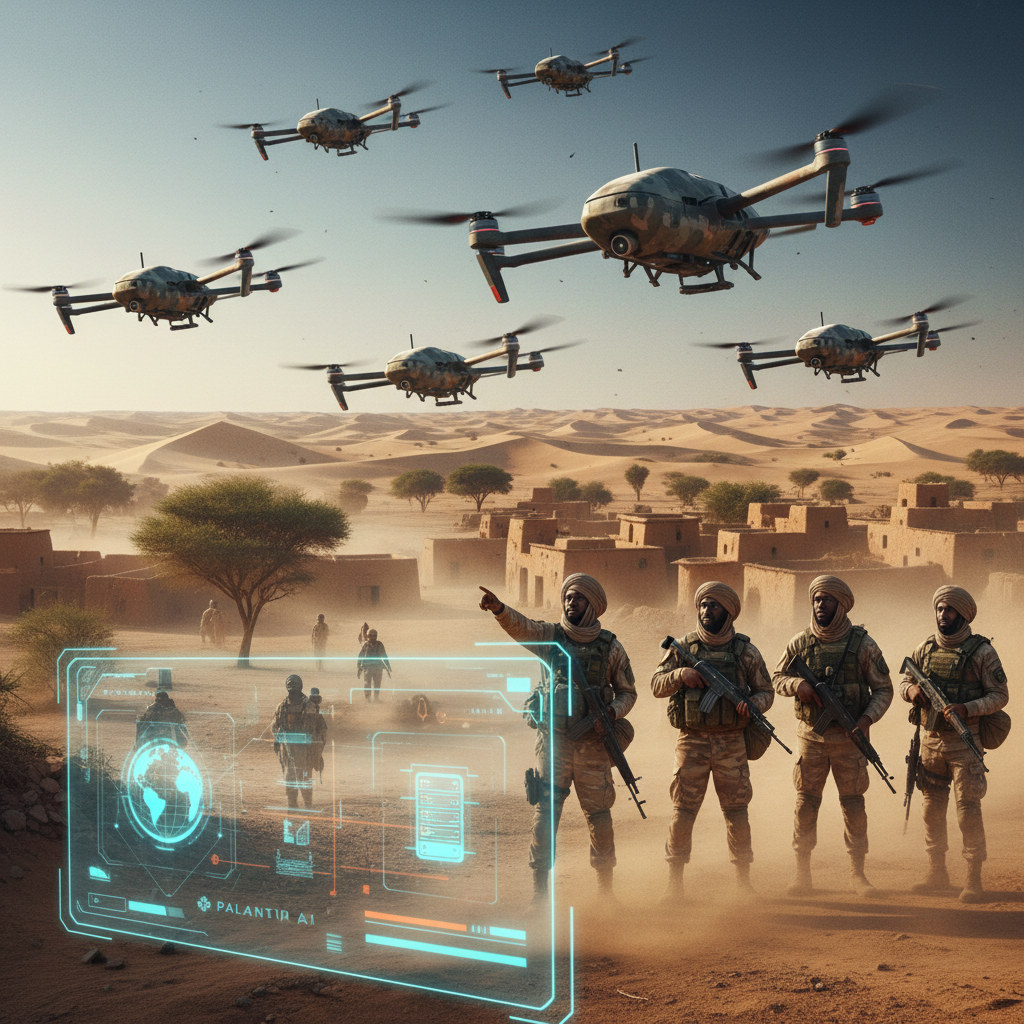
The dry winds of the Sahel often carry dust, but now, they also carry whispers of a new kind of warfare. Recent, unconfirmed but persistent reports from Mali's northern territories suggest the deployment of highly sophisticated drone systems, purportedly enhanced with advanced artificial intelligence, operating with a degree of autonomy previously unseen in this theater. While official confirmations remain elusive, the implications are profound, particularly given the persistent rumors of involvement by companies like Palantir Technologies, known for their deep expertise in data integration and AI-driven intelligence platforms.
This is not merely about faster surveillance. This is about a shift in the very nature of conflict, where algorithms begin to make decisions that once belonged solely to human commanders. For a nation like Mali, grappling with complex security challenges and a fragile peace, the introduction of such technology demands immediate and rigorous scrutiny. The question is no longer if AI will be used in warfare, but how, by whom, and with what accountability.
Sources close to regional security operations, speaking on condition of anonymity due to the sensitivity of the matter, describe systems capable of identifying patterns, tracking movements, and even suggesting, or in some cases, executing, responses with minimal human oversight. While the specific capabilities remain shrouded in secrecy, the potential for autonomous targeting raises fundamental ethical dilemmas. “The idea that a machine, however sophisticated, could determine a target in a densely populated area, where the distinction between combatant and civilian is often blurred, is deeply troubling,” stated Dr. Aminata Traoré, a prominent Malian human rights advocate and former government advisor. “We cannot outsource moral responsibility to an algorithm.”
The official stance from Bamako has been cautious. A spokesperson for the Ministry of Defense, Lieutenant Colonel Moussa Koné, acknowledged the ongoing efforts to modernize national security capabilities but declined to comment on specific technological deployments. “Mali is committed to protecting its citizens and territorial integrity,” Koné stated in a brief press conference. “We utilize all available tools, in accordance with international law, to achieve this objective.” This carefully worded statement does little to quell the growing concerns among local communities and international observers.
Expert analysis suggests that if Palantir, or a similar entity, is indeed involved, their role would likely extend beyond mere drone operation. Palantir's platforms, such as Gotham, are designed to integrate vast quantities of disparate data, from satellite imagery and communication intercepts to biometric data and social media feeds, creating a comprehensive operational picture. An AI layer atop this could then identify anomalies, predict movements, and potentially automate response protocols. This capability, while promising enhanced efficiency, also centralizes immense power and introduces new vectors for error and unintended consequences.
“The data tells a different story than the one often presented in polished tech demos,” remarked Dr. Fatoumata Diallo, a researcher specializing in AI ethics at the University of Bamako. “In our context, data is often incomplete, biased, or simply wrong. Training autonomous systems on such data risks perpetuating and amplifying existing injustices. A system that cannot distinguish a farmer from an insurgent based on movement patterns alone is a dangerous one.” Dr. Diallo’s concerns echo those raised by global AI ethics watchdogs, who have long warned about the deployment of such systems in environments lacking robust oversight and accountability frameworks. The MIT Technology Review has extensively covered these ethical quandaries in autonomous systems.
The implications for civilian protection are particularly stark. Mali's conflict has seen countless instances of civilian casualties, often accidental, from both state and non-state actors. Introducing AI that operates with reduced human intervention could exacerbate this tragic reality. The principle of distinction, a cornerstone of international humanitarian law, becomes incredibly complex when an algorithm is tasked with making split-second targeting decisions based on imperfect data in a dynamic environment.
Furthermore, the question of data sovereignty arises. If foreign entities are collecting and processing sensitive operational data within Mali, who truly owns and controls that information? What are the long-term implications for national security and privacy? These are not abstract academic questions, but practical concerns that directly impact the sovereignty of the Malian state and the safety of its people. The global debate on AI regulation, as covered by Reuters, highlights the urgency of establishing clear legal and ethical boundaries.
Looking ahead, this development necessitates a multi-faceted response. Firstly, there must be absolute transparency regarding the nature and extent of autonomous AI systems deployed in Mali. The Malian government has a responsibility to its citizens to clarify these reports. Secondly, a robust framework for accountability must be established, ensuring that responsibility for any harm caused by autonomous systems can be clearly attributed and addressed. This includes adherence to international humanitarian law and human rights principles.
Thirdly, there is an urgent need for national and regional dialogue on the ethical boundaries of AI in warfare. This should involve not only military strategists and technologists but also ethicists, legal experts, civil society organizations, and community representatives. We cannot afford to allow this technology to advance unchecked, particularly in regions already vulnerable to instability. The BBC News Technology section frequently reports on these global discussions.
Let's be realistic, the genie of military AI is out of the bottle. However, how we manage its deployment, how we ensure human control, and how we uphold ethical standards will define the future of conflict and human security. Practical solutions, not moonshots, are required here. This is not just a technological challenge, it is a profound moral and political one. The stability of Mali, and indeed the broader Sahel, may well depend on our ability to navigate this new, uncharted ethical frontier with wisdom and foresight. The drums of war are changing their rhythm, and we must listen carefully to the new beat.