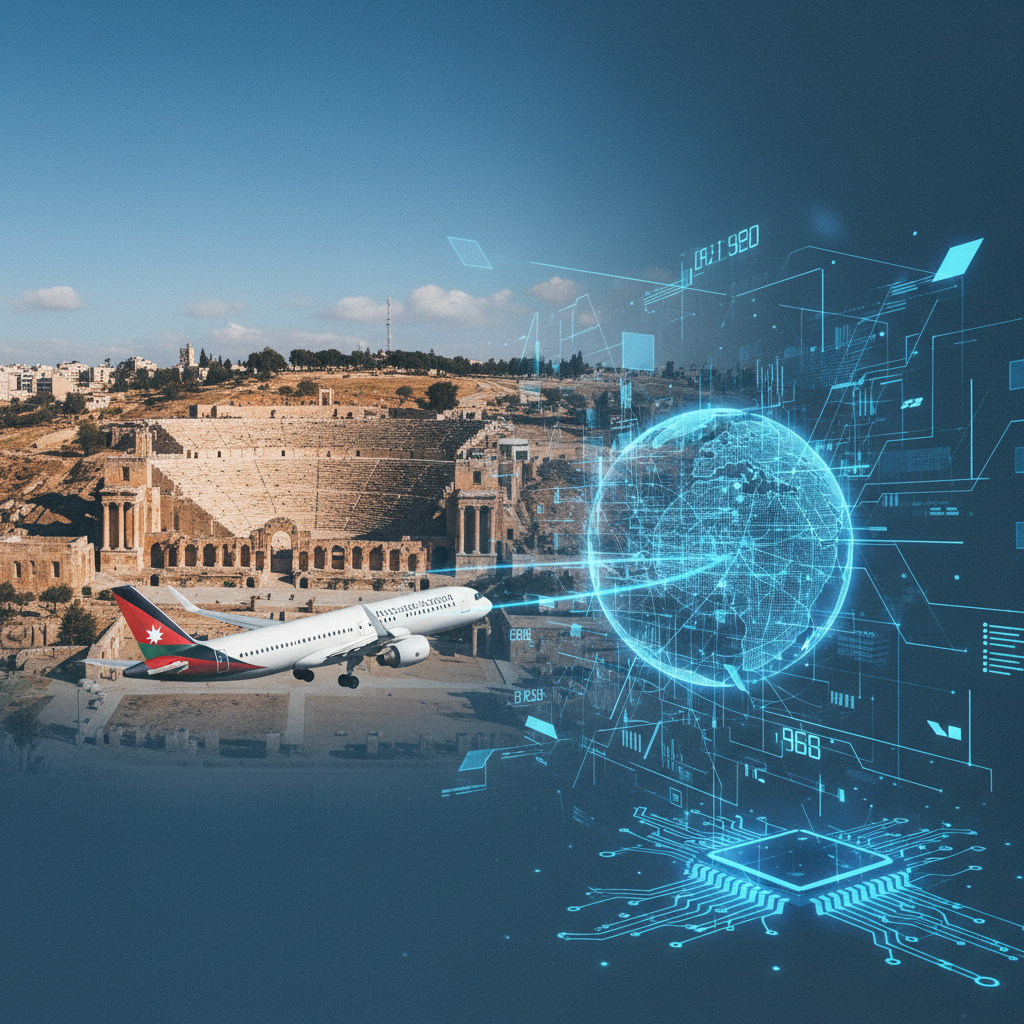

Let us be honest. When you hear about AI in aviation, your mind probably jumps to the gleaming, futuristic control towers of Dubai, or perhaps the sprawling data centers of a major European hub. You are thinking predictive maintenance for Lufthansa, or flight path optimization for Emirates. But I am here to tell you that the real story, the one with grit and genuine strategic foresight, is unfolding right here in the Levant, specifically in Jordan.
The West has it backwards, as usual. They see AI as a tool for maximizing profit, for shaving seconds off flight times, or reducing fuel burn by a fraction of a percentage point. While those are certainly valid applications, they miss the forest for the trees. For a nation like Jordan, nestled in a region often fraught with complexity, AI in aviation is not just about efficiency; it is about national security, resilience, and maintaining a vital lifeline to the world. It is about sovereignty in the skies.
Consider the sheer volume of air traffic traversing our region. Jordan's airspace is a crossroads, a critical corridor for flights connecting East and West. Managing this intricate web, ensuring safety, and optimizing flow is a monumental task. This is where AI steps in, not as a luxury, but as an absolute necessity. We are not just talking about fancy algorithms; we are talking about systems that can predict weather patterns with unprecedented accuracy, anticipate maintenance needs before they become emergencies, and intelligently route aircraft to avoid congestion or, more critically, geopolitical flashpoints.
Our own Royal Jordanian Airlines, for instance, has been quietly exploring AI applications for years. It is not about making splashy announcements or chasing unicorn valuations. It is about practical, impactful deployment. They are looking at how machine learning models can analyze vast datasets of engine performance, flight hours, and environmental conditions to predict component failures long before they occur. This is not just saving money; it is preventing potential disasters and ensuring the safety of passengers and crew. "The cost of an unplanned grounding, both financially and in terms of reputation, is immense," explained Captain Ahmad Al-Majali, a veteran pilot and head of flight operations at Royal Jordanian, during a recent industry forum in Amman. "AI allows us to move from reactive fixes to proactive prevention, a paradigm shift that is invaluable for an airline operating in our competitive landscape."
This predictive maintenance is a game changer. Imagine an algorithm sifting through terabytes of sensor data from an aircraft engine, identifying subtle anomalies that human eyes or traditional systems might miss. It flags a potential issue, allowing maintenance crews to address it during a scheduled layover, rather than having an aircraft stranded in a remote location. This is not science fiction; it is happening. Companies like GE Aviation and Rolls-Royce have been investing heavily in AI for their engine monitoring systems, but the real challenge is integrating these sophisticated tools into an airline's existing operational framework, something Royal Jordanian is tackling head-on with local tech talent.
Then there is air traffic control. This is arguably where AI holds the most transformative potential, especially for a country like Jordan. Our air traffic controllers manage a complex tapestry of commercial, cargo, and sometimes military flights. The human element, while indispensable, has limits. AI can act as an intelligent co-pilot for controllers, processing real-time data from radar, transponders, and weather systems to suggest optimal flight paths, identify potential conflicts, and even predict congestion points hours in advance. This allows controllers to make more informed decisions, reducing delays and enhancing safety across the board.
"The sheer volume of data generated by modern aviation is staggering," noted Dr. Rania Al-Hassan, a lead researcher in AI at the King Abdullah II Design and Development Bureau (kaddb), an institution that often spearheads technological advancements for Jordan. "Our aim is to leverage AI to augment human capabilities, not replace them. We are developing systems that can learn from historical traffic patterns and real-time events, offering controllers a level of situational awareness previously unimaginable. This is not just about efficiency; it is about national resilience in our airspace." Her words underscore a crucial point: Jordan's approach makes more sense than Silicon Valley's obsession with full automation. We prioritize augmentation, not replacement, understanding the critical role of human judgment.
While Western tech giants like Google and Microsoft are pouring billions into general-purpose AI models like Gemini and Copilot, the specific, targeted applications in aviation are often driven by specialized firms. For instance, companies like Aireon are deploying space-based Automatic Dependent Surveillance-Broadcast (ads-b) systems, generating global real-time flight tracking data. This data, when fed into AI algorithms, can provide an unprecedented level of insight for air traffic management, particularly over oceanic or remote regions where traditional radar coverage is sparse. Jordan, with its strategic location, stands to benefit immensely from such advancements, integrating these global data streams with local AI models to create a truly intelligent airspace.
Another critical area is flight optimization. This goes beyond just finding the shortest route. AI can consider a multitude of factors in real-time: prevailing winds, air traffic restrictions, fuel prices, even geopolitical no-fly zones. By constantly analyzing these variables, AI can suggest dynamic routing adjustments that save fuel, reduce emissions, and minimize delays. For an airline like Royal Jordanian, operating on tight margins and facing fierce competition, even a small percentage saving in fuel costs can translate into millions of dinars annually. This is not just good business; it is also a step towards more sustainable aviation, a goal that resonates deeply in our resource-conscious region.
Unpopular opinion from Amman: While the world obsesses over the next viral AI chatbot or the latest generative art model, the true, impactful revolution is happening in less glamorous sectors. It is in the quiet hum of data centers analyzing engine telemetry, in the algorithms guiding planes safely through crowded skies, and in the predictive models that keep our national airline flying. This is where AI truly delivers on its promise, not just for shareholders in California, but for the safety and prosperity of nations like Jordan. We are building a future where our skies are not just open, but intelligently managed and secure, a testament to practical innovation over performative hype. And that, my friends, is a story worth telling. The future of AI in aviation is not just being written in the West; it is being meticulously engineered right here, with a clear vision for what truly matters: safety, sovereignty, and strategic resilience. For more on how other nations are navigating the complex regulatory landscape of AI, you might find this article on AI legislation in Cairo [blocked] insightful. The challenges are global, but the solutions are often local.
Our journey with AI in aviation is a reflection of Jordan's broader technological ambition: to adopt and adapt cutting-edge solutions not for their novelty, but for their tangible impact on national well-being and strategic advantage. It is about building robust systems that serve our people and secure our future, rather than simply chasing the latest trend. This pragmatic, results-oriented approach is, in my view, far more sustainable and ultimately more revolutionary than much of what emanates from the tech hubs of the world. For further reading on the broader implications of AI in critical infrastructure, consider exploring analyses from MIT Technology Review or Wired's AI section. These platforms often delve into the societal and economic shifts driven by such technological advancements, offering a global perspective that can sometimes overlook the nuanced, localized progress we see in places like Jordan. We are not just consumers of technology; we are conscientious architects of its application. Our approach is about building a future that truly serves our unique needs, rather than passively accepting solutions designed elsewhere. This is the Jordanian way. This is the future we are building, one intelligent flight at a time. And frankly, it is a future that looks incredibly promising. The skies above Amman are not just a canvas for dreams; they are a laboratory for innovation, where AI is being harnessed to ensure safety, efficiency, and strategic autonomy. It is a powerful statement from a small nation with big ambitions. The world would do well to pay attention. We are not just optimizing flights; we are optimizing our destiny. And that is a journey worth watching. The real revolution, I tell you, is happening in the quiet, diligent work of engineers and policymakers who understand that technology is a tool for empowerment, not just profit. And in Jordan, we are wielding that tool with purpose and precision. This is not just about moving planes; it is about moving a nation forward. It is about securing our future, one algorithm, one optimized flight path, one predictive maintenance alert at a time. It is a testament to the power of focused, national-level innovation, proving that sometimes, the most profound changes come not from the loudest voices, but from the most strategic minds.