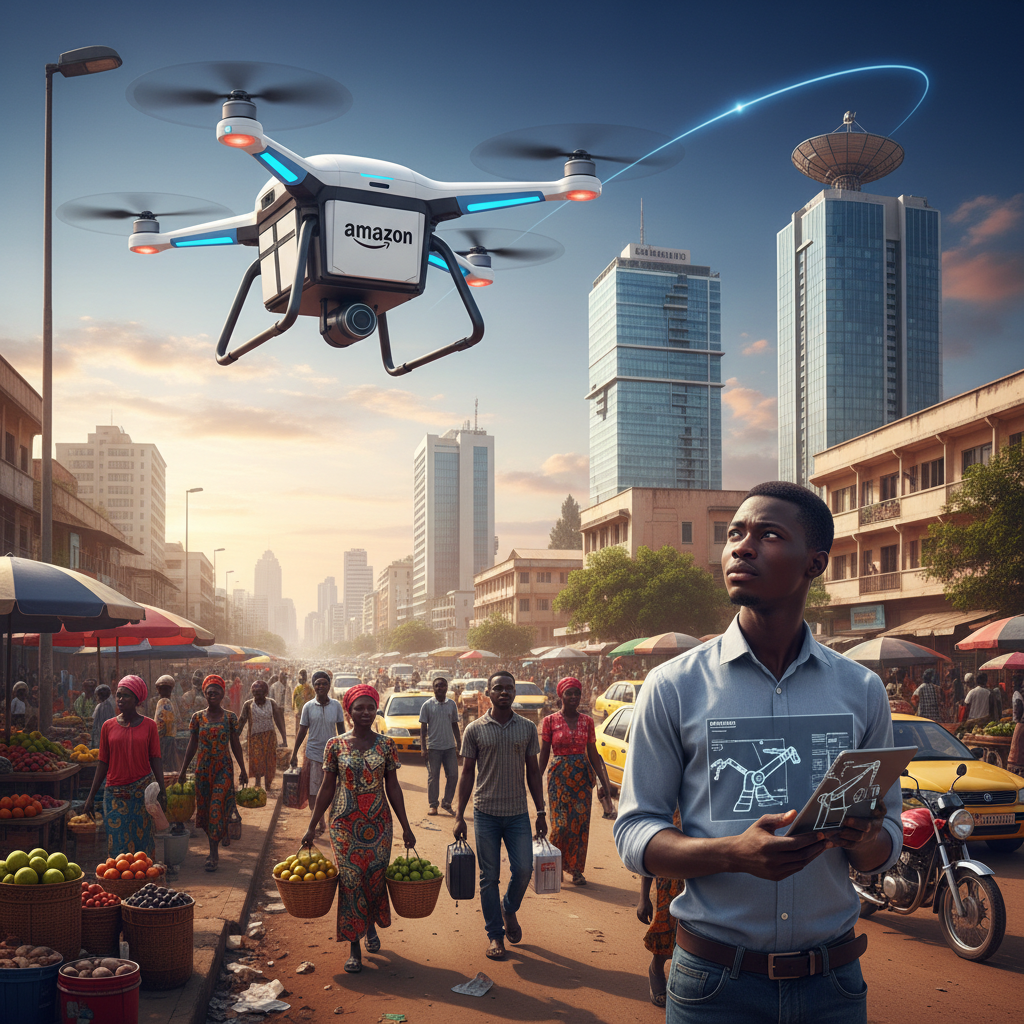

Picture this: the bustling port of Abidjan, a symphony of horns, shouts, and the rhythmic clang of cargo being loaded and unloaded. This is the heartbeat of Côte d'Ivoire's economy, a place where human effort, ingenuity, and sheer will power the flow of goods across our nation and beyond. Now, imagine advanced AI and sleek robots entering this vibrant ecosystem, promising unprecedented efficiency. This is not some distant science fiction; it is the reality Amazon is bringing to the world, and its ripples are beginning to touch our continent, raising questions about progress, jobs, and our unique way of life.
Amazon, under the leadership of Andy Jassy, has been relentless in its pursuit of logistics supremacy, pouring billions into AI and robotics to optimize every step of its supply chain. From autonomous mobile robots like Proteus navigating warehouses to AI algorithms predicting demand with uncanny accuracy, their operations are a marvel of modern engineering. In their latest earnings call, Amazon reported a 20% increase in fulfillment speed in regions leveraging advanced robotics, a staggering figure that highlights the power of these technologies. But for us in Côte d'Ivoire, the conversation is not just about speed or efficiency; it is about people, livelihoods, and the future of our communities.
I recently spoke with Dr. Aminata Koné, a logistics expert and senior lecturer at the Institut National Polytechnique Félix Houphouët-Boigny in Yamoussoukro. She told me something I will never forget: 'The digital transformation is inevitable, Aïssatà, but its form here must be distinctly African. We cannot simply import solutions; we must adapt, innovate, and ensure our people are part of the journey, not just spectators.' Dr. Koné emphasized that while Amazon's innovations are impressive, the context of their implementation in a place like Côte d'Ivoire is entirely different from a fully automated warehouse in Seattle or Leipzig. Our informal sector is robust, our labor force is young, and our infrastructure, while improving, presents unique challenges and opportunities.
Consider the 'petits commerçants,' the small traders who are the backbone of our local markets, from Treichville to Bouaké. Their supply chains are often informal, built on trust, personal relationships, and a deep understanding of local demand. How does an AI-driven system, designed for scale and standardization, integrate with this intricate web? This is the story they don't want you to hear, the nuanced human impact behind the gleaming promises of efficiency. While Amazon's AI can predict consumer trends in Paris or New York, can it truly understand the subtle shifts in demand for, say, attiéké ingredients in a specific Abidjan neighborhood during a local festival? This requires a different kind of intelligence, one deeply embedded in culture and community.
However, there is also a compelling argument for the potential benefits. Imagine a future where AI-optimized routes reduce delivery times for life-saving medicines to remote villages, or where predictive analytics help farmers get their produce to market more efficiently, reducing waste and increasing income. Mr. Jean-Luc Koffi, a young entrepreneur who runs a small e-commerce platform for Ivorian artisans, sees a glimmer of hope. 'Right now, logistics is my biggest headache,' he confessed. 'Getting products from a weaver in Korhogo to a customer in San Pedro is expensive and slow. If Amazon's AI can streamline even a fraction of that, it opens up new markets for our artisans, both locally and internationally.' He dreams of a day when his small business can leverage sophisticated tools, perhaps even Amazon Web Services' machine learning capabilities, to compete on a global stage.
Indeed, Amazon's influence extends beyond just physical logistics. Their cloud computing arm, AWS, provides the foundational AI infrastructure for countless businesses worldwide. For Côte d'Ivoire, this could mean access to powerful tools for local startups, enabling them to build their own AI-driven solutions. The Ministry of Digital Economy, Telecommunications and Innovation has been actively promoting digital literacy and infrastructure development, understanding that a digitally empowered populace is key to harnessing these global trends. According to a recent report by the African Development Bank, digital skills training programs in Côte d'Ivoire have seen a 15% increase in enrollment over the last two years, indicating a growing readiness to embrace new technologies.
Yet, the specter of job displacement looms large. Automation in warehouses, while creating some new roles in maintenance and data analysis, inevitably reduces the need for manual labor. For a country like Côte d'Ivoire, where youth employment is a critical concern, this is not a minor detail. 'We need to ensure that as these technologies arrive, we are also investing heavily in reskilling our workforce,' urged Madame Fatoumata Diallo, a labor union representative from Abidjan. 'It is not enough to say jobs will change; we must actively prepare our people for those new roles, or we risk widening the economic gap.' Her concerns are valid and echo sentiments heard in many developing nations grappling with the pace of technological change. The MIT Technology Review has published numerous articles exploring the global impact of automation on employment, highlighting the need for proactive policy responses.
Amazon itself is aware of these complexities. Their recent expansion into various African markets has been met with a mix of excitement and apprehension. While their primary focus remains on consumer delivery, the underlying AI and robotics infrastructure they deploy has broader implications. The question for Côte d'Ivoire, and indeed for all of Africa, is how we can shape this revolution to serve our own developmental goals. Can we negotiate partnerships that prioritize local job creation, technology transfer, and the development of indigenous AI talent? Can we learn from the experiences of other nations, both positive and negative, as documented by sources like TechCrunch which frequently covers global tech expansion?
The answer, I believe, lies in a blend of strategic foresight and a deep commitment to our people. It means investing in Stem education from primary school to university, fostering a culture of innovation, and creating regulatory frameworks that protect workers while encouraging technological adoption. It means leveraging our unique cultural strengths, our entrepreneurial spirit, and our vibrant communities to find uniquely Ivorian solutions to global challenges. The arrival of Amazon's advanced logistics is not just a business story; it is a human story, one that will define how Côte d'Ivoire navigates the complex currents of the global AI era. It is a story of adaptation, resilience, and the enduring spirit of a people determined to shape their own future, even as the world around them accelerates at an unprecedented pace.