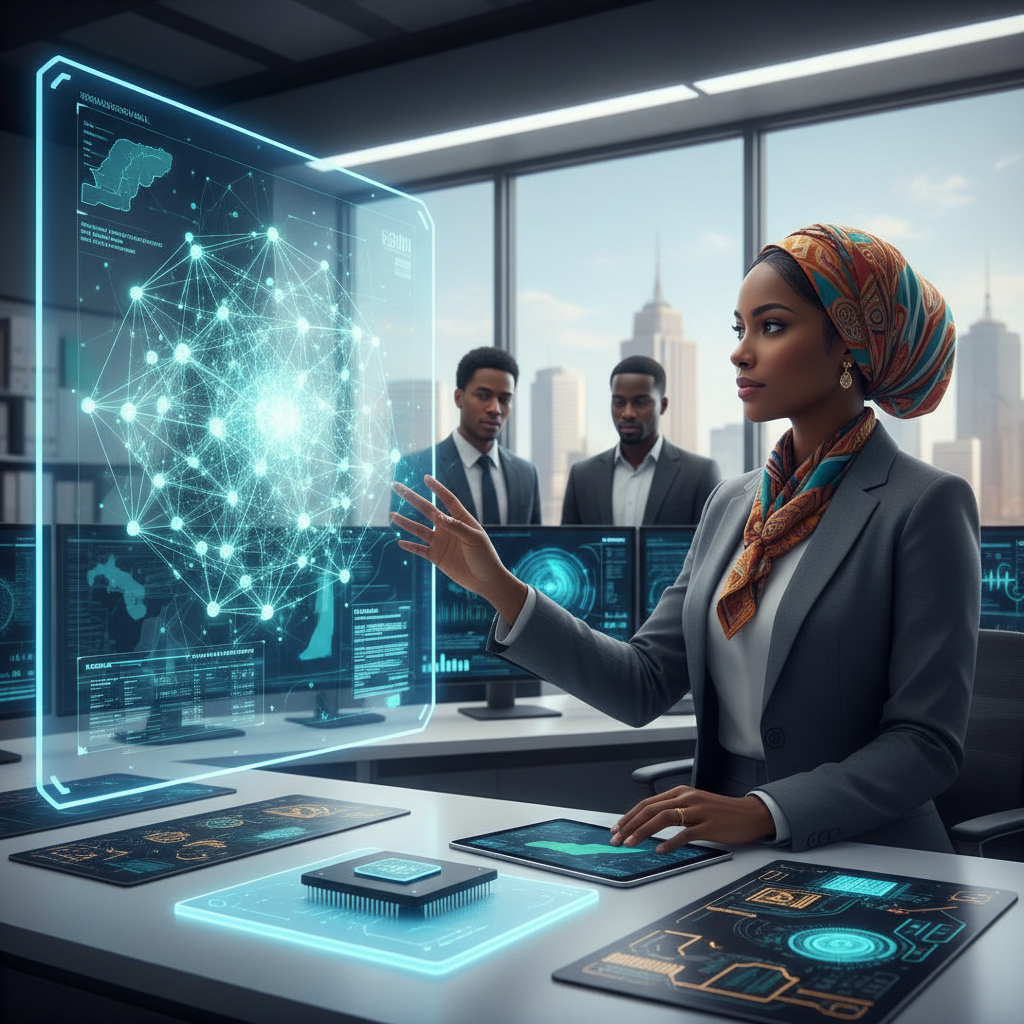

I remember sitting in a taxi on Louis Botha Avenue, the morning sun just beginning to paint the Joburg skyline in hues of orange and grey. The radio was buzzing with talk of the latest AI breakthroughs, and the driver, an older man named Thabo, sighed. "Amahlé," he said, "they say these machines will take our jobs. First the factories, now maybe even the people in fancy offices. What will become of us?"
Thabo's question, born of a genuine concern for his livelihood and community, echoes a sentiment felt far beyond the taxi ranks of Johannesburg. It's a question that cuts to the heart of what we call 'white-collar automation' and it’s something we, in South Africa and across the continent, need to understand deeply. It's not just about robots on assembly lines anymore. It's about sophisticated algorithms performing tasks once thought exclusive to human intellect, impacting sectors from law and finance to consulting and journalism.
What is White-Collar Automation?
At its core, white-collar automation refers to the use of artificial intelligence, machine learning, and robotic process automation (RPA) to perform tasks traditionally carried out by human knowledge workers. Think of the tasks that require cognitive abilities, data analysis, decision-making, and communication. Historically, these were seen as immune to automation, unlike the repetitive physical labor of blue-collar jobs. Today, that line is blurring faster than a Gautrain speeding through the highveld.
It's not about a physical robot sitting at a desk, though humanoid robots like those from Figure AI are certainly advancing. Instead, it's often about software bots, advanced algorithms, and large language models like OpenAI's GPT or Anthropic's Claude, working behind the scenes. They can draft legal documents, analyze financial reports, generate marketing copy, conduct market research, and even write news articles. This isn't just a tech story because it's a justice story, touching on livelihoods, economic equity, and the very structure of our societies.
Why Should You Care?
Here's the thing nobody's talking about enough, especially in our context: the impact of white-collar automation is global, but its effects are not evenly distributed. For a country like South Africa, with high unemployment rates and a persistent digital divide, understanding this phenomenon is critical. Our young people are striving for jobs in these very sectors, hoping to build a better life. If those jobs are being fundamentally reshaped or even eliminated by AI, we need to adapt, and quickly.
Consider the consulting industry. Firms like McKinsey and Accenture have reportedly been using AI tools to streamline research, data analysis, and report generation, leading to smaller teams and faster project completion. For law offices, AI can sift through thousands of legal documents for e-discovery in minutes, a task that once took paralegals weeks. Newsrooms are using AI to generate basic news reports, transcribe interviews, and even personalize content delivery. This isn't science fiction, it's happening right now, and it directly impacts the career paths of our graduates and the economic stability of our families.
How Did It Develop?
The seeds of white-collar automation were sown decades ago with the advent of early expert systems and rule-based software. However, the true acceleration began with the explosion of data, increased computational power, and breakthroughs in machine learning, particularly deep learning. The ability of AI to recognize patterns in vast datasets, learn from examples, and generate human-like text or insights has transformed its capabilities.
The development of large language models (LLMs) in the last few years has been a game-changer. Companies like Google with their Gemini models, and Microsoft integrating OpenAI's GPT into products like Copilot, have made these powerful tools accessible to businesses worldwide. This shift from AI as a niche academic pursuit to a mainstream business tool has been remarkably swift, catching many off guard.
How Does It Work in Simple Terms?
Imagine you have a very diligent, incredibly fast assistant who never sleeps and has read every book, report, and email ever written. That's a simplified way to think about AI in white-collar automation. For example, if you're a lawyer, instead of manually reviewing thousands of pages of contracts, an AI system can scan them, identify key clauses, flag anomalies, and even suggest revisions based on past cases. It's like having a super-powered intern who can process information at light speed.
In a newsroom, an AI might take raw data from a financial report, identify the most important figures, and then write a concise summary article, complete with headlines, in a matter of seconds. It's not creating original investigative journalism, but it's handling the routine, data-heavy reporting that frees up human journalists for more complex, nuanced storytelling. It's about automating the predictable and repetitive cognitive tasks.
Real-World Examples
- Legal Tech: Companies like LegalZoom and Ross Intelligence (though Ross has faced challenges) use AI to automate legal research, contract review, and even predict case outcomes. This can significantly reduce costs and time for routine legal tasks, making legal services more accessible, but also potentially reducing the need for entry-level legal professionals.
- Financial Services: Banks and investment firms deploy AI for fraud detection, algorithmic trading, and personalized financial advice. JP Morgan Chase, for instance, has reportedly used AI to analyze commercial loan agreements, saving thousands of hours of manual work. This means fewer human hours spent on document review and more on complex client relationships or strategic planning.
- Consulting and Business Process Outsourcing (BPO): Global consulting giants and BPO firms, many of whom have significant operations in South Africa, are leveraging AI to automate data collection, analysis, and report generation. This streamlines operations, but also means that the workforce needed to perform those tasks might shrink or require different skills. For example, a global consulting firm might use an AI to quickly synthesize market trends from various sources, a task that previously required a team of junior analysts.
- Journalism and Content Creation: News organizations like The Associated Press have been using AI to generate earnings reports and sports recaps for years. Tools like Jasper and Copy.ai assist marketers and content creators in drafting emails, social media posts, and blog articles. While human oversight is still crucial for accuracy, tone, and ethical considerations, the sheer volume of content that can be produced is staggering.
Common Misconceptions
One big misconception is that AI will replace all white-collar jobs entirely. While some roles may be fully automated, the more likely scenario is that AI will augment human capabilities, changing the nature of jobs rather than eliminating them wholesale. The focus shifts from performing repetitive tasks to managing AI systems, interpreting their outputs, and engaging in creative problem-solving that AI still struggles with.
Another myth is that AI only affects low-skill jobs. White-collar automation proves this wrong. Highly educated professionals in fields requiring extensive data processing and pattern recognition are very much in the crosshairs. The challenge is not just for the 'unskilled' but for everyone to upskill and adapt.
What to Watch for Next
The trajectory of white-collar automation is clear: it will continue to expand. We need to watch how governments and educational institutions respond. Will we see widespread reskilling initiatives? How will labor laws adapt to a world where AI is a co-worker? What role will African innovation play in shaping these tools, ensuring they serve our unique needs and values, rather than simply importing solutions from Silicon Valley?
For us in South Africa, the concept of Ubuntu, "I am because we are," offers a powerful lens through which to view this. How can we ensure that AI's advancements benefit the collective, rather than exacerbating inequalities? We must advocate for policies that prioritize human dignity and prepare our workforce for the jobs of tomorrow, not just mourn the jobs of yesterday.
Let that sink in. The future of work is not just about technology, it's about humanity, and our collective responsibility to shape it justly. We must demand that our leaders and our innovators build an AI future that uplifts everyone, from the taxi driver on Louis Botha to the CEO in Sandton. The conversation starts now, and we must all be part of it.
For more insights into how AI is transforming industries globally, you can explore reports and analyses on MIT Technology Review and Reuters Technology. The ongoing discussions about AI's impact on labor are also frequently covered by outlets like TechCrunch. We also have an article on When Algorithms Clash With Livelihoods: Why Sri Lanka's Unions Are Not Silenced by Silicon Valley's AI Promises [blocked] that touches on similar themes of AI and labor.