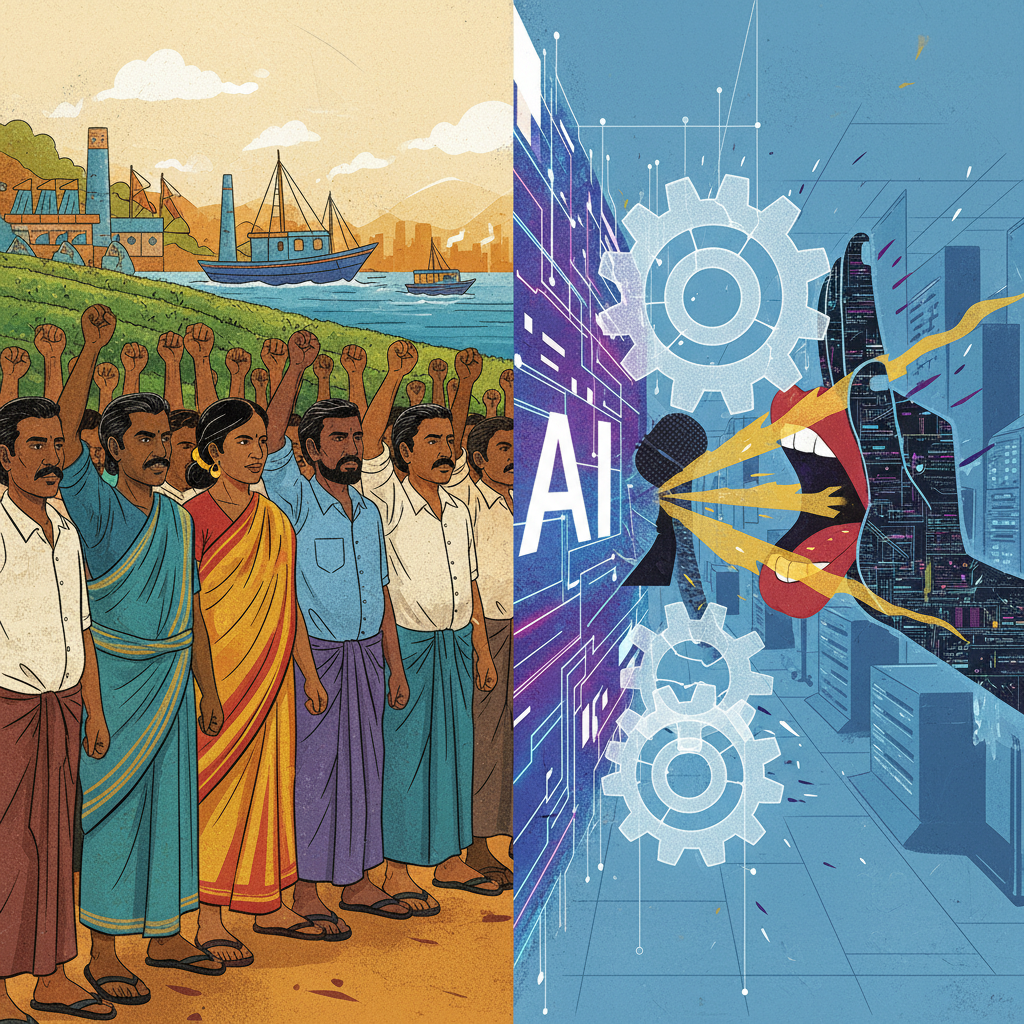

The narrative from Silicon Valley is consistent, almost liturgical: artificial intelligence, we are told, will usher in an era of unprecedented productivity, freeing humanity from mundane tasks and elevating our collective potential. From Google's Gemini to OpenAI's GPT models, the message is one of inevitable progress. Yet, here in Sri Lanka, and indeed across much of Asia, a different story is unfolding, one where the gleaming promises of AI clash sharply with the stark realities of livelihoods threatened and futures uncertain. I have been tracking this for months, observing the quiet, yet persistent, resistance brewing in workshops, factories, and offices.
The rhetoric of efficiency and innovation, while compelling in boardrooms, often fails to account for the human cost. For decades, the global South has been a vital cog in the machinery of global supply chains, providing the labor that fuels industries from textiles to data processing. Now, as AI-driven automation gains traction, these very workforces find themselves on the precipice of significant disruption. The idea that AI will simply create new, better jobs is a comforting thought, but it is one that often lacks concrete evidence, particularly in economies where retraining infrastructure is nascent and social safety nets are threadbare. Here's what the data actually shows: a disproportionate impact on routine, process-driven roles, many of which are concentrated in developing nations.
Consider the garment industry, a cornerstone of Sri Lanka's economy, employing hundreds of thousands. Automation, driven by advanced robotics and AI vision systems, can now perform tasks once requiring skilled human hands, from cutting fabric to quality control. While some argue this will lead to higher-value jobs in machine maintenance or AI supervision, the sheer volume of displaced workers presents an immediate, unaddressed challenge. "We are not against technology," states Palitha Fernando, General Secretary of the Free Trade Zones and General Services Employees Union, a formidable voice for workers' rights in Sri Lanka. "But when technology arrives without a plan for our people, without investment in their future, it becomes a weapon against them. We demand a seat at the table, not just a notice of redundancy." His words echo a sentiment gaining momentum globally, from the docks of Los Angeles to the manufacturing hubs of Vietnam.
This pushback is not merely a knee-jerk reaction to change; it is a calculated response born of historical experience. Labor unions, often caricatured as Luddites, are in fact demonstrating a shrewd understanding of power dynamics. They recognize that the deployment of AI is not a neutral technical process, but a socio-economic one with profound implications for wealth distribution and worker agency. When companies like Amazon deploy AI-powered inventory management and robotic systems in their warehouses, the immediate effect is often a reduction in human staff and an intensification of work for those remaining, monitored by algorithms that prioritize speed over human well-being. The promises don't match the reality for many on the shop floor.
Anticipating counterarguments, proponents of AI often point to the long history of technological progress, arguing that every industrial revolution has ultimately led to more jobs, not fewer. They cite the agricultural revolution, the industrial revolution, and even the rise of the internet as precedents where initial job displacement was followed by unprecedented economic growth and new forms of employment. They might also argue that AI will make businesses more competitive, securing existing jobs and creating new opportunities through economic expansion. Indeed, some economists predict a net positive impact on employment in the long run, albeit with significant short-term disruption.
However, this historical analogy, while superficially appealing, overlooks critical distinctions. Previous technological shifts often involved a gradual transition, allowing societies time to adapt and retrain their workforces. The current pace of AI development, particularly in generative AI and advanced robotics, is far more rapid and pervasive. Moreover, the nature of the jobs being created by AI often requires specialized skills not easily acquired by displaced workers, especially those in manual or low-skill service sectors. The digital divide, already a significant challenge in countries like Sri Lanka, exacerbates this problem, making access to necessary retraining and education an uphill battle. We cannot simply assume that a tea plucker or a data entry clerk will seamlessly transition into an AI prompt engineer or a robotics technician without substantial, systemic support.
Furthermore, the benefits of AI-driven productivity gains are not always equitably distributed. Often, these gains accrue disproportionately to capital owners and highly skilled professionals, widening the already vast chasm of income inequality. This is not just an economic issue; it is a social and political one. Unchecked automation without robust social policies risks creating a large, disenfranchised underclass, fueling social unrest and instability. The lessons from the 2008 financial crisis, where the burden of economic restructuring fell heavily on ordinary citizens, should serve as a stark reminder of the dangers of prioritizing corporate efficiency over societal well-being.
The response from labor movements is therefore not merely about resisting change; it is about demanding a just transition. Unions are increasingly advocating for policies that include mandatory retraining programs, universal basic income experiments, shorter workweeks, and a greater share of automation profits for workers. They are pushing for collective bargaining agreements that include clauses on AI deployment, ensuring transparency, consultation, and safeguards against arbitrary job losses. In some sectors, like the entertainment industry in the West, unions have already secured agreements on the ethical use of AI, setting a precedent for other industries to follow. This is a critical development, as the power to shape the future of work must not reside solely with technology developers and corporate executives.
For Sri Lanka, a nation still grappling with economic recovery and structural reforms, the impact of AI automation is a double-edged sword. While AI offers potential for growth in areas like agricultural optimization or smart infrastructure, its unmanaged deployment in labor-intensive sectors could destabilize the very foundations of our economy. The government, alongside employers, has a moral and economic imperative to engage with labor unions, not to sideline them. Dialogue, not dismissal, is the path forward.
As AI continues its inexorable march into every facet of our lives, the question is not whether automation will happen, but how it will happen, and for whose benefit. The voices of labor unions, often dismissed as relics of a bygone era, are proving to be prescient and powerful. They are reminding us that technology is a tool, and like any tool, its impact depends on the hands that wield it and the purpose it serves. Ignoring these voices, particularly in developing economies, would be a profound miscalculation, potentially trading short-term efficiency gains for long-term social upheaval. The future of work, and indeed the future of our societies, hinges on our ability to navigate this technological transformation with empathy, foresight, and genuine collaboration. More insights on the societal impact of AI can be found on Wired's AI section. For a broader perspective on AI's business implications, Reuters Technology offers valuable analysis.