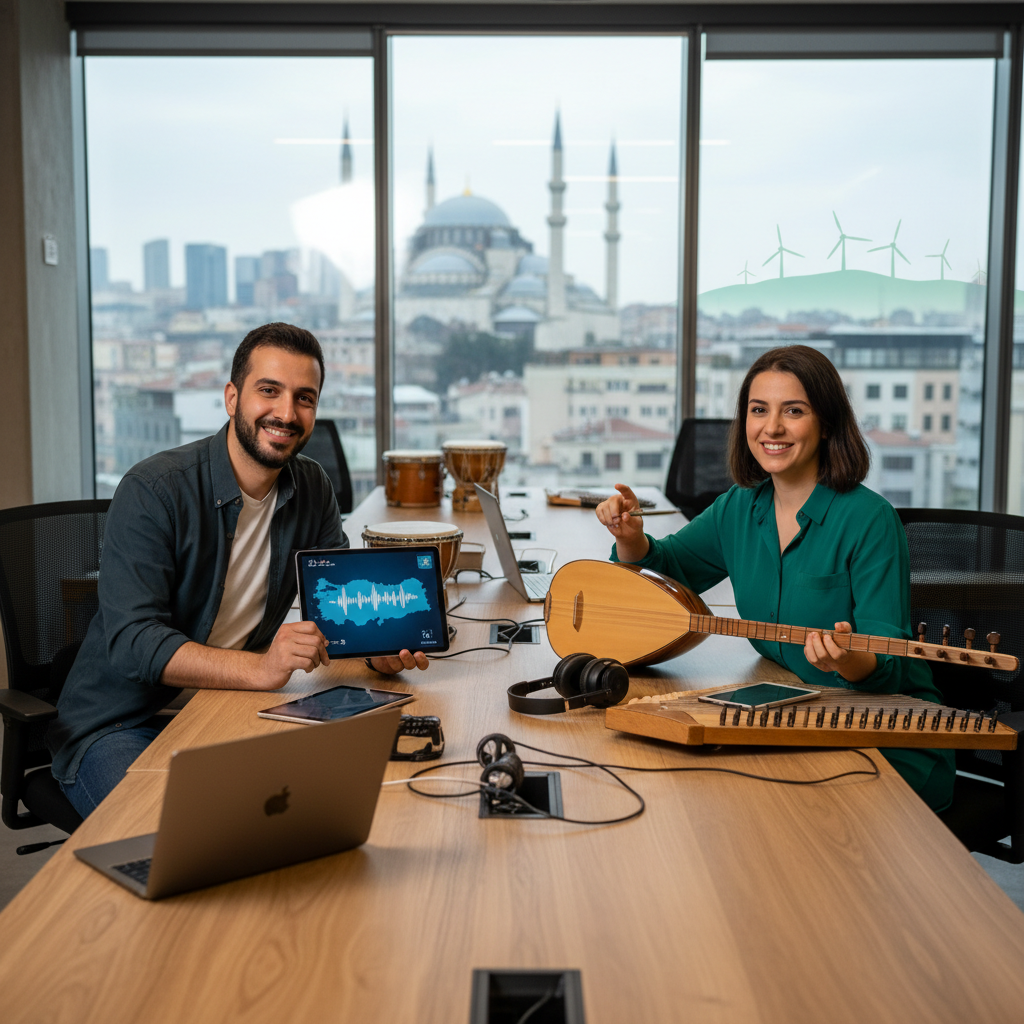

The scent of freshly brewed Turkish coffee still lingers in the air as I reflect on my conversation with Elif Aksoy and Can Demir, the brilliant minds behind MusiGenie. We met in a cozy cafe in Kadıköy, the vibrant heart of Istanbul's Asian side, a place where ancient traditions blend seamlessly with modern life. It felt fitting, really, because their startup, MusiGenie, is doing something remarkably similar: blending the deep, soulful heritage of Turkish music with the cutting-edge possibilities of artificial intelligence.
For months now, the global music industry has been in a state of existential angst. Headlines scream about AI-generated tracks topping charts, artists feeling threatened, and a looming crisis of authenticity. From Drake deepfakes to virtual pop stars, the conversation often feels like a doomsday prophecy for human creativity. But Elif and Can, with their warm smiles and infectious optimism, see not a crisis, but an opportunity, especially for cultures often overlooked by the Western-centric tech gaze.
The Genesis of a Turkish AI Symphony
Elif, a classically trained kemençe player with a Ph.D. in computational musicology from Boğaziçi University, recounted her 'aha' moment. "I was working on an algorithm to analyze makam, the intricate melodic modes of Turkish classical music, for my thesis," she explained, gesturing expressively. "The system could identify patterns, predict progressions, but it lacked soul. It was technically perfect, yet emotionally hollow." Can, her long-time friend and a software engineer who had spent years at a prominent e-commerce giant before returning to Istanbul, chimed in. "That's where I came in. I saw the potential to not just analyze, but to generate, to create new compositions that respected the rules of makam but introduced novel variations." He spoke with the quiet confidence of someone who understands the complex dance between code and creativity.
Their shared vision was clear: to build an AI that could understand, learn, and then compose music, particularly focusing on the rich, nuanced traditions of Turkish and Middle Eastern sounds, which are often underrepresented in mainstream AI music models. They wanted to empower artists, not replace them. "Istanbul bridges two worlds and so does its AI scene," Elif told me, a sentiment that perfectly encapsulates their mission. "We're not just building technology; we're building a bridge for our cultural heritage to the future."
The Problem They're Harmonizing
The music industry's current dilemma is multifaceted. On one hand, there's the sheer volume of AI-generated content, much of it generic, flooding platforms like Spotify and YouTube. On the other, there's a genuine need for tools that can assist human artists, especially independent ones, in production, composition, and even finding new creative directions. For artists working within niche genres or non-Western musical traditions, these tools are even scarcer. Existing AI music platforms often default to Western scales and structures, making it challenging to generate authentic Turkish folk or classical pieces.
MusiGenie addresses this by focusing on cultural specificity. Their AI is trained on vast datasets of Turkish folk, classical, and contemporary music, incorporating elements like makam, usul (rhythmic patterns), and traditional instrumentation. This allows it to generate music that doesn't just sound