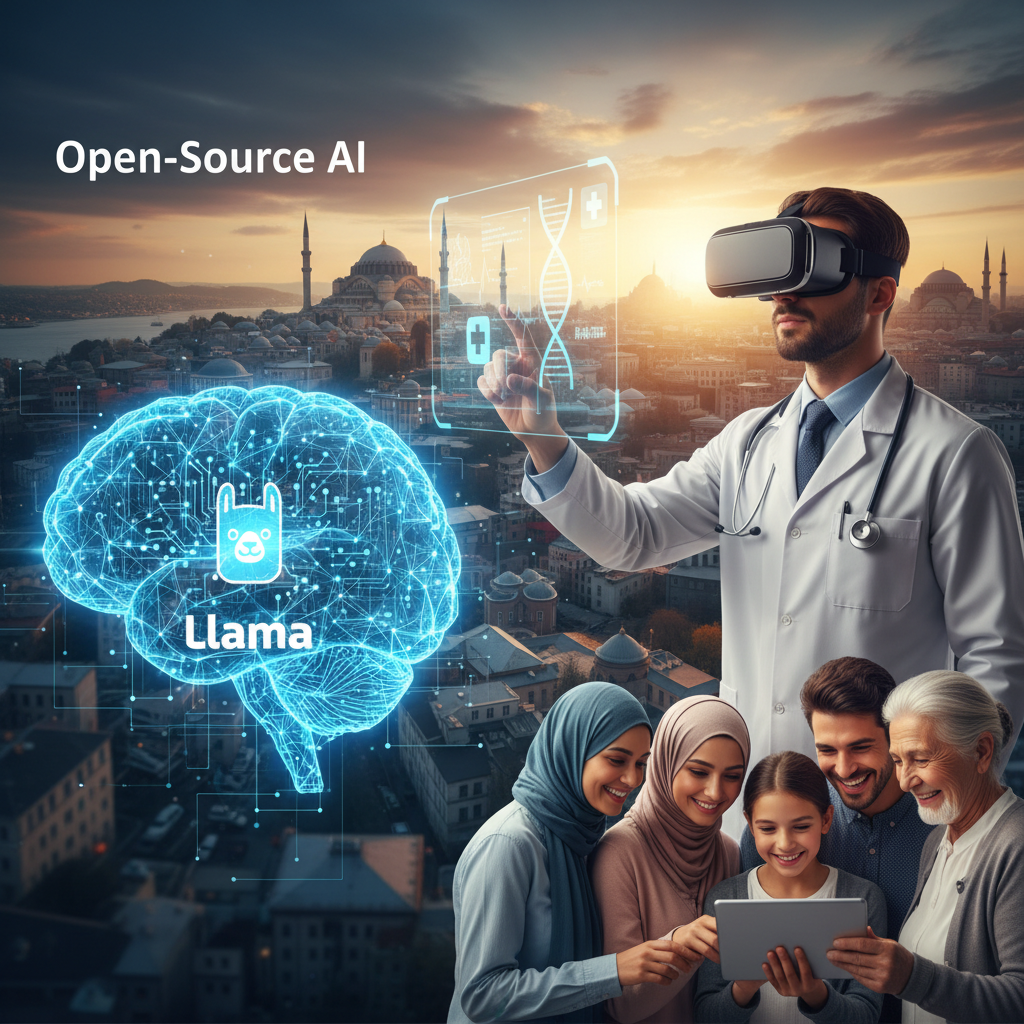

From the bustling Grand Bazaar to the quiet corners of a village clinic in Anatolia, the promise of artificial intelligence feels both distant and incredibly close. We see the gleaming headlines about breakthroughs from Silicon Valley, often wondering how these powerful technologies will truly touch our lives, especially in something as personal as our health. Many of these advancements come from companies like OpenAI and Google, whose sophisticated AI models are largely kept under wraps, guarded secrets of innovation. But there is another path emerging, one that speaks to the spirit of collaboration and shared knowledge: the open-source AI movement.
What is Open-Source AI?
At its heart, open-source AI means that the underlying code, the very 'brain' of the artificial intelligence model, is made publicly available. Think of it like a traditional Turkish recipe passed down through generations. Instead of a chef keeping their secret spice blend to themselves, they share it freely, allowing others to adapt, improve, and create their own variations. In the world of AI, this means developers, researchers, and even ordinary citizens can access, modify, and distribute the software. Meta's Llama series, particularly Llama 2 and the more recent Llama 3, stands as a prominent example of this philosophy in action, contrasting sharply with the proprietary, 'closed' models offered by companies such as OpenAI with its GPT series and Google with its Gemini models.
Why Should You Care?
Why does this matter to you, whether you are a doctor in Kadıköy or a student in İzmir? The answer lies in accessibility, innovation, and trust. When AI models are open, they become tools for everyone, not just a select few. Imagine a small startup in Ankara wanting to develop an AI diagnostic tool for a rare disease. With a closed model, they might face prohibitive costs or be limited by the provider's terms. With an open-source model, they can download it, fine-tune it with their specific data, and build their solution without permission or exorbitant fees. This democratizes AI development, fostering a vibrant ecosystem of innovation. Moreover, the transparency of open-source code allows for greater scrutiny, helping us understand how these powerful systems make decisions, which is crucial for building trust, especially in sensitive areas like healthcare. As Professor Ayşe Karaca, a leading AI ethics researcher at Boğaziçi University, told me over Turkish tea, "Transparency is not just a technical feature, it is the bedrock of public confidence in AI, particularly when it touches human well-being."
How Did It Develop?
The concept of open source is not new; it has roots in the free software movement of the 1980s and 1990s. For years, open-source software like Linux has powered everything from smartphones to supercomputers. In AI, this philosophy gained significant traction as large language models (LLMs) began to demonstrate incredible capabilities. Initially, many of the most powerful LLMs were developed and kept proprietary by large tech companies. However, Meta made a significant move by releasing Llama in 2023, followed by Llama 2 and Llama 3, under licenses that allowed for broad commercial and research use. This decision was a game-changer, igniting a new wave of open-source AI development and challenging the dominance of closed-source giants. This shift has been widely discussed in the tech community, with many seeing it as a pivotal moment for the future of AI TechCrunch.
How Does It Work in Simple Terms?
Think of an AI model as a very complex student who has read millions of books and articles. A closed model is like this student attending an exclusive, private university where their notes and learning methods are kept secret. You can ask them questions, and they will give you answers, but you cannot see how they arrived at those answers or teach them new things yourself. You are simply consuming their output.
An open-source model, on the other hand, is like a student whose entire library, notes, and learning techniques are available to everyone. You can see what books they read, how they connected ideas, and even teach them new subjects or correct their misunderstandings. You can then take their knowledge base and apply it to your specific needs, perhaps focusing their learning on medical textbooks if you are building a healthcare AI. This fundamental difference allows for customization, auditability, and independent improvement.
Real-World Examples in Healthcare
The impact of open-source AI in healthcare is already tangible and growing:
-
Personalized Medicine in Local Clinics: Imagine a small clinic in a Turkish town, perhaps in Gaziantep, where doctors use an open-source Llama-based model, fine-tuned with local patient data, to identify subtle patterns in medical records. This could help them predict disease progression or suggest personalized treatment plans, tailored to the regional demographics and common health issues. This level of customization would be difficult and costly with proprietary models.
-
Drug Discovery for Neglected Diseases: Researchers at a university in Istanbul could leverage an open-source LLM to sift through vast amounts of scientific literature and chemical databases, accelerating the identification of potential drug candidates for diseases that might not attract large pharmaceutical investments. The ability to freely modify and extend the model's capabilities is crucial here.
-
Medical Imaging Analysis for Remote Areas: In more remote parts of Turkey, where specialist radiologists might be scarce, open-source AI models can be adapted to analyze X-rays or MRI scans, flagging potential anomalies for general practitioners. This acts as a crucial first line of defense, improving access to early diagnosis and reducing the burden on central hospitals.
-
Healthcare Chatbots and Patient Education: Open-source models can power localized, culturally sensitive chatbots that answer patient questions, provide information about common ailments, or guide them through post-operative care instructions, all in their native language and dialect. This can significantly improve patient engagement and understanding.
Common Misconceptions
One common misconception is that open-source means less secure or lower quality. This is often not true. Because the code is open, a global community of developers can scrutinize it, identify vulnerabilities, and contribute fixes, often leading to more robust and secure software. Another misconception is that open-source models are always 'free' in every sense. While the software itself might be free to use, deploying and maintaining these models, especially large ones, still requires significant computing resources and expertise. However, the absence of licensing fees and the freedom to modify the code offer substantial advantages.
What to Watch For Next
The open-source AI movement is still evolving rapidly. We are seeing a proliferation of new models, better tools for fine-tuning, and a growing community of contributors. The competition between open and closed models will likely drive both sides to innovate faster, offering better performance, greater safety, and more specialized applications. We should watch for how governments and regulatory bodies, including those here in Turkey and across Europe, respond to this dichotomy. Will they favor transparency and open access, or will they lean towards controlled, proprietary systems, especially in critical sectors like healthcare? The choices made today will shape the future of AI for generations. Istanbul bridges two worlds and so does its AI scene, constantly navigating between global trends and local needs. The open-source movement, with models like Meta's Llama, represents an exciting opportunity to bridge that gap and ensure that the benefits of AI are truly shared by all.
This is not just about technology; it is about people, their health, and their future. The ability to harness and adapt AI, rather than just consume it, is a powerful step towards a more equitable and innovative world. The crossroads of innovation are here, and open-source AI is paving a new path forward for us all, from the smallest startup to the largest hospital, ensuring that the power of artificial intelligence is truly in the hands of many, not just a few. For more insights into the broader implications of AI, you might find articles on MIT Technology Review helpful.