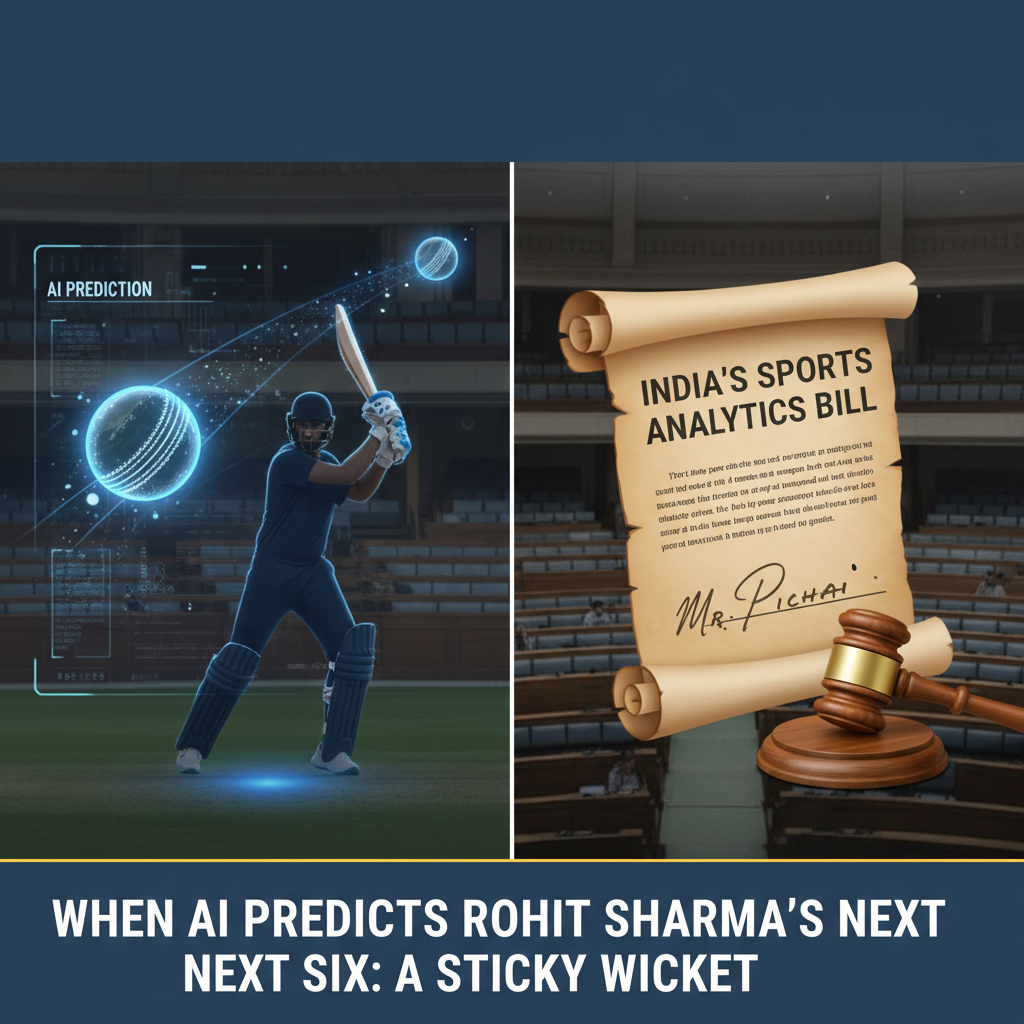

You know, for a country that breathes cricket and lives for its kabaddi heroes, it was only a matter of time before the government decided to have a say in how we analyze our beloved games. The latest buzz from New Delhi is the proposed 'AI in Sports Analytics and Integrity Bill, 2026' and frankly, it feels like we are trying to catch a bouncer with a buttered glove. The idea, apparently, is to bring some order to the wild west of AI applications in sports, from predicting player fatigue to enhancing fan engagement through personalized content. But as always, the devil is in the details, and this bill has more horns than a Kerala temple elephant.
The policy move itself is a response to the rapid proliferation of AI tools in Indian sports. We have seen a surge in startups offering everything from advanced biomechanical analysis for cricketers to AI-driven scouting for football clubs. Data is being crunched faster than a papadum at a wedding, promising to unlock new levels of performance and prevent career-ending injuries. The government, through the Ministry of Youth Affairs and Sports, says it wants to ensure fairness, data privacy, and prevent algorithmic bias. They are particularly concerned about the potential for AI to be misused in betting or to unfairly disadvantage athletes based on opaque algorithms. Oh, the irony, considering some of the opaque decision-making we see in other sectors, but I digress.
Who is behind this ambitious, or perhaps overzealous, legislative push? Primarily, it is a joint effort by the Ministry of Youth Affairs and Sports, with significant input from the Ministry of Electronics and Information Technology. The driving force, according to sources I spoke with in the capital, is a growing unease about the lack of oversight. "We cannot allow a free-for-all where algorithms dictate careers and potentially compromise the integrity of our national sports," stated Mr. Rajesh Kumar, Joint Secretary for Sports Policy, during an off-the-record briefing. "This bill aims to establish clear guidelines for data collection, algorithmic transparency, and accountability, ensuring that technology serves the sport, not the other way around." He pointed to incidents in other countries, without naming specifics, where AI models were accused of racial bias in talent identification or where player data was allegedly exploited commercially without consent. It is a valid concern, mind you, but the proposed solutions often feel like using a sledgehammer to crack a coconut.
So, what does this mean in practice for the burgeoning sports tech ecosystem in India? For starters, any entity using AI for player performance analysis, injury prediction, or fan engagement will need to register with a newly formed 'National AI Sports Analytics Board' (nasab). This board will be tasked with auditing algorithms, certifying data security protocols, and ensuring compliance with privacy standards akin to our existing data protection laws. Companies will have to submit detailed impact assessments, explain their models' methodologies, and provide mechanisms for athletes to access and challenge their own data. Imagine a young bowler in Chennai, whose career trajectory is being shaped by an algorithm, suddenly having the right to demand a full explanation of how that AI reached its conclusions. It sounds good on paper, but the bureaucratic hurdles could be monumental. "The compliance burden alone could stifle innovation for smaller startups," warned Dr. Anjali Sharma, CEO of 'SportSense AI', a Bengaluru-based firm specializing in cricket analytics. "We are already competing with global giants like Google and NVIDIA in terms of resources. Adding layers of regulatory approval will make it incredibly difficult to scale and innovate quickly." Her company uses sophisticated computer vision and machine learning models to analyze bowling actions and batting techniques, providing instant feedback to coaches. The thought of submitting their proprietary algorithms for government review sends shivers down her spine.
The industry reaction, as you might expect, is a mixed bag of apprehension and cautious optimism. Larger players, particularly those with international operations, are already accustomed to navigating complex regulatory landscapes. "While challenging, clear regulations can foster trust and create a more stable environment for investment," commented Mr. Vikram Singh, Head of AI Strategy for a major sports broadcasting network, which uses AI for personalized content delivery and real-time match insights. "We welcome a framework that protects athletes and fans, provided it is pragmatic and forward-looking, not just a knee-jerk reaction." However, many smaller firms, the innovative engines of our tech sector, are worried. They fear that the cost of compliance, the potential for intellectual property leakage during audits, and the sheer time involved in approvals could put them out of business. Some even suggest that it is a stealth tactic to favor larger, more established players, effectively creating a 'license raj' for AI in sports. File this under 'things that make you go hmm'.
Civil society groups, particularly those focused on digital rights and athlete welfare, have largely welcomed the initiative, albeit with caveats. "For too long, athletes' data has been treated as a commodity, with little transparency or agency for the individuals themselves," stated Ms. Priya Das, a legal expert from the 'Digital Rights India' foundation. "This bill is a crucial step towards ensuring that AI in sports is used ethically and responsibly. However, the implementation must be robust, and the Nasab must be truly independent, not just another government rubber stamp." She emphasized the need for athlete representation on the board and clear avenues for grievance redressal. The concerns around bias, particularly in a diverse country like India where regional variations in physique and technique are significant, are paramount. An AI trained predominantly on data from one demographic might inadvertently disadvantage athletes from another, perpetuating existing inequalities.
Will it work? That, my friends, is the million-dollar question, or perhaps the multi-crore rupee question. The intent is noble, no doubt. Protecting athletes, ensuring fair play, and safeguarding data are all commendable goals. However, the execution is where these grand plans often falter in India. The risk of creating a bureaucratic quagmire that stifles genuine innovation is high. We have seen it before, where well-meaning regulations become roadblocks rather than guardrails. The speed at which AI technology evolves means that any fixed set of rules could be obsolete before the ink even dries. The government needs to strike a delicate balance between oversight and fostering innovation. Perhaps a sandbox approach, allowing startups to test their solutions under controlled regulatory conditions, could be a more agile solution. MIT Technology Review has often highlighted the benefits of such adaptive regulatory models in other tech sectors, and India could learn a thing or two.
Ultimately, the success of the 'AI in Sports Analytics and Integrity Bill, 2026' will depend on its flexibility, the expertise of the Nasab, and its willingness to engage constructively with both industry and athletes. If it becomes another layer of red tape, we might just see India's promising sports tech talent looking for greener pastures, or rather, greener pitches, abroad. While Silicon Valley discovered what Kerala knew all along about the importance of community and local knowledge, perhaps Delhi needs to learn a thing or two about fostering innovation without smothering it. Otherwise, we might find ourselves with perfectly regulated, yet utterly stagnant, sports analytics, watching our competitors sprint ahead while we are still stuck in the starting blocks. For more insights on how AI is shaping global industries, you can always check out TechCrunch's AI section. The future of Indian sports, much like a crucial last-over chase, hangs in the balance, and it is not just about the algorithms, but about the wisdom behind the rules that govern them. For a broader perspective on AI's impact across various sectors, Wired's AI coverage is always a good read.