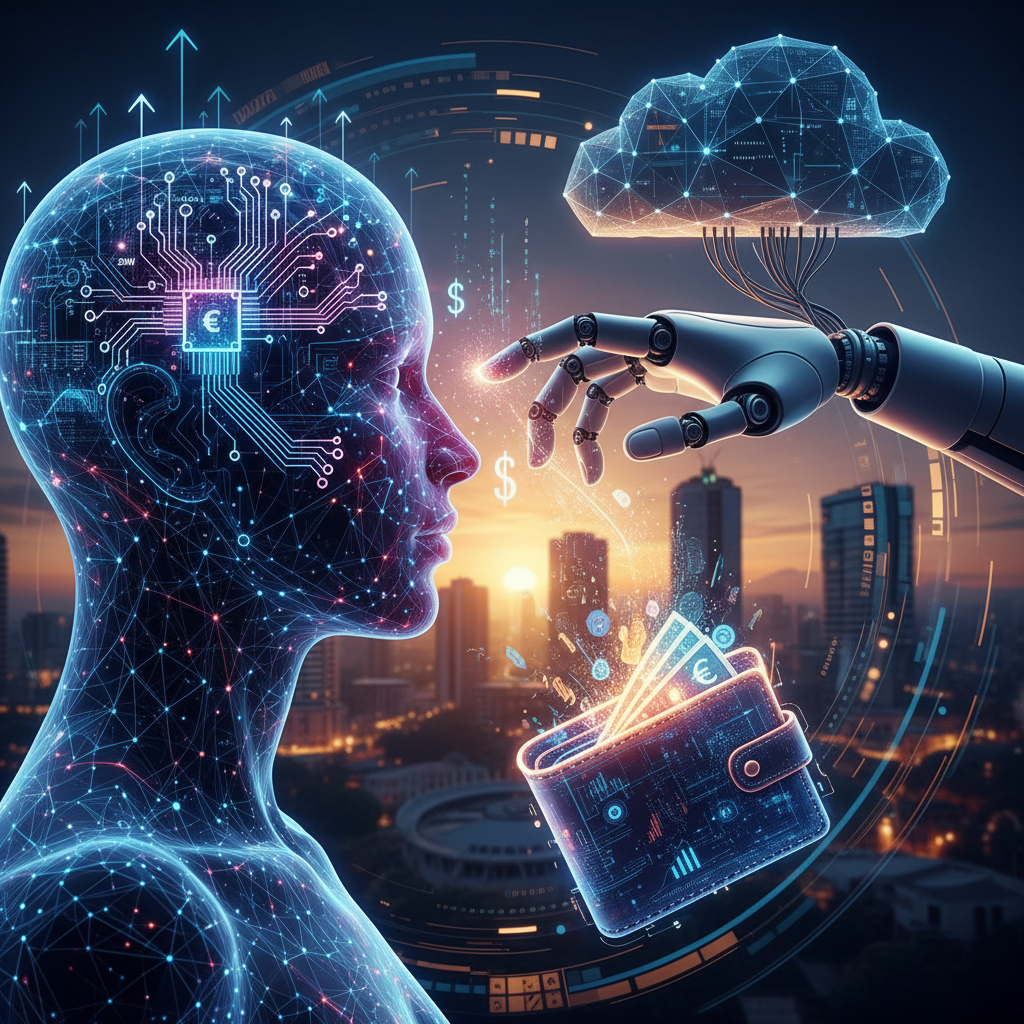

The sun was just beginning its descent over the bustling streets of Lusaka, painting the sky in shades of orange and purple, when my cousin, Chanda, showed me his phone. On the screen, a sleek, minimalist interface displayed his investment portfolio, managed entirely by an AI. "Lindiwe," he said, his eyes gleaming with a mix of pride and a touch of unease, "this thing made me 15% last quarter. All I do is approve its suggestions." He was talking about a new breed of robo-advisors, digital platforms powered by artificial intelligence that offer automated, algorithm-driven financial planning services with minimal human intervention. They are increasingly making their way into Zambia, promising democratized access to investment opportunities previously reserved for the wealthy. But as these algorithms take the reins of our financial futures, what is happening to our human brains, our decision-making, and our very understanding of money?
It is a question that has kept me pondering, especially as I see more young Zambians, those who grew up with smartphones glued to their palms, embracing these tools. The promise is tempting: lower fees, diversified portfolios, and the removal of emotional biases that often plague human investors. In a twist that surprised absolutely no one, the global financial industry has been quick to adopt AI. From high-frequency algorithmic trading on Wall Street that executes millions of trades per second, to sophisticated AI models assessing credit risk for micro-loans in rural communities, the machines are here. Companies like BlackRock, through its Aladdin platform, have been leveraging AI and machine learning for risk management and portfolio optimization for years, influencing trillions of dollars globally. Locally, while we might not have the same scale, the impact is just as personal.
Psychologically, the allure of the robo-advisor is powerful. It offers a sense of control without requiring deep financial literacy, a kind of 'set it and forget it' approach to wealth building. This can be particularly appealing in markets like Zambia, where traditional financial advisory services can be expensive or inaccessible. However, this convenience comes with a cognitive trade-off. "When we delegate complex decision-making to AI, we risk what psychologists call 'automation bias,'" explains Dr. Natasha Phiri, a behavioral economist at the University of Zambia. "People tend to over-rely on automated systems, even when those systems provide incorrect or suboptimal advice. They trust the machine more than their own intuition or even contradictory evidence." She pointed to studies showing that individuals are less likely to question an AI's recommendation compared to a human's, even if the human is equally qualified. This phenomenon is not unique to finance, it is observed across various fields where AI is deployed, from healthcare diagnostics to autonomous driving.
This trust, while beneficial for efficiency, can erode critical thinking skills. If an AI consistently tells you what to do with your money, are you truly learning about market dynamics, risk tolerance, or long-term financial planning? Or are you simply becoming a button-pusher, a passive executor of algorithmic commands? The irony is almost too perfect: we seek financial freedom, but in doing so, we might be ceding cognitive autonomy. The concept of 'financial literacy' itself begins to shift. Is it about understanding P/E ratios and macroeconomic indicators, or is it about understanding how to interact with and critically evaluate an AI financial assistant?
Consider the emotional impact. Traditional investing involves a certain amount of emotional resilience. Market downturns are gut-wrenching, and celebrating gains feels earned. With AI, these emotional peaks and valleys are smoothed out. The machine makes the tough calls, rebalances the portfolio, and often, the human investor is shielded from the immediate psychological stress. While this sounds good, it might also prevent the development of emotional intelligence around money. "Learning to manage financial anxiety and make rational decisions under pressure is a crucial life skill," Dr. Phiri elaborated. "If AI removes that learning opportunity, what happens when the system inevitably faces an unprecedented black swan event, or when an individual needs to make a financial decision outside the AI's scope?" The recent volatility in global markets, partly influenced by geopolitical tensions and supply chain disruptions, has shown that even the most sophisticated algorithms can be caught off guard, highlighting the need for human oversight and understanding.
Beyond individual psychology, there are broader societal implications. As AI-driven financial tools become more prevalent, they have the potential to exacerbate existing inequalities if not carefully managed. Access to these sophisticated platforms often requires a certain level of digital literacy and internet connectivity, which are not uniformly distributed across Zambia. While some platforms are designed for low-cost entry, the digital divide remains a significant barrier. Furthermore, the data used to train these algorithms, often reflecting historical financial behaviors, might inadvertently perpetuate biases against certain demographics or regions. If an AI is trained on data primarily from urban, formally employed individuals, how accurately can it assess the risk profile of a small-scale farmer in a rural Zambian village, whose financial life operates on different rhythms and metrics?
Moreover, the rise of algorithmic trading on global exchanges, driven by massive players like Citadel Securities and Virtu Financial, creates a market environment where human intuition and slower, deliberate analysis are increasingly disadvantaged. These algorithms can detect patterns and execute trades at speeds unimaginable to humans, potentially leading to flash crashes or market instabilities that are difficult for human regulators to comprehend or control. This global algorithmic dance eventually trickles down, affecting interest rates, investment returns, and the overall economic landscape even in emerging markets like ours.
So, what is a Zambian to do in this brave new world of AI-driven finance? The answer, I believe, lies in a balanced approach. Embrace the efficiency and accessibility that robo-advisors offer, but do not surrender your cognitive faculties entirely. Think of the AI as a powerful tool, not an infallible oracle. Educate yourself, even if it is just the basics, about how these systems work and the principles of investing. Question the recommendations, understand the underlying logic, and always maintain a healthy skepticism. "Financial education needs to evolve," says Mr. David Banda, CEO of a local fintech startup that offers AI-powered micro-lending. "It is no longer just about understanding compound interest, but about understanding algorithmic transparency and data privacy as well." His company, which uses AI for risk assessment in underserved communities, emphasizes user education as a core part of its service. You can learn more about how AI is shaping various industries by visiting MIT Technology Review.
For policymakers and regulators, the challenge is immense. How do you regulate an opaque algorithm? How do you protect consumers from automation bias while fostering innovation? These are not easy questions, and the answers will require a collaborative effort between technologists, ethicists, and economists. The Bank of Zambia, for instance, has been cautiously exploring regulatory frameworks for fintech, but the pace of AI innovation often outstrips traditional legislative processes. The conversation around AI ethics, particularly in finance, is gaining traction globally, with organizations like the Financial Stability Board and the International Monetary Fund publishing reports on the potential risks and benefits. For more on the broader implications of AI, Wired offers insightful perspectives.
Ultimately, the integration of AI into our financial lives is inevitable. It offers unprecedented opportunities for growth and inclusion, particularly in developing economies. But as we hand over more of our decision-making to machines, we must consciously work to preserve our human agency, our critical thinking, and our emotional intelligence. The goal should not be to replace human judgment, but to augment it. My cousin Chanda, for all his excitement, still calls his human financial advisor for a second opinion on major life decisions. Perhaps that is the sweet spot: letting the algorithms handle the grunt work, while we humans retain the wisdom. For ongoing developments in AI and finance, Reuters Technology is a reliable source.