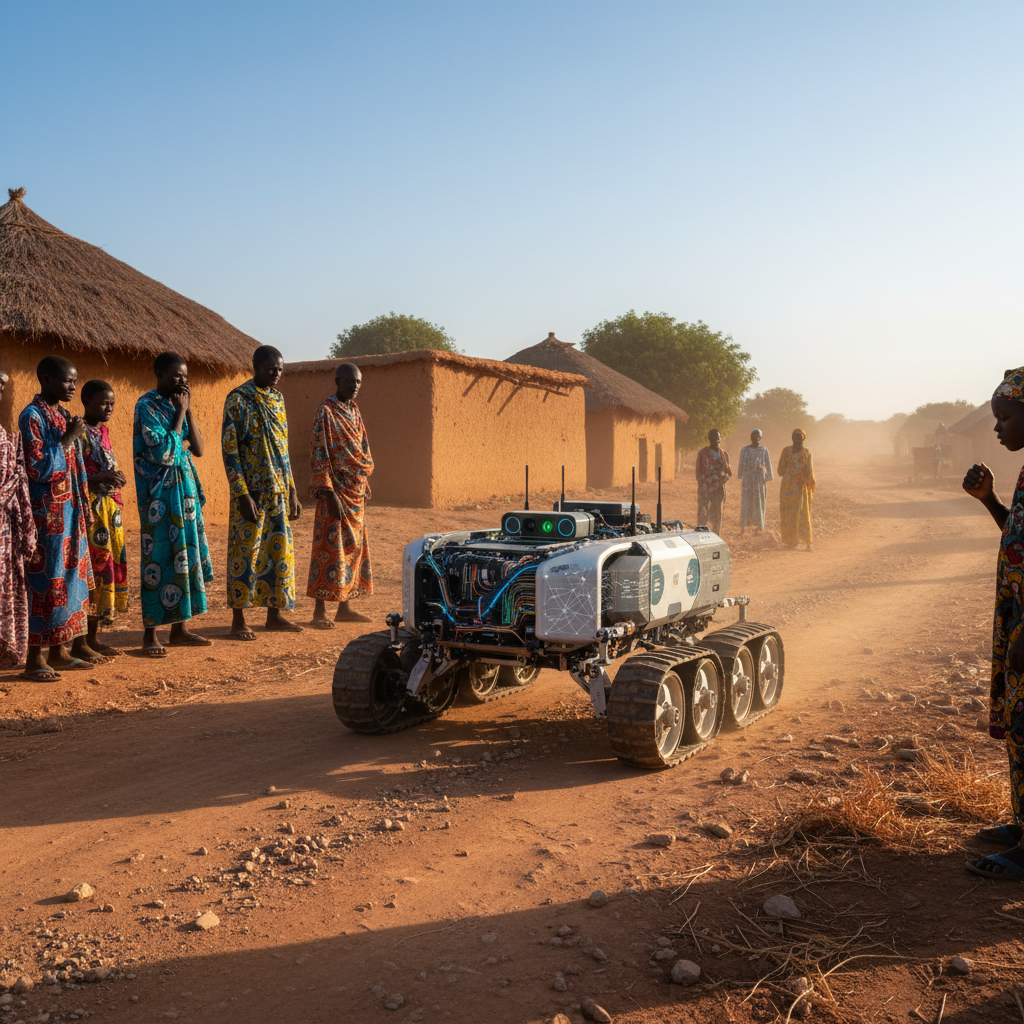

In Bamako, as in many global hubs, the promise of artificial intelligence echoes through our nascent tech communities. We hear of grand visions from companies like Google and NVIDIA, of AI transforming everything from agriculture to healthcare. Yet, the journey from a brilliant AI concept to a reliable, impactful deployment is often fraught with unseen challenges. This is where a concept like MLOps, and specifically platforms such as Weights & Biases, steps in. It is not about the theoretical elegance of an algorithm, but about its practical resilience and performance in the field.
What Exactly is MLOps, and Where Does Weights & Biases Fit In?
MLOps, or Machine Learning Operations, is a set of practices that aims to streamline the lifecycle of machine learning models. Think of it as the engineering discipline for AI. Just as DevOps brought efficiency and reliability to software development, MLOps seeks to do the same for machine learning. It encompasses everything from data collection and preparation, model training and validation, to deployment, monitoring, and ongoing maintenance. Without MLOps, AI projects often devolve into a chaotic mess of unversioned code, untracked experiments, and models that perform poorly once they leave the controlled environment of a research lab.
Weights & Biases, or W&B as it is commonly known, is a platform designed to be a central nervous system for MLOps. It provides tools for tracking experiments, visualizing model performance, managing datasets, and collaborating on machine learning projects. Imagine a bustling market in Djenné, where every vendor needs to keep track of their produce, their sales, and their inventory. W&B offers a similar level of meticulous organization for the complex, iterative process of AI development. It helps teams understand what worked, what did not, and why, preventing the costly repetition of mistakes.
Why Should We Care About MLOps and W&B in Mali and Beyond?
For regions like ours, where resources are often constrained and every investment must yield tangible benefits, the efficiency and reliability offered by MLOps are not luxuries, they are necessities. We have seen too many pilot projects, brimming with potential, falter due to a lack of systematic management. The data tells a different story than the optimistic press releases sometimes suggest. Without robust MLOps, AI initiatives can become black boxes, difficult to debug, impossible to scale, and ultimately, unsustainable.
Consider a project aiming to use AI for crop disease detection in rural Mali. A model might perform exceptionally well in a laboratory setting with clean, curated data. However, once deployed in the field, it encounters varying light conditions, different camera qualities from farmers' phones, and a wider range of disease manifestations. Without W&B, tracking these real-world performance discrepancies, retraining the model with new data, and deploying updates efficiently becomes an insurmountable task. This is why practical solutions, not moonshots, are what we desperately need. As Dr. Timnit Gebru, a prominent AI researcher, has often emphasized, the real-world implications of AI systems, particularly for marginalized communities, demand rigorous oversight and accountability. Her work consistently highlights the need for careful consideration of data, ethics, and deployment practices.
How Did MLOps Develop?
The journey to MLOps began as machine learning transitioned from academic research to industrial application. Early AI development was often a bespoke process, with individual researchers or small teams handling every aspect. As models grew more complex, data volumes exploded, and the demand for continuous deployment increased, this ad-hoc approach became untenable. Companies like Google, pioneers in large-scale AI deployment, were among the first to recognize the need for standardized practices. Their internal tools and methodologies eventually inspired the broader MLOps movement.
Weights & Biases itself emerged from this growing need. Founded in 2017 by Lukas Biewald, Chris Van Pelt, and Shawn Lewis, it quickly gained traction by offering a user-friendly, comprehensive platform for experiment tracking and model management. It addressed a critical gap: while there were many tools for building models, there were few for managing the entire lifecycle effectively. The platform has since become a staple for many AI teams, from startups to large enterprises, seeking to bring order to their machine learning workflows.
How Does It Work in Simple Terms? Analogies and Examples
Imagine you are building a traditional mud-brick house, a common sight in our villages. You mix the mud, form the bricks, lay them, and construct the walls. This is akin to training an AI model. Now, imagine you are building hundreds of these houses across different villages, each with slightly different soil, weather, and available materials. You need to keep track of which mud mix works best in which condition, how long the bricks take to dry, which designs withstand heavy rains, and how long each house lasts. This entire process of managing the construction, learning from each house, and improving future builds is MLOps.
Weights & Biases acts as your master builder's logbook. For every house, you record: what type of mud was used, how many bricks were made, who built it, how long it took, what challenges were faced, and how it performed over time. If a house collapses, you consult your logbook to understand why and adjust your methods for the next one. In the context of AI, W&B logs every experiment: the specific dataset used, the model architecture, the hyperparameters, the training metrics (accuracy, loss), and even the computational resources consumed. This detailed record allows developers to compare different versions of a model, understand the impact of changes, and reproduce past results, which is crucial for scientific rigor and practical deployment.
Real-World Examples of W&B in Action
-
Drug Discovery at Insilico Medicine: This Hong Kong-based AI company uses W&B to accelerate drug discovery. They train numerous generative AI models to identify novel molecules for various diseases. With W&B, they can track thousands of experiments, compare the efficacy of different molecular designs, and quickly iterate on their models, significantly reducing the time and cost associated with traditional drug development. The sheer volume of experiments makes a systematic tracking tool indispensable.
-
Autonomous Driving Development at Cruise: Developing self-driving cars involves training highly complex perception and prediction models. Companies like Cruise, a subsidiary of General Motors, generate vast amounts of data from real-world driving. W&B helps their machine learning engineers manage the hundreds of experiments needed to refine these models, ensuring that safety-critical components are thoroughly tested and continuously improved. Every tweak to an algorithm can have profound safety implications, demanding meticulous tracking.
-
Agricultural AI in India: Startups in India are leveraging AI for precision agriculture, optimizing crop yields and detecting plant diseases. One such company, Cropin, uses W&B to manage models that analyze satellite imagery and weather data. By tracking model performance across diverse geographical regions and crop types, they can ensure their AI recommendations are accurate and relevant for farmers, ultimately improving food security. This is particularly relevant for us in Mali, given our agricultural backbone.
-
Language Model Development at Hugging Face: Hugging Face, a leading platform for natural language processing, uses W&B extensively for developing and fine-tuning large language models. Given the complexity and computational cost of training models with billions of parameters, W&B provides the necessary visibility into experiment runs, allowing researchers to optimize training processes and evaluate model performance across various linguistic tasks. Their commitment to open science also benefits from the reproducibility W&B offers.
Common Misconceptions About MLOps and Weights & Biases
One common misconception is that MLOps is only for large, well-funded organizations. This is simply not true. While large companies certainly benefit, even small teams or individual researchers can gain immense value from adopting MLOps practices and tools like W&B. It is about efficiency and quality, not scale. Another misunderstanding is that MLOps is just about deployment. Deployment is a crucial part, but MLOps covers the entire lifecycle, from the initial data exploration to continuous monitoring post-deployment.
Some also believe that MLOps tools are overly complex and require specialized engineering knowledge. While there is a learning curve, platforms like W&B are designed to be user-friendly, abstracting away much of the underlying complexity. The investment in learning these tools pays dividends in reduced debugging time, improved model performance, and faster iteration cycles.
What to Watch For Next
The MLOps landscape is continuously evolving. We can expect to see further integration of MLOps platforms with cloud services, enhanced automation capabilities, and more sophisticated tools for explainable AI (XAI) and ethical AI. The focus will increasingly shift towards not just building performant models, but also building fair, transparent, and robust AI systems. The demand for MLOps engineers is growing rapidly, reflecting the industry's recognition of this critical discipline. According to TechCrunch, investments in MLOps startups continue to rise, indicating strong market confidence in the sector.
For us in Mali, and across Africa, embracing MLOps is not merely adopting a trend, it is about building sustainable AI ecosystems. It is about moving beyond pilot projects to truly impactful, scalable solutions that address our unique challenges. Let's be realistic: without the discipline and structure that MLOps provides, many of the grand AI promises will remain just that, promises. The future of AI in Africa depends on our ability to manage these complex systems effectively, ensuring they serve our people and contribute to genuine development.