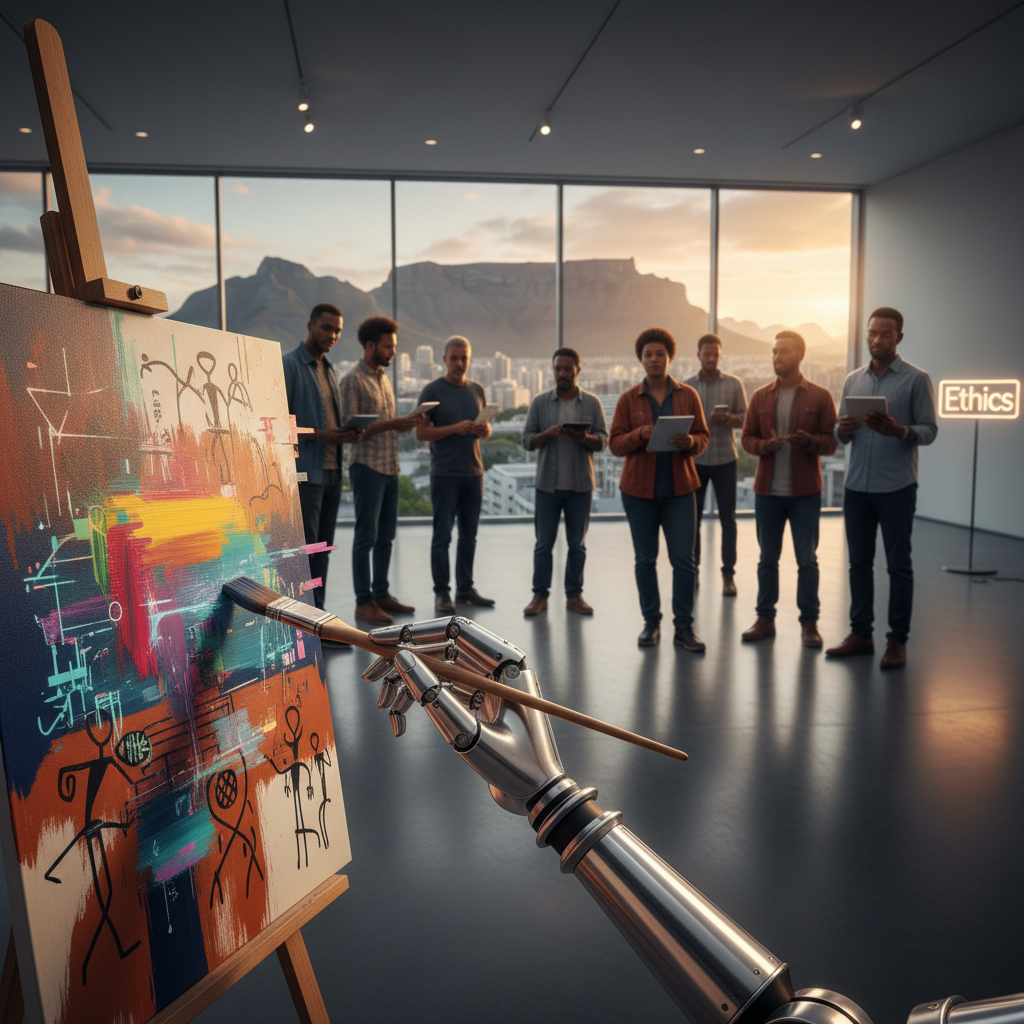

The morning sun was already beating down on the Maboneng Precinct, painting the street art in vibrant hues, as I sat sipping rooibos tea. A young artist, Thabo, was meticulously adding detail to a mural, his hands moving with a practiced grace. We spoke about his latest digital art pieces, some of which he'd been experimenting with using generative AI tools. "Amahlé," he said, his brow furrowed, "the AI can make incredible things, but then I wonder, is it truly mine? If I feed it my style, my heritage, and it spits out something new, who owns that new thing?"
Thabo's question is not just a philosophical musing for artists in Johannesburg, it is the very heart of one of the most pressing legal and ethical challenges facing our global tech landscape: intellectual property in the age of generative AI. For South Africa, a nation rich in cultural heritage and a burgeoning tech scene, this isn't just a tech story because it's a justice story. It speaks to ownership, to fair compensation, and to the very essence of creativity. This deep dive will peel back the layers, looking at the technical architecture, algorithms, and practical considerations of AI-generated IP, all through the lens of what it means for us here at the southern tip of Africa.
The Technical Challenge: Untangling the Creative Chain
The core technical challenge in AI-generated IP lies in attributing originality and authorship. Traditional IP law, particularly copyright, is built on the premise of human authorship. When an AI, say a large language model like OpenAI's GPT-4 or a diffusion model like Stability AI's Stable Diffusion, generates a novel piece of content, it does so by learning from vast datasets of existing human-created works. The output is a complex transformation, not a direct copy. The problem is discerning where human input ends and machine creativity begins, and how to assign rights to an entity that cannot legally hold them.
From a technical standpoint, the difficulty arises because these models are not mere tools in the traditional sense, like a paintbrush or a camera. They are sophisticated systems that learn patterns, styles, and semantic relationships, then synthesize new data points that were never explicitly in their training set. The 'creative' act is an emergent property of complex statistical relationships. This makes it incredibly difficult to draw a clear line in the sand.
Architecture Overview: How AI 'Creates'
Let's consider the architecture of typical generative AI systems relevant to IP. We're primarily talking about Generative Adversarial Networks (GANs) and Transformer-based models, especially diffusion models.
-
Generative Adversarial Networks (GANs): A GAN consists of two neural networks: a Generator (G) and a Discriminator (D). The Generator creates new data instances, for example, images. The Discriminator evaluates these instances for authenticity, trying to distinguish between real data from the training set and fake data created by the Generator. They are trained simultaneously in a zero-sum game. The Generator tries to fool the Discriminator, and the Discriminator tries to get better at not being fooled. This adversarial process drives the Generator to produce increasingly realistic and novel outputs. For instance, a GAN trained on South African landscape paintings could generate new, unique landscapes that capture the essence of the original art.
-
Diffusion Models: These models, like those powering Midjourney or Google's Imagen, work by learning to reverse a process of adding noise to data. During training, the model learns to gradually denoise an image, effectively learning the structure and composition of the training data. At inference time, it starts with pure noise and iteratively denoises it, guided by a text prompt or other input, to generate a coherent image. This iterative refinement allows for incredible detail and adherence to complex prompts.
Both architectures involve massive datasets, often scraped from the internet without explicit consent from creators. This is where the IP questions really start to bite. The 'source code' for the AI's creativity is this vast, often uncredited, corpus of human work.
Key Algorithms and Approaches: The Learning Loop
The algorithms at play are deep learning techniques, primarily convolutional neural networks (CNNs) for image processing and transformer networks for text and sequence data.
For a diffusion model, the core idea can be conceptualized with this simplified pseudo-code:
# Conceptual Pseudocode for Diffusion Model Inference

function generate_image(prompt, num_steps, noise_schedule, model_weights):
 image = initialize_with_random_noise()
 for t from num_steps down to 1:
 predicted_noise = model.predict_noise(image, t, prompt, model_weights)
 image = image - noise_schedule[t] * predicted_noise # Denoise step
 image = add_slight_noise_for_diversity(image) # Optional: adds stochasticity
 return image
# Conceptual Pseudocode for Diffusion Model Inference

function generate_image(prompt, num_steps, noise_schedule, model_weights):
 image = initialize_with_random_noise()
 for t from num_steps down to 1:
 predicted_noise = model.predict_noise(image, t, prompt, model_weights)
 image = image - noise_schedule[t] * predicted_noise # Denoise step
 image = add_slight_noise_for_diversity(image) # Optional: adds stochasticity
 return image
This model.predict_noise function is the heart of it, a neural network trained to understand how noise transforms an image and how to reverse that. The prompt is the human input, guiding the generation. The model_weights encapsulate all the learned patterns from the training data. When a South African designer uses a prompt like "a Ndebele pattern infused with cyberpunk aesthetics," the model leverages its learned understanding of Ndebele art from its training data to generate something new.
Implementation Considerations: Data, Compute, and Ethics
Implementing these models requires significant computational resources, often involving NVIDIA GPUs, and access to massive, diverse datasets. For African developers, this means navigating the high cost of cloud computing and the challenges of curating culturally relevant datasets that are both large enough and ethically sourced. Consider a startup in Cape Town wanting to train an AI on indigenous Khoisan rock art for educational purposes. The data collection alone presents a complex IP challenge. Who owns the rights to replicate and digitize these ancient works for AI training?
"The issue of data provenance is paramount," explains Dr. Naledi Mkhize, a Senior Researcher at the Council for Scientific and Industrial Research (csir) in Pretoria. "If we are to build AI that respects our heritage, we must ensure the training data is either public domain, licensed appropriately, or explicitly consented to by the original creators or their communities. Otherwise, we risk perpetuating digital colonialism, where our cultural assets are exploited without benefit to their originators." Let that sink in.
Benchmarks and Comparisons: Human vs. Machine
Comparing AI-generated content to human-created content for IP purposes is like comparing apples to mangoes. Metrics like FID (Frechet Inception Distance) or Clip score measure the quality and relevance of AI output, but they don't assess originality in a legal sense. Human judges often struggle to differentiate. In a recent study by the University of Johannesburg's Law Faculty, 70% of legal professionals surveyed could not reliably distinguish between human-written poetry and AI-generated poetry, when both were of high quality. This blurs the lines for copyright assessment.
Code-Level Insights: Libraries and Frameworks
Developers working with generative AI primarily use Python with frameworks like TensorFlow and PyTorch. Libraries like Hugging Face's diffusers provide pre-trained models and easy-to-use pipelines for image generation, while transformers handles large language models. For fine-tuning, tools like LoRA (Low-Rank Adaptation) allow developers to adapt a pre-trained model to a specific style or dataset with minimal computational cost. This is crucial for smaller teams in places like Nairobi or Lagos who want to imbue models with local flavor without training from scratch.
# Example: Using Hugging Face Diffusers for image generation
from diffusers import DiffusionPipeline
import torch

pipeline = DiffusionPipeline.from_pretrained("runwayml/stable-diffusion-v1-5", torch_dtype=torch.float16)
pipeline.to("cuda")

prompt = "A vibrant Xhosa initiation ceremony, abstract style, oil painting"
image = pipeline(prompt).images[0]
image.save("xhosa_ai_art.png")
# Example: Using Hugging Face Diffusers for image generation
from diffusers import DiffusionPipeline
import torch

pipeline = DiffusionPipeline.from_pretrained("runwayml/stable-diffusion-v1-5", torch_dtype=torch.float16)
pipeline.to("cuda")

prompt = "A vibrant Xhosa initiation ceremony, abstract style, oil painting"
image = pipeline(prompt).images[0]
image.save("xhosa_ai_art.png")
This simple code snippet demonstrates how easily an AI can generate art. The IP question then becomes: who owns xhosa_ai_art.png? The developer? Stability AI? The Xhosa community whose culture inspired the prompt and potentially the training data? Or perhaps no one, if it lacks human authorship?
Real-World Use Cases: Where the Rubber Meets the Road
- Music Composition: Startups like Jukebox AI in South Africa are exploring AI-generated soundtracks for local films and advertisements. If an AI composes a unique score, does the film producer own the copyright, or the AI developer, or is it uncopyrightable?
- Fashion Design: A designer in Durban uses Midjourney to generate hundreds of patterns inspired by Zulu beadwork. She selects one, modifies it slightly, and prints it on fabric. Is the final garment protected by her copyright, or is the AI's contribution too significant to ignore?
- Educational Content: An NGO creates AI-generated storybooks for children, featuring characters and folklore from various African cultures. The AI generates unique illustrations and narratives. Who holds the rights to these stories, especially if they draw heavily from traditional oral histories?
- Legal Drafting: AI tools like Microsoft's Copilot for legal research assist lawyers in drafting contracts and briefs. If a novel legal argument is formulated by the AI, can it be patented or copyrighted by the law firm?
Gotchas and Pitfalls: The Unseen Traps
The biggest pitfall is the current legal vacuum. Most IP laws predate AI. Courts globally are grappling with this. The US Copyright Office has stated that AI-generated works without significant human authorship are not copyrightable. However, what constitutes 'significant human authorship' is a gray area. Another pitfall is the risk of 'style theft.' If an AI is trained on a specific artist's entire oeuvre, and then generates new works in that artist's unmistakable style, it raises questions of unfair competition and moral rights, even if direct copying isn't involved.
"Here's the thing nobody's talking about enough," says Adv. Sipho Dlamini, a leading IP lawyer based in Sandton. "The current legal frameworks are designed for human intent and human creativity. An AI has neither. We need to move beyond simply trying to fit a square peg into a round hole. We need new legal instruments that acknowledge the AI's role, the dataset's contribution, and the human's guiding hand, perhaps through a system of 'contributory rights' or 'derivative rights' that are distinct from traditional copyright."
Resources for Going Deeper
For those wanting to dive deeper into the technical aspects of generative AI, I recommend exploring the Hugging Face documentation for practical implementations. For the legal and ethical dimensions, the World Intellectual Property Organization (wipo) has ongoing discussions, and academic papers on arXiv often cover the latest research. For a broader understanding of AI's societal impact, MIT Technology Review provides excellent analyses.
The future of creativity, ownership, and innovation hinges on how we answer these questions. For South Africa, as we strive to build our own robust AI ecosystem, ensuring equity and respect for our diverse cultural heritage in this new digital frontier is not just a legal nicety, it is an Ubuntu imperative. We must ensure that the benefits of this technological leap are shared, and that the voices of our creators, whether human or AI-assisted, are heard and valued.