
Imagine the bustling heart of Barcelona, a city where ancient Gothic architecture meets dazzling modernisme. Now picture a small, sunlit office in the Eixample district, filled with towering legal tomes and the scent of strong coffee. This is where we find María, a sharp, ambitious junior lawyer, just a few years out of Esade Law School. For months, María has been wrestling with a complex international trade dispute, a labyrinth of regulations spanning three continents. The sheer volume of documentation, the endless cross-referencing, the fear of missing a crucial precedent, it was all consuming. Her days stretched late into the night, fueled by caffeine and an unwavering commitment to her clients, but also by a gnawing anxiety.
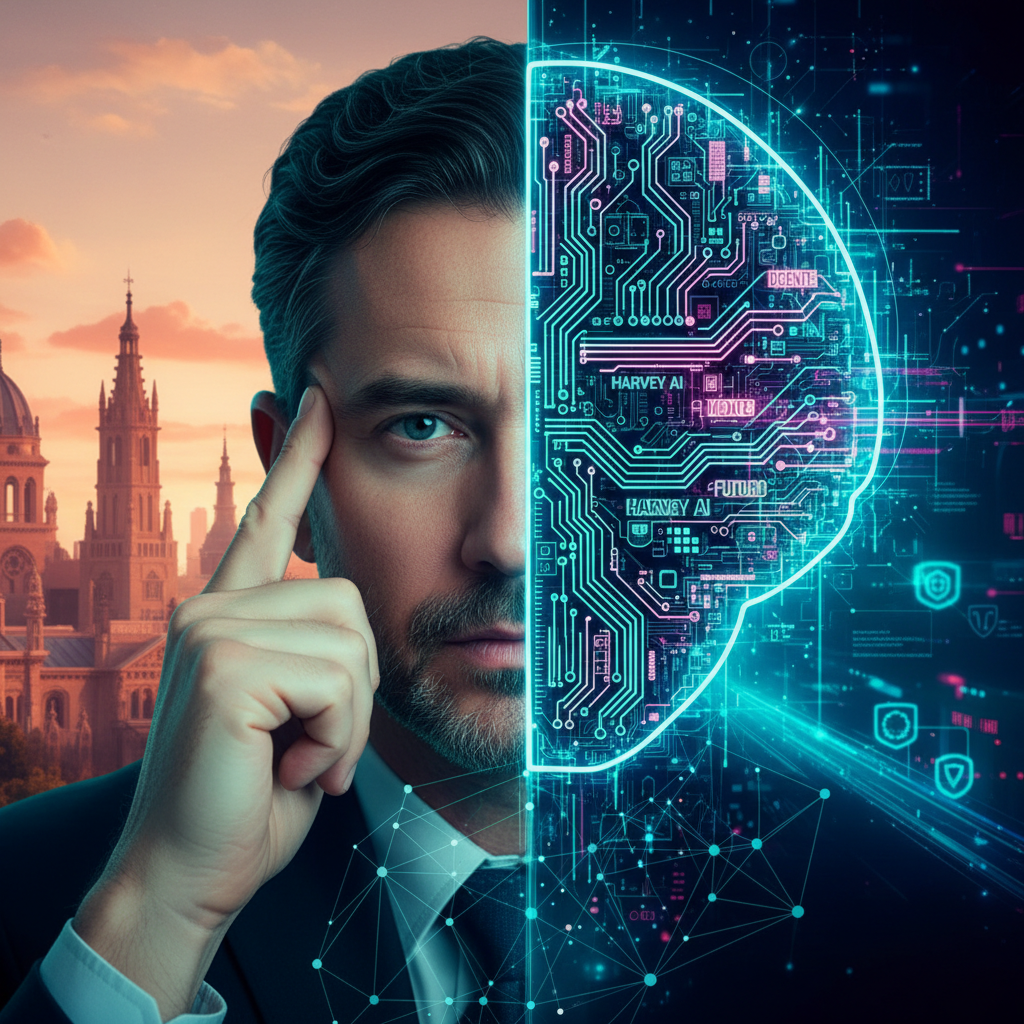
Then came Harvey AI. Not with a bang, but with a quiet, almost unassuming integration into her firm's workflow. Suddenly, María found herself with a digital co-pilot, an AI that could sift through thousands of legal documents in minutes, identify relevant clauses, summarize case law, and even draft initial responses with astonishing accuracy. The change was immediate and profound. Her hours became more humane, her research more precise, and her confidence soared. But beyond the tangible benefits, something deeper was happening in María's mind. She wasn't just using a tool; she was interacting with an intelligence that was subtly, yet powerfully, reshaping her cognitive processes.
This isn't just María's story; it's a narrative unfolding across Spain and indeed, the entire European legal landscape. Harvey AI, founded by former lawyers Winston Weinberg and Gabriel Pereyra, has become the legal industry's most-used AI tool, a testament to its practical utility and deep understanding of legal complexities. What started as a vision to empower legal professionals is now sparking fascinating psychological shifts. Researchers are keenly observing how this human-AI collaboration impacts cognitive load, decision-making, and even the very definition of legal expertise.
One of the most immediate effects is the dramatic reduction in cognitive burden. Traditionally, legal research is a labor-intensive, mentally exhausting process. Lawyers often spend upwards of 30 percent of their time on research alone, according to a 2023 report by Thomson Reuters. Harvey AI automates much of this, freeing up mental bandwidth. "We are seeing a clear shift from 'information retrieval' to 'information synthesis' in legal professionals," explains Dr. Elena Ramos, a cognitive psychologist specializing in human-computer interaction at the University of Valencia. "Instead of spending hours digging, they are now spending that time analyzing, strategizing, and applying their unique human judgment to the AI-generated insights. This can lead to deeper, more nuanced legal arguments." This shift, she notes, can also reduce burnout, a pervasive issue in the legal field.
However, this cognitive ease isn't without its psychological nuances. There's a delicate balance to strike. Over-reliance on AI can lead to what psychologists call "automation bias," where humans tend to favor AI-generated answers, even when they might be flawed, simply because they come from a sophisticated system. "The key is to maintain a critical distance," advises Professor Javier Morales, a leading expert in legal ethics and AI at the Complutense University of Madrid. "Lawyers must remember that Harvey is a tool, an incredibly powerful one, but a tool nonetheless. The ultimate responsibility and the 'why' behind the legal strategy still rests with the human." He emphasizes the importance of training lawyers not just on how to use AI, but how to think critically alongside AI.
Another fascinating aspect is the impact on learning and skill development. For junior lawyers like María, Harvey AI can be an incredible mentor, exposing them to a breadth of legal knowledge and patterns they might take years to accumulate otherwise. It's like having access to the collective wisdom of countless senior partners at their fingertips. "¡Increíble! This startup just gave junior lawyers a superpower," María once exclaimed to me over a café con leche, her eyes sparkling with enthusiasm. But there's also the concern that if not managed properly, this could stunt the development of fundamental research skills. Will the next generation of lawyers truly understand the foundational principles if they always have an AI to do the heavy lifting? This is a question many law schools, including our own IE Law School, are actively grappling with, integrating AI literacy and critical evaluation into their curricula.
The broader societal implications are equally compelling. As legal processes become more efficient and potentially more accessible, what does this mean for justice itself? Could AI help bridge the access-to-justice gap, making legal services more affordable for ordinary citizens? In Spain, where legal aid can be a complex system, the potential for AI to streamline initial consultations and document preparation for pro bono cases is immense. It could empower more people to navigate the legal system, ensuring that justice isn't just for those who can afford the most expensive legal teams. This is a truly exciting prospect, a vision of a more equitable legal future that resonates deeply with our Mediterranean values of community and fairness.
Of course, the ethical considerations are paramount. Data privacy, algorithmic bias, and the potential for AI to perpetuate existing societal inequalities if not carefully designed and monitored, are all critical points of discussion. The EU AI Act, a landmark piece of legislation, is precisely designed to address many of these concerns, ensuring that AI systems deployed in Europe adhere to strict ethical guidelines. This regulatory framework provides a crucial safeguard, fostering trust and responsible innovation.
So, what practical advice can we offer to lawyers and firms embracing this new era? First, embrace lifelong learning. The legal landscape is evolving rapidly, and continuous education on AI tools and their ethical implications is no longer optional. Second, foster a culture of critical engagement. Encourage lawyers to question AI outputs, to verify, and to always apply their human judgment. Third, integrate AI thoughtfully. Don't just layer it on top; rethink workflows, roles, and responsibilities to leverage AI's strengths while preserving human expertise. Finally, remember the human element. Law is fundamentally about people, their stories, and their rights. AI enhances the process, but the empathy, the negotiation, the nuanced understanding of human nature, these will always remain the domain of the human lawyer.
Barcelona is buzzing with this technological transformation, and Spain's AI moment has arrived. The integration of tools like Harvey AI is not just a technological upgrade; it's a profound psychological experiment unfolding in real time. It's challenging us to redefine what it means to be a lawyer, to rethink how we learn, and to imagine a future where technology amplifies human potential, rather than diminishing it. And honestly, qué emoción to be living through it all! The future of law, powered by AI and guided by human wisdom, looks brighter than ever. For more insights into how AI is transforming industries globally, keep an eye on DataGlobal Hub. We are just getting started on this incredible journey. The conversations around AI's impact on human cognition are only growing, as explored in articles like The Silent Scars: When Google Gemini and OpenAI GPT Hallucinations Undermine Sri Lanka's Healthcare and Justice [blocked], which delves into the critical need for accuracy and ethical deployment.