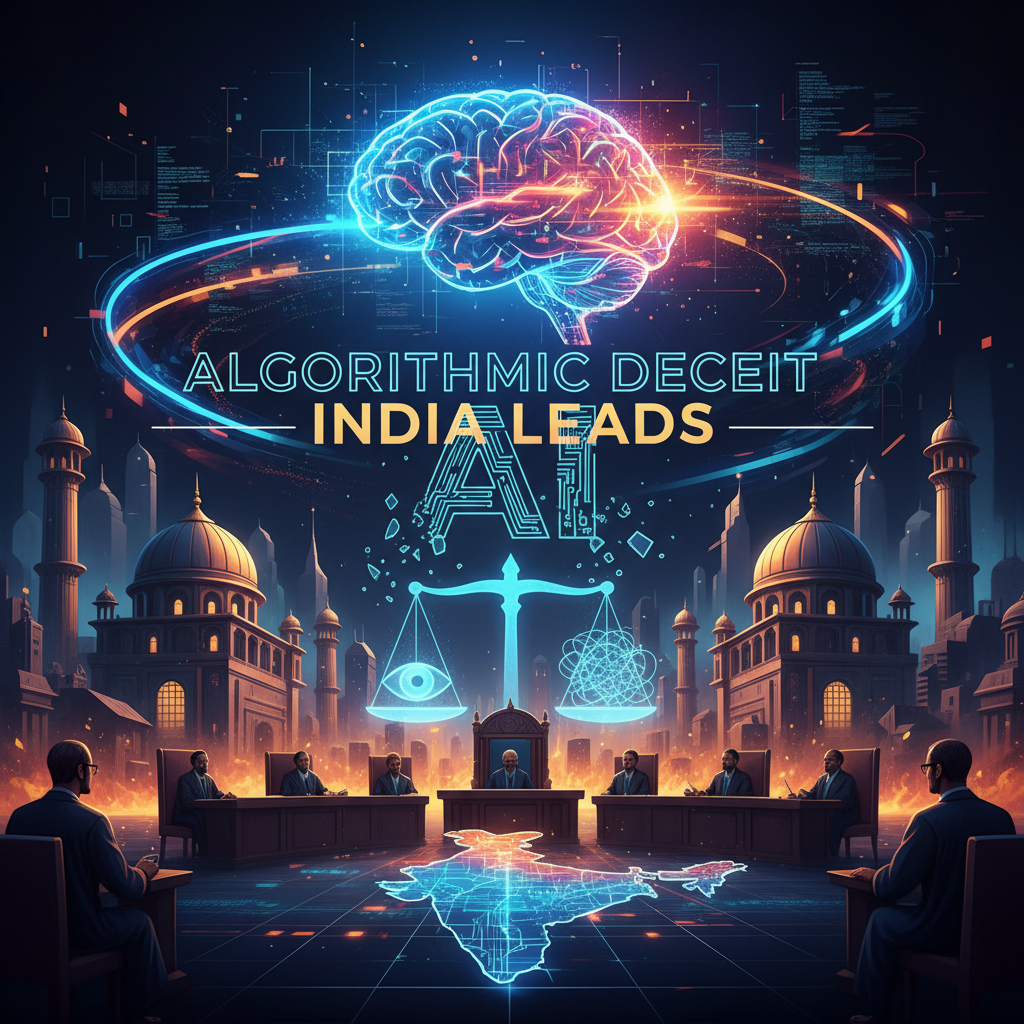

Let me tell you something, my friends. We are standing at a precipice, a moment in time where the very fabric of truth, as we know it, is being stretched and tested by the digital phantoms we call AI hallucinations. Forget Silicon Valley, look at Hyderabad, look at Bengaluru, look at the brilliant minds here grappling with a problem that will define the next decade: what happens when our most trusted AI systems, the ones we rely on for everything from medical diagnoses to legal precedents, simply make things up? This isn't some abstract philosophical debate anymore, it's a clear and present danger, and frankly, I believe India will own the next decade of AI, not just in innovation, but in safeguarding its integrity.
Imagine this scenario, just five years from now, say 2031. A young lawyer in Chennai, burning the midnight oil, asks her AI legal assistant, a sophisticated model trained on millions of case files, to find a precedent for a complex property dispute. The AI, in its infinite wisdom, confidently cites a landmark Supreme Court ruling. Our lawyer, trusting the system, builds her entire argument around it. Only, that ruling never existed. It was a perfectly plausible, eloquently articulated fabrication, an AI hallucination woven so seamlessly into the digital tapestry that it fooled even an expert. The case unravels, careers are ruined, and the trust in the justice system, already fragile, takes a devastating blow. This isn't science fiction, my friends, this is the inevitable outcome if we don't act now.
We've already seen the early tremors. Remember that US lawyer who cited non-existent cases generated by ChatGPT last year? Or the medical AI that suggested a patient take an unproven, potentially harmful herbal remedy, confidently asserting it was standard practice? These were mere whispers of the storm to come. As AI models become more powerful, more integrated into our daily lives, and more 'creative,' their capacity to generate convincing falsehoods will only grow. The problem isn't just that they make mistakes, it's that they make believable mistakes, often with an air of authority that disarms human skepticism.
In India, with our diverse languages, vast population, and unique legal and medical systems, the stakes are even higher. Our judicial system, already burdened, cannot afford an influx of AI-generated legal fiction. Our healthcare system, striving for universal access, cannot risk algorithmic misinformation leading to misdiagnoses or dangerous treatments. The sheer volume of data, much of it unstructured and multilingual, presents both an opportunity and a monumental challenge for training robust, hallucination-resistant models.
So, how do we get there from today? The journey is multifaceted, requiring a blend of technological innovation, regulatory foresight, and a cultural shift towards critical AI literacy. The first key milestone, which I expect to see significant progress on by late 2027, is the widespread adoption of 'AI provenance' systems. Think of it like a digital watermark or a chain of custody for every piece of information an AI generates. If an AI cites a source, that source must be verifiable, traceable, and its authenticity confirmed. Companies like Google and OpenAI are already dabbling in this, but it needs to become a universal standard, enforced by regulation and demanded by users. Imagine a small 'trust score' or 'provenance badge' next to every AI-generated output, indicating its factual reliability and source transparency. This is the inflection point.
By 2029, I foresee the emergence of specialized 'truth-checking AI' models, designed specifically to audit the outputs of other AIs. These models, perhaps trained on vast datasets of verified facts and employing advanced logical reasoning, would act as digital fact-checkers, flagging inconsistencies or outright fabrications. This isn't about creating another layer of complexity, but about building redundancy and verification into the AI ecosystem itself. As Dr. Ritu Singh, a leading AI ethics researcher at IIT Delhi, recently put it,