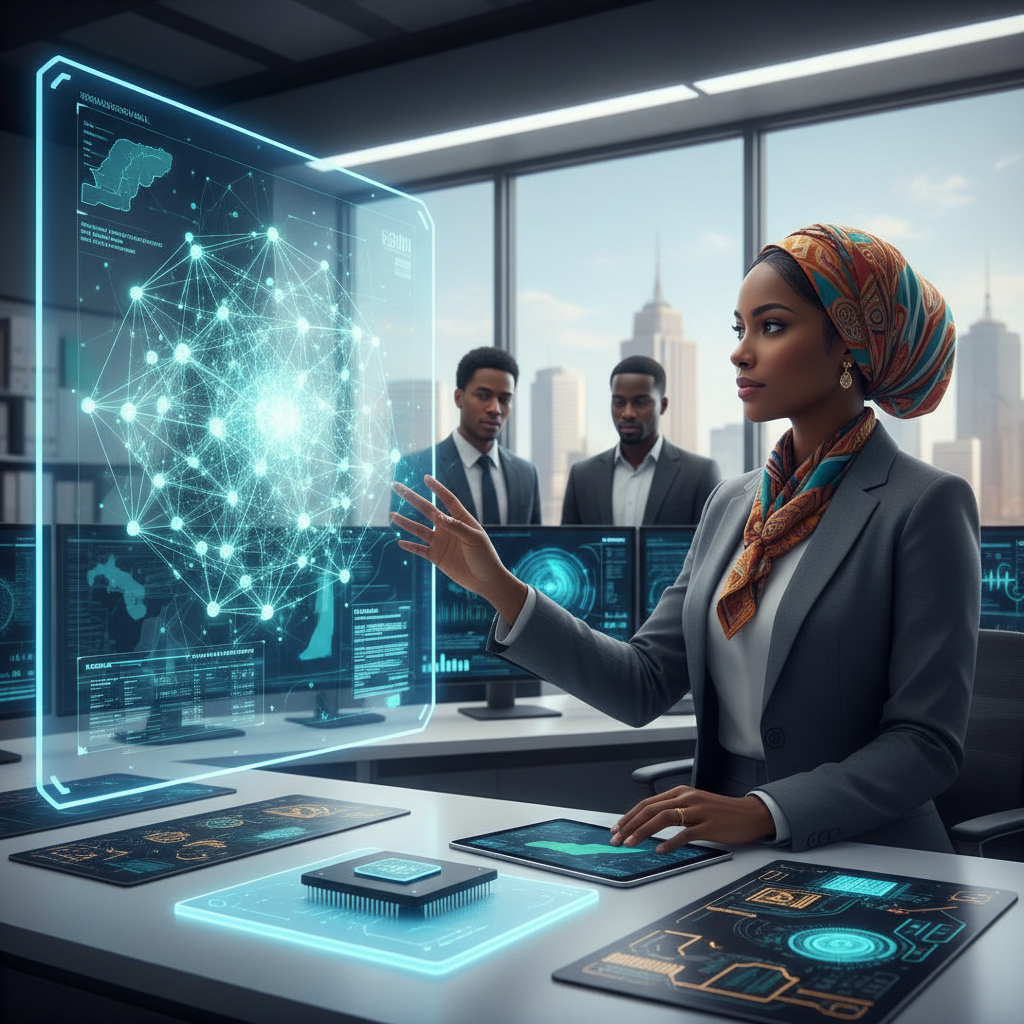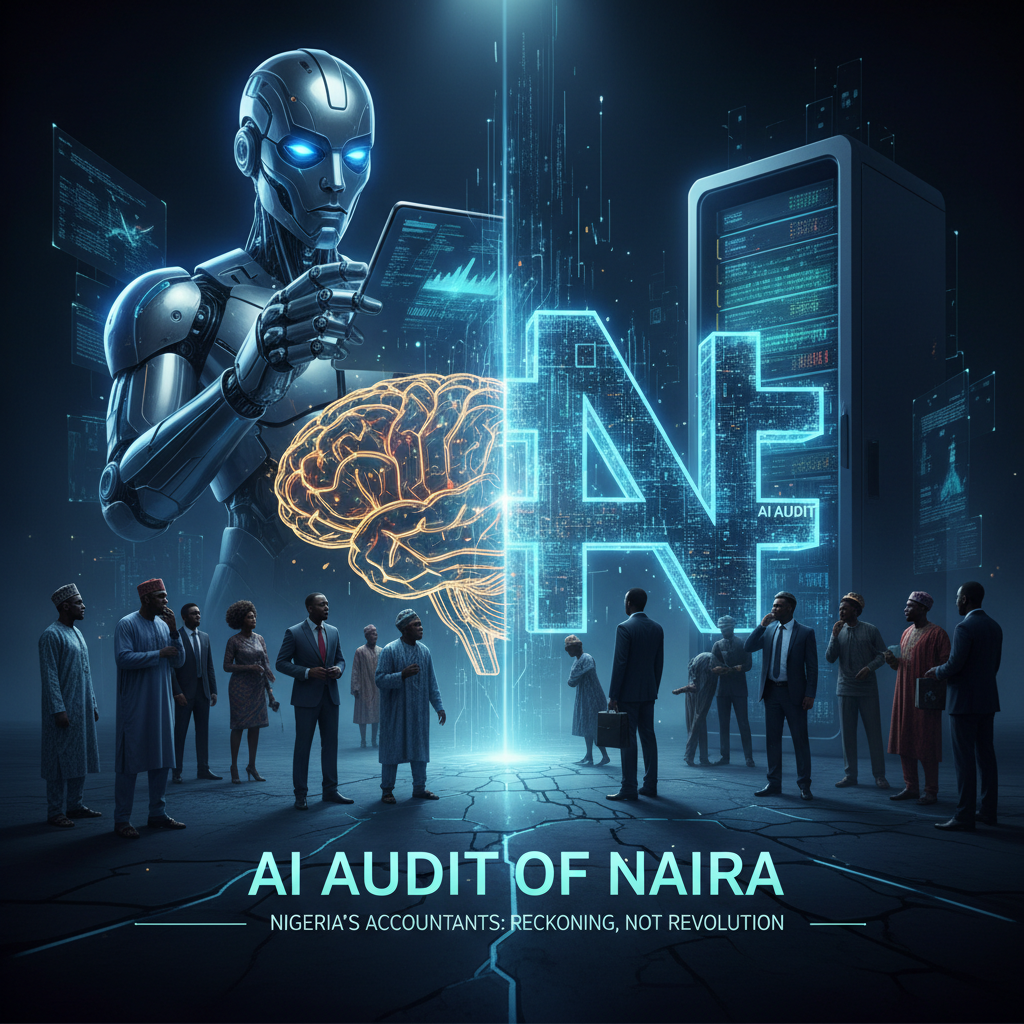

Picture this: it's 2030. The bustling streets of Lagos still hum with energy, but inside the gleaming towers of Eko Atlantic, the accounting firms look eerily quiet. Gone are the rows of junior auditors poring over ledgers, replaced by silent server racks humming with the power of artificial intelligence. A small team of highly specialized data scientists and AI ethicists oversees the operations, while the bulk of the traditional accounting workforce has either retrained or, more likely, been displaced. Financial statements for companies listed on the Nigerian Exchange are generated, audited, and filed with near-instantaneous speed, their accuracy guaranteed by algorithms that detect fraud and anomalies with superhuman precision. Compliance checks, once a labyrinth of paperwork and human interpretation, are now automated, referencing real-time regulatory updates from the Federal Inland Revenue Service and the Central Bank of Nigeria. This isn't science fiction; this is the inevitable future of accounting and audit in Nigeria, and indeed, across Africa. But while many in Silicon Valley and even some of our own tech enthusiasts are cheering this as progress, I, Nkirukà Ezenwà, have a rather unpopular opinion about it all.
Everyone's celebrating, but I have questions. Are we truly ready for this seismic shift, or are we simply sleepwalking into another form of digital colonialism, where the tools of our financial oversight are built and controlled by entities far removed from our local realities? The promise is seductive: automated bookkeeping, anomaly detection that catches every rogue transaction, and compliance systems that never miss a beat. For a country like Nigeria, grappling with issues of transparency and financial integrity, this sounds like a godsend. Imagine a world where ghost workers are instantly flagged, where illicit financial flows leave an indelible algorithmic trail, and where tax evasion becomes a statistical impossibility. The potential for good is immense, no doubt. But let's talk about what nobody wants to discuss: the power dynamics at play.
How do we get to this future from today's reality? The journey is already underway. Global giants like Microsoft, with their Copilot offerings, and Google's Gemini models are already integrating AI capabilities into enterprise software, making their way into the financial departments of large corporations worldwide. Here in Nigeria, local fintech innovators are also exploring AI for fraud detection and credit scoring, but the heavy lifting in audit automation will likely come from established players or their subsidiaries. Over the next five years, we will see a rapid acceleration in the adoption of AI powered tools for basic bookkeeping tasks. Robotic Process Automation, RPA, is already automating repetitive data entry and reconciliation. By 2028, expect to see sophisticated machine learning models taking over much of the initial audit sampling and risk assessment. These models will learn from vast datasets of financial transactions, identifying patterns indicative of fraud or error faster and more accurately than any human team. The shift will be gradual, then sudden.
Key milestones will mark this transition. First, the widespread adoption of AI-powered financial reporting tools by major corporations, reducing the human effort required for monthly and quarterly closes by as much as 70 percent. Next, the emergence of AI-driven anomaly detection systems becoming standard practice in internal audit departments, significantly cutting down on the time spent on manual reviews. We are already seeing early versions of this. According to a recent report, the global market for AI in finance is projected to reach over $22 billion by 2027, with a significant portion allocated to audit and compliance solutions. Reuters often covers these market trends. Finally, and most controversially, the regulatory bodies themselves, like the Financial Reporting Council of Nigeria, will begin to accept and even mandate AI-generated audit reports, perhaps with human oversight reduced to a mere supervisory role. This is where the rubber meets the road, where the theoretical benefits clash with very real concerns.
So, who wins and who loses in this brave new world? The clear winners will be the large corporations and financial institutions that can afford to implement and maintain these sophisticated AI systems. They will benefit from unprecedented efficiency, reduced operational costs, and enhanced accuracy in their financial reporting. Governments, theoretically, could also win by having more robust tools to combat corruption and improve tax collection, leading to better public services. The developers of these AI systems, primarily Big Tech firms and specialized AI startups, will also reap immense profits. Think of companies like OpenAI and Google DeepMind, whose foundational models will power many of these applications. Their influence will only grow.
But the losers, my friends, are the ones we must speak for. The vast majority of entry-level and mid-career accountants and auditors will find their traditional skills obsolete. Many will struggle to retrain for the highly specialized roles that remain, roles that require a deep understanding of AI, data science, and ethical frameworks, not just debits and credits. This is not merely about job displacement; it is about a fundamental restructuring of an entire profession. In a country like Nigeria, where unemployment is a persistent challenge, this has profound societal implications. Furthermore, the risk of algorithmic bias is enormous. If the AI models are trained on historical data that reflects existing inequalities or biases, they will perpetuate and even amplify them. Imagine an AI system flagging transactions from certain demographics or regions as 'high risk' simply because of historical patterns, without understanding the nuanced realities of our informal economy or cultural practices. Who audits the auditors when the auditors are algorithms? And what happens when these powerful AI tools are not developed locally, but imported, carrying with them the implicit values and biases of their creators?
This isn't just about technology; it's about sovereignty. When our financial data, our economic health, and the integrity of our businesses are entrusted to black-box algorithms developed thousands of miles away, what control do we truly retain? The question of data ownership and algorithmic transparency becomes paramount. We need to ensure that as AI reshapes our financial landscape, we are not simply becoming consumers of foreign technology, but active participants in its development and governance. We must demand explainable AI, local data governance, and robust ethical guidelines tailored to our unique context. The conversation around AI in accounting needs to move beyond mere efficiency gains and delve into the deeper questions of power, equity, and control.
What should readers do now? If you are an accountant or auditor in Nigeria, do not bury your head in the sand. Start learning about data analytics, machine learning fundamentals, and AI ethics today. The future is not about replacing humans with AI, but about augmenting human capabilities. Those who can work alongside AI, leveraging its power while understanding its limitations, will be the ones who thrive. For policymakers, the time for proactive regulation and investment in local AI talent is now. We cannot afford to wait until the tsunami hits. We must foster an ecosystem where Nigerian innovators can build AI solutions that understand our local context, our Naira, our markets, and our people. We need to invest in education, infrastructure, and research to ensure that we are not just recipients of this technological wave, but shapers of it. The future of accounting and audit in Nigeria is not just about numbers; it is about our nation's future, and we must approach it with our eyes wide open and our voices clear. For a deeper dive into the ethical considerations of AI, you might find this article on Anthropic's Constitutional AI [blocked] insightful. The stakes are too high to simply trust the algorithms without question. We must ask the hard questions, now, before the ledger is irrevocably written by machines we do not understand or control. For more on the broader implications of AI in business, check out Bloomberg Technology.