
The landscape of global defense is undergoing a profound transformation, driven not by new geopolitical alignments, but by algorithms. At the forefront of this shift is Anduril Industries, the defense technology company founded by Oculus co-founder Palmer Luckey, which has rapidly ascended to prominence, securing significant contracts with the Pentagon and allied nations. Their success hinges on a concept that remains opaque to many outside military and tech circles: AI-powered autonomous defense. But what exactly does this entail, and why should it command our attention, particularly from a Canadian perspective?
What is AI-Powered Autonomous Defense?
At its core, AI-powered autonomous defense refers to military systems that can perceive, decide, and act within their environment without direct human intervention, leveraging artificial intelligence. Unlike traditional automated systems, which follow pre-programmed rules, autonomous systems can adapt to unforeseen circumstances, learn from data, and make complex decisions in real-time. Think of it as moving beyond a guided missile, which has a human-defined target, to a system that can identify, track, and engage targets based on mission parameters, all without a human in the loop for every single action.
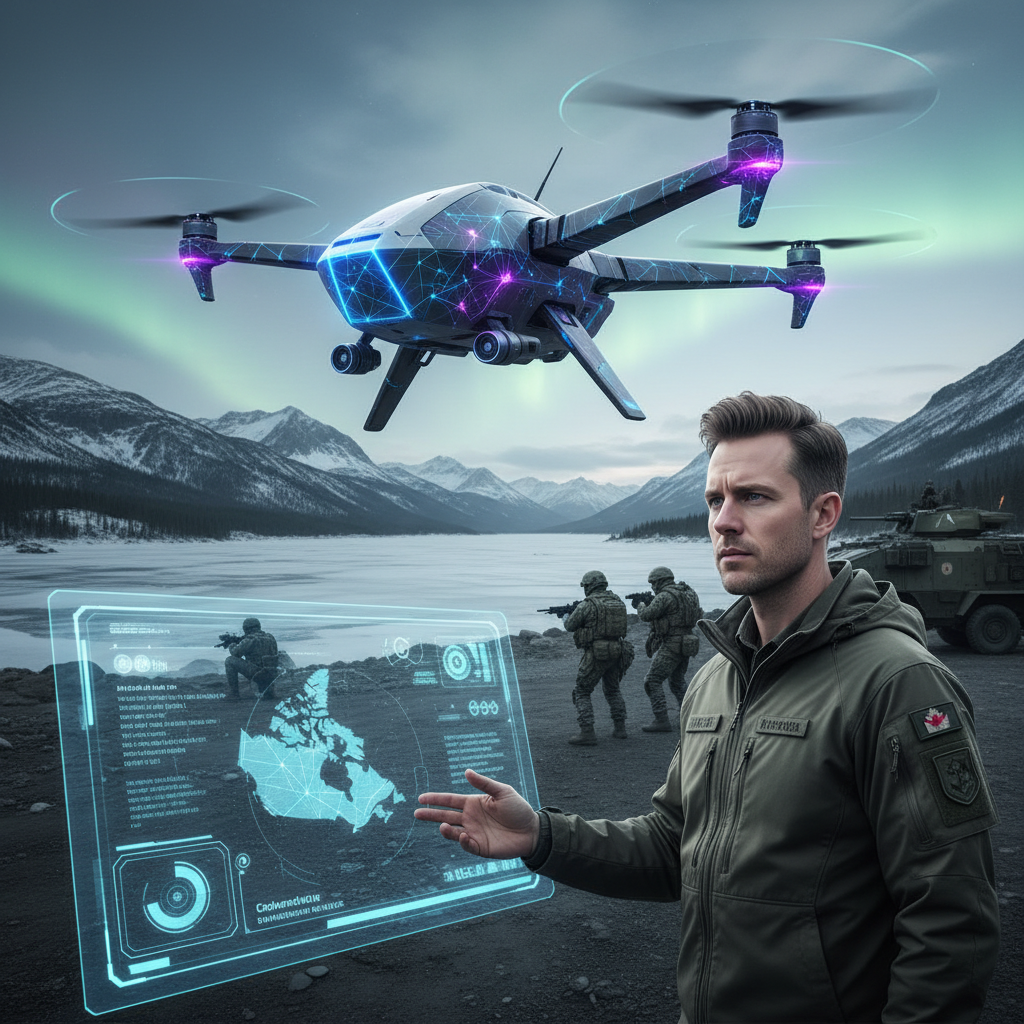
This is not merely about faster drones or smarter sensors. It is about a paradigm shift where machines are entrusted with critical functions, from intelligence gathering and surveillance to target identification and, controversially, engagement. Anduril, for instance, focuses on integrating AI across various platforms, from ground-based sentinels like their Lattice system to aerial drones and counter-drone technologies, all networked together to form a cohesive, intelligent defense grid. The promise is enhanced efficiency, reduced human risk in dangerous environments, and a speed of response that human operators simply cannot match.
Why Should You Care?
The implications of AI-powered autonomous defense extend far beyond military strategy; they touch upon ethics, international law, and the very nature of conflict. For Canadians, a nation that prides itself on peacekeeping and multilateralism, understanding this technology is paramount. The proliferation of such systems could fundamentally alter global power dynamics and the thresholds for conflict. If machines can make decisions of war and peace, what does that mean for accountability? What happens when these systems malfunction, or are exploited by adversaries?
Moreover, Canada, with its vast and often remote territories, including the Arctic, is increasingly exploring technological solutions for surveillance and defense. The Canadian approach deserves more scrutiny, as the adoption of autonomous systems, even for defensive purposes, must be weighed against ethical considerations and the potential for unintended escalation. The discussion is no longer theoretical; it is about tangible systems being deployed today.
How Did It Develop?
The journey to AI-powered autonomous defense is rooted in decades of research in artificial intelligence, robotics, and sensor technology. Early automated systems, like cruise missiles from the 1980s, could follow a pre-programmed flight path, but lacked adaptability. The 1990s and 2000s saw advancements in machine vision and expert systems, allowing for more sophisticated target recognition. However, the real acceleration came with the deep learning revolution of the 2010s. The ability of neural networks to process vast amounts of data, identify patterns, and learn complex tasks, often surpassing human capabilities in specific domains, opened the door for truly autonomous decision-making.
Companies like Anduril emerged in this era, recognizing the potential to apply commercial AI and software development methodologies to the traditionally slow-moving defense sector. Palmer Luckey, known for his disruptive approach to virtual reality, brought a similar ethos to defense, aiming to build systems that were modular, software-defined, and rapidly deployable. This contrasted sharply with legacy defense contractors, often burdened by lengthy development cycles and proprietary hardware. The U.S. Department of Defense, seeking a technological edge, became a willing partner, pouring billions into these new ventures.
How Does It Work in Simple Terms?
Imagine a highly advanced security system for a vast property, say, a national park, that not only detects intruders but can also identify their intent and deploy appropriate responses. This is a simplified analogy for AI-powered autonomous defense.
-
Sensing and Perception: Instead of human guards, a network of sensors, including cameras, radar, and acoustic detectors, constantly monitors the environment. AI algorithms analyze this raw data, much like your brain processes what your eyes see and ears hear. It distinguishes between a deer, a bear, or a human intruder. Anduril's 'Lattice' platform acts as this central nervous system, integrating data from diverse sources.
-
Understanding and Interpretation: The AI then interprets what it perceives. Is that a drone flying overhead a commercial aircraft or a potential threat? Is the vehicle approaching an authorized one or an adversary? This involves sophisticated pattern recognition and predictive analytics, drawing on vast datasets of known threats and behaviors.
-
Decision-Making: Based on its interpretation and pre-defined mission parameters, the AI decides on the best course of action. This could range from simply alerting human operators, to tracking the object, or even, in more advanced scenarios, deploying a countermeasure. The level of autonomy, meaning how much decision-making power is delegated to the AI, is a critical and highly debated aspect.
-
Action: The system then executes the decision. This might involve directing a camera to zoom in, sending a drone to investigate, or activating a defensive weapon system. The goal is to perform these actions with speed and precision that humans cannot replicate, especially in complex, rapidly evolving situations.
Real-World Examples
-
Counter-UAS Systems: Anduril's 'Anvil' system, a small, autonomous drone, is designed to intercept and neutralize adversarial drones. Once a threat drone is identified by the Lattice network, Anvil can be deployed to physically ram and disable it, all with minimal human input after initial authorization. This is particularly relevant for protecting critical infrastructure or military bases from drone attacks.
-
Border Surveillance: The company's 'Sentry' towers, equipped with advanced sensors and AI, provide persistent surveillance over large areas, automatically detecting and classifying objects of interest. This allows border patrol agents to focus on verified threats rather than constantly monitoring feeds, significantly enhancing efficiency. The U.S. Customs and Border Protection has deployed these systems along parts of the southern border.
-
Maritime Domain Awareness: Autonomous underwater vehicles (AUVs) and unmanned surface vessels (USVs) are being equipped with AI to patrol vast ocean expanses, identify suspicious vessels, and monitor maritime activity. These platforms can operate for extended periods without human crews, providing persistent surveillance in challenging environments.
-
Integrated Air Defense: Future systems envision a network of AI-powered sensors and interceptors that can detect, track, and engage incoming missiles or aircraft at speeds and scales impossible for human-centric command structures. This 'system of systems' approach is where companies like Anduril aim to integrate their various offerings.
Common Misconceptions
One pervasive misconception is that AI-powered autonomous defense equates to 'killer robots' making arbitrary decisions. While the ethical debate around lethal autonomous weapons systems, or Laws, is very real and urgent, current deployments often involve a 'human-on-the-loop' or 'human-in-the-loop' model, where humans retain oversight or final approval. However, the trend is towards increasing autonomy, and the definition of 'meaningful human control' is a moving target.
Another error is equating these systems with general artificial intelligence. These are highly specialized AIs, trained for specific tasks like object recognition or threat assessment, not sentient beings capable of independent thought or moral reasoning. Let's separate the marketing from the reality; these are sophisticated algorithms, not Skynet.
Finally, there is a belief that these systems are infallible. The data suggests a different conclusion. Like any complex software, they are susceptible to errors, biases in training data, and adversarial attacks. The consequences of such failures in a defense context are, of course, far more severe than a buggy smartphone app.
What to Watch for Next
The trajectory of AI-powered autonomous defense will be shaped by several key factors. First, regulatory frameworks and international treaties. Nations, including Canada, are grappling with how to govern these technologies, with discussions ongoing at the United Nations and other forums. The push for a global ban on fully autonomous lethal weapons is gaining momentum, but consensus remains elusive.
Second, the ongoing competition between major powers. As the United States, China, and other nations invest heavily in AI for defense, the pressure to deploy increasingly autonomous systems will grow. This technological arms race could lead to rapid advancements, but also heightened risks of escalation. According to a recent report in Reuters, defense spending on AI is projected to climb significantly over the next decade.
Third, the role of ethical AI development. Companies like Anduril, along with larger players like Google and Microsoft, face increasing scrutiny regarding the ethical implications of their defense contracts. Public pressure and internal dissent can influence the direction of research and deployment. The debate around responsible AI in defense is far from settled, and it demands sustained engagement from civil society, academics, and policymakers globally. For a deeper dive into the ethical considerations of AI, readers might find this MIT Technology Review section insightful.
As these systems become more sophisticated and pervasive, the conversation must evolve beyond technical specifications to encompass profound ethical and societal questions. From our vantage point in Canada, a nation often caught between powerful allies and its own commitment to peace, understanding and influencing this technological frontier is not merely an academic exercise; it is a matter of national and international security. The future of warfare, and indeed global stability, may well depend on how we collectively navigate the rise of AI-powered autonomous defense. We must remain vigilant, asking the difficult questions, and demanding transparency and accountability from all involved.