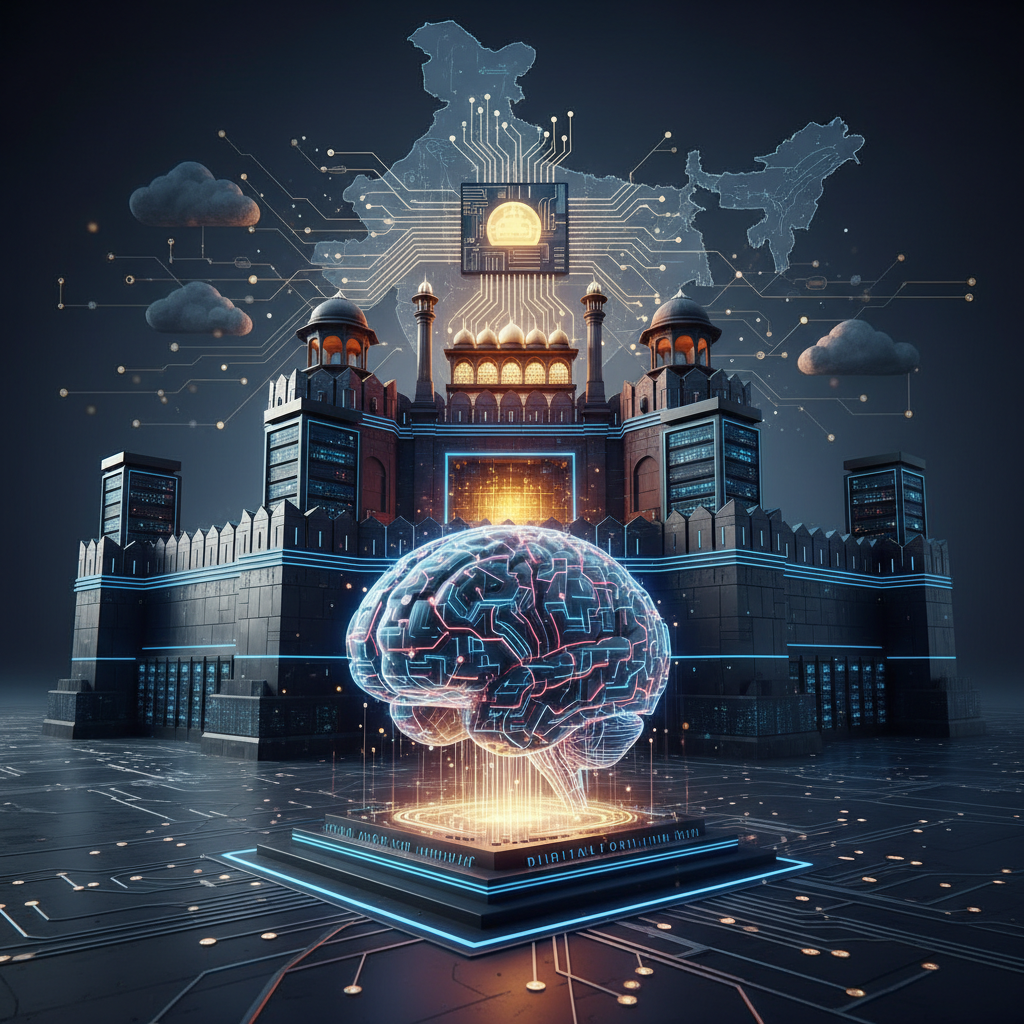

Let us cut through the noise, shall we. Everyone is talking about the latest GPT model or some fancy new AI application. But I am here to tell you, my friends, that is like admiring the paint job on a car while ignoring the engine under the hood. The real power, the absolute bedrock of the AI revolution, lies not in the algorithms themselves, but in the raw, unadulterated computing power that fuels them. We are talking about AI compute sovereignty, and if you are not paying attention to this, you are missing the entire plot.
What is AI Compute Sovereignty?
Simply put, AI compute sovereignty is a nation's ability to independently access, control, and develop the computational infrastructure necessary to build, train, and deploy advanced artificial intelligence systems. It means not relying on foreign powers, companies, or supply chains for the fundamental hardware and software tools that underpin AI. Think of it like energy independence, but for intelligence. Just as a nation needs its own oil, gas, or solar farms to power its economy, it needs its own AI chips, data centers, and advanced software stacks to power its digital future. This is not just about having some servers, it is about owning the entire ecosystem, from silicon foundries to cloud infrastructure, all within national borders and under national control.
Why Should You Care? The Geopolitical Chessboard
Why should you care about something that sounds so technical, so esoteric? Because this is where the geopolitical chess game of the 21st century is being played. The nation that controls AI compute controls its destiny. Imagine a scenario where your nation's most critical AI applications, perhaps for defense, healthcare, or economic planning, are running on hardware manufactured and controlled by a rival power. What happens if that supply chain is disrupted, or worse, weaponized? This is not some far-fetched dystopian novel. We are already seeing the tremors of this with the current semiconductor bottleneck, a situation that has exposed the fragility of global supply chains and the immense power wielded by a handful of chip manufacturers. As Reuters has extensively covered, the AI chip shortage is not just an economic headache, it is a national security concern. For India, a nation with aspirations to be a global AI leader, this is not merely a strategic imperative, it is an existential one.
How Did It Develop? A Brief History of Power
The story of compute sovereignty is intertwined with the history of computing itself. In the early days of computing, hardware was largely proprietary and often developed within national boundaries. Then came globalization, and with it, a complex, interconnected supply chain. Companies like Intel, AMD, and later NVIDIA, became dominant, designing chips that were then manufactured by a handful of specialized foundries, primarily Tsmc in Taiwan. This hyper-specialization, while efficient, created choke points. The rise of deep learning and large language models, demanding unprecedented computational power, supercharged this reliance. Training a model like OpenAI's GPT 4 or Google's Gemini requires thousands upon thousands of cutting-edge GPUs, and the global supply of these is tightly controlled. We went from a world where everyone built their own cars to one where only a few factories make the engines, and everyone else just assembles them. Now, with AI, even the engine blueprints are often foreign.
How Does It Work in Simple Terms? The 'Masala' Analogy
Think of AI compute sovereignty like cooking a perfect biryani. To make a truly authentic, delicious biryani, you need more than just a recipe. You need the right ingredients, the right spices, and the right cooking vessel. If you have to import all your spices from one vendor, and your rice from another, and your cooking pot from a third, you are at their mercy. What if one vendor decides not to sell to you? Or raises prices exorbitantly? Or, heaven forbid, sends you stale ingredients? Your biryani, your national dish, is compromised. In the AI world, the 'recipe' is the algorithm, the 'spices' are the data, and the 'cooking pot' is the AI chip and the data center. AI compute sovereignty means growing your own spices, cultivating your own rice, and forging your own cooking pots. It means owning the entire process, from the raw silicon wafer, the 'uncooked rice', to the finished, deployed AI model, the 'delicious biryani'.
Real-World Examples: From Defense to Digital Public Goods
The implications are vast. Consider these examples:
-
National Defense and Security: Imagine India's defense AI systems, critical for surveillance, autonomous weaponry, or cyber defense, being dependent on chips that could be remotely disabled or have backdoors. With compute sovereignty, these systems are built on trusted hardware, ensuring national security. "Our strategic autonomy in defense AI is directly tied to our ability to produce and control the underlying compute infrastructure," says Dr. Priya Sharma, Director of India's National AI Research Centre. "We cannot afford to outsource our digital security."
-
Digital Public Infrastructure: India has pioneered digital public goods like UPI and Aadhaar. Extending this to AI means building national AI models for healthcare, education, and agriculture, accessible to all. This requires massive, secure, and sovereign compute. "The next generation of India's digital public infrastructure will be AI-powered," explains Rajesh Kumar, CEO of a leading Indian AI startup. "To ensure equitable access and data privacy, we need our own compute clouds, not just rented servers from abroad." This is where DataGlobal Hub comes in, chronicling these shifts.
-
Economic Competitiveness: AI is the new oil. Nations that can train and deploy advanced AI models faster and cheaper will dominate industries from finance to manufacturing. Having sovereign compute infrastructure means Indian companies can innovate without being held hostage by global chip prices or allocation queues. This fuels our startups, our unicorns. "Forget Silicon Valley, look at Hyderabad," I always say. The talent is here, the ambition is here, but we need the computational muscle to match.
-
Data Privacy and Ethics: When data is processed on foreign servers, under foreign laws, the privacy of Indian citizens is always at risk. Sovereign compute allows data to remain within national borders, subject to Indian laws and ethical frameworks. This is crucial for building trust in AI systems.
Common Misconceptions: It's Not Just About Making Chips
Many think compute sovereignty is just about building a chip factory. While chip manufacturing is a huge part of it, it is not the whole story. It is a multi-layered challenge. It involves:
- Chip Design: Designing the specialized AI accelerators, like NVIDIA's GPUs or Google's TPUs, that are optimized for AI workloads.
- Foundry Capacity: The actual fabrication of these chips, a highly capital-intensive and technologically complex process, dominated by Tsmc.
- Packaging and Assembly: The intricate process of putting chips into usable packages.
- Data Center Infrastructure: Building and operating massive data centers with reliable power, cooling, and network connectivity.
- Software Stack: Developing the operating systems, AI frameworks (like PyTorch or TensorFlow), and specialized software tools that run on this hardware.
- Talent: A skilled workforce of engineers, researchers, and technicians across all these domains.
It is a full-stack problem, not just a hardware problem. It is a long game, a multi-decade commitment.
What to Watch For Next: India's Digital Fort Knox
The next few years will be critical. Watch for governments, including India's, to invest heavily in domestic semiconductor manufacturing, perhaps through joint ventures or incentives. Look for the rise of indigenous AI chip design companies. Keep an eye on the development of national AI clouds, like India's proposed 'Bharat AI Cloud', which aims to provide sovereign compute resources for researchers and startups. We will see more strategic alliances and possibly even trade wars centered around access to advanced semiconductors. The race is on, and the stakes could not be higher. India has the intellectual capital, the demographic dividend, and the ambition. This is the inflection point. We are not just building an AI future, we are building a sovereign AI future. India will own the next decade of AI, but only if we secure our compute sovereignty, building our own digital Fort Knox, brick by silicon brick.