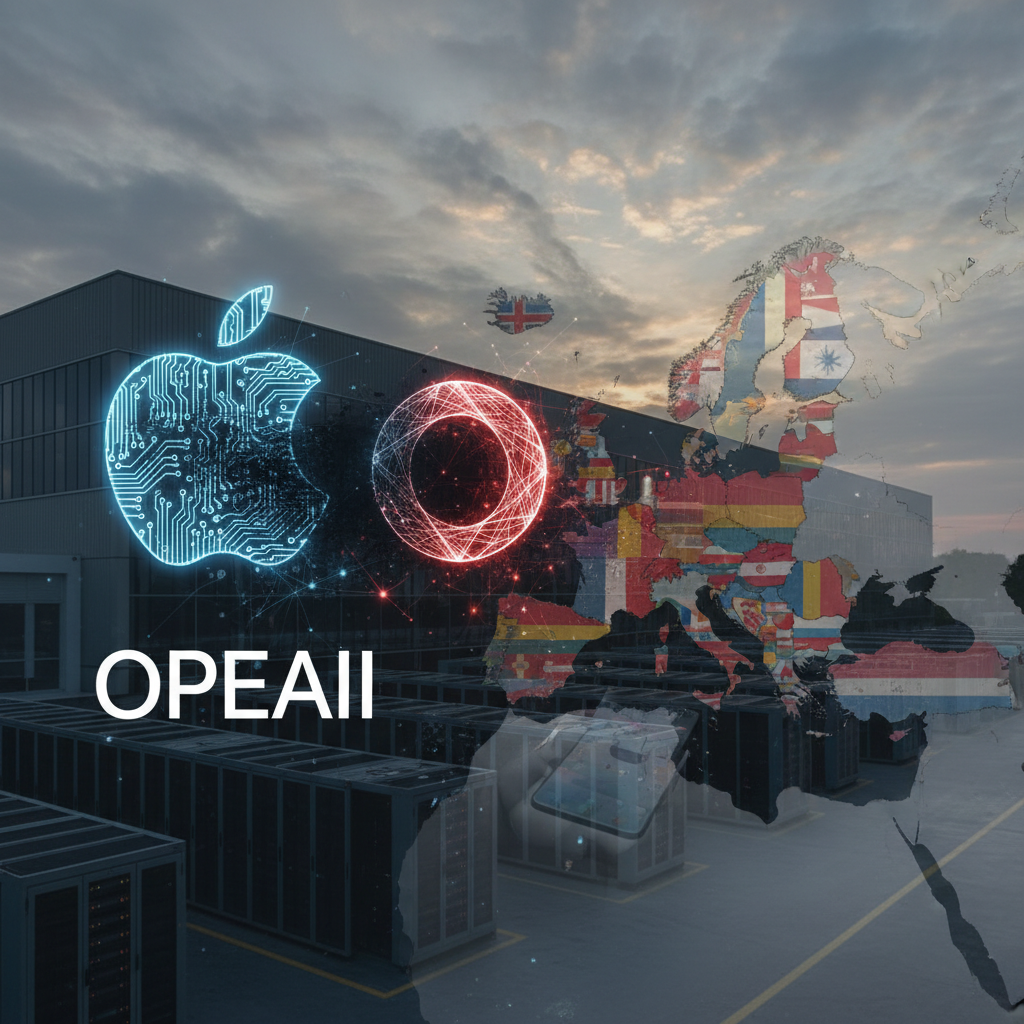
The digital world, much like the ancient Greek seas, is a place of both immense opportunity and unforeseen peril. We stand today at a crossroads, gazing upon a horizon where artificial intelligence promises to reshape everything, from our economies to our very understanding of intelligence itself. And at the heart of this unfolding drama, a quiet revolution is brewing, one championed by entities like Together AI, who are building what some call the 'anti-OpenAI.' They are pushing for open-source infrastructure, a world where anyone can run any model, free from the walled gardens of proprietary giants.
This vision, on its surface, is seductive. It speaks to the Hellenic ideal of accessibility, of knowledge shared and democratized. But as a journalist who thinks in decades, not quarters, I see not just the promise, but the shadows that lengthen behind it. The unfettered proliferation of powerful AI models, even with the best intentions, presents a complex tapestry of risks that Europe, and especially Greece, must confront head-on.
The Risk Scenario: Uncontrolled Proliferation and Misuse
Imagine a scenario, not so far-fetched, where highly capable, open-source large language models (LLMs) or even more advanced multimodal AI systems become trivially easy to deploy, requiring minimal computational resources and expertise. Together AI's mission, to provide the infrastructure for running these models efficiently, accelerates this future. While this democratizes access, it also democratizes risk. Malicious actors, state or non-state, could leverage these models for sophisticated disinformation campaigns, generating hyper-realistic fake news, deepfakes, or propaganda at an unprecedented scale and speed. We already see glimpses of this, but imagine it amplified by orders of magnitude, with models fine-tuned for specific, nefarious purposes, easily accessible and virtually untraceable.
Furthermore, the very openness that Together AI champions means that safety guardrails built into proprietary models by companies like OpenAI or Anthropic might be stripped away or bypassed. If a powerful model capable of designing biological agents or cyberattacks is released into the wild, even inadvertently, the consequences could be catastrophic. The 'red teaming' efforts by major labs, while imperfect, are at least an attempt to find vulnerabilities before widespread deployment. With open-source, the 'red team' becomes everyone, including those who wish to exploit rather than secure.
Technical Explanation: The Engine Behind the Open Floodgates
Together AI is not just another startup, it's a critical piece of the emerging open-source AI ecosystem. Their core offering revolves around providing cloud infrastructure optimized for training and inference of large AI models, particularly those that are open-source. They offer a platform where developers can access powerful GPUs and frameworks to deploy models like Llama 3, Mistral, or Falcon, often at a fraction of the cost of traditional cloud providers. This is achieved through innovations in model serving, quantization, and distributed computing, making these complex models accessible to a broader range of users.
Their infrastructure effectively lowers the barrier to entry for running and fine-tuning these models. This means that an individual or a small group with limited resources can now wield AI capabilities that, just a few years ago, were exclusive to well-funded research labs. This democratizes AI development, fostering innovation and competition, but it also means that the responsibility for ethical deployment shifts from a few large corporations to a vast, decentralized community, many of whom may lack the resources or ethical frameworks to manage such power responsibly. The ease of access, combined with the power of these models, creates a potent cocktail for both progress and peril.
Expert Debate: Freedom Versus Control
The debate surrounding open-source AI is fierce and deeply divided. On one side, proponents argue that openness is essential for innovation, transparency, and preventing a monopolistic future dominated by a few tech giants. Dario Amodei, CEO of Anthropic, has often spoken about the need for careful development, stating in public forums that "the most powerful AI models will require careful scrutiny and robust safety measures before widespread deployment." This reflects a more cautious approach, emphasizing controlled release and extensive testing.
Conversely, advocates for open-source, like many at Hugging Face or Together AI, believe that restricting access to powerful models creates an unequal playing field and stifles innovation. They contend that a diverse community of researchers and developers is better equipped to identify and mitigate risks than a small, closed group. As one prominent open-source AI researcher, who prefers not to be named given the sensitivity of the topic, recently told a virtual conference: "The best way to find bugs and biases is to let a million eyes examine the code. Security through obscurity is a fallacy in the long run." This perspective champions the collective intelligence of the open-source community as the ultimate safeguard.
However, the European Union, through its AI Act, has taken a more nuanced, and some would say, cautious approach. While the Act generally supports open-source, it introduces obligations for high-risk AI systems, regardless of their licensing model. This reflects a recognition that the impact of an AI system, not just its source code, determines its risk profile. Brad Smith, Vice Chair and President of Microsoft, has also emphasized the need for global cooperation on AI safety, suggesting that "no single country or company can solve the challenges of AI on its own. It requires a shared commitment to responsible development and deployment." This global perspective underscores the interconnectedness of AI safety, transcending national borders and corporate interests.
Real-World Implications for Greece and Europe
For Greece, and indeed for the entire European Union, the rise of easily deployable open-source AI models presents both unique opportunities and formidable challenges. On the opportunity side, Greek startups and researchers, often operating with more limited budgets than their Silicon Valley counterparts, can now access cutting-edge AI capabilities without prohibitive costs. This could foster local innovation in areas like sustainable tourism, maritime logistics, and cultural heritage preservation, where Greece has a distinct advantage. Imagine AI models fine-tuned on ancient Greek texts to uncover new historical insights, or intelligent systems optimizing shipping routes in the Aegean Sea, reducing fuel consumption and emissions. [The Mediterranean approach to AI is fundamentally different], often prioritizing human-centric design and societal benefit over pure technological advancement.
However, the risks are equally pronounced. Greece, with its strategic geopolitical location and robust tourism sector, is particularly vulnerable to sophisticated disinformation campaigns targeting its economy or national security. The ease with which open-source models can be weaponized for propaganda or cyberattacks could destabilize political discourse or damage critical infrastructure. Furthermore, the ethical implications of AI, from algorithmic bias to privacy concerns, resonate deeply in a society that values civic participation and individual rights. Athens was the birthplace of democracy, now it's reimagining AI governance, grappling with how to uphold these ancient ideals in a hyper-connected, AI-driven world.
Europe's AI Act is a commendable first step, attempting to create a regulatory framework that balances innovation with safety. But the very nature of open-source, borderless and decentralized, makes enforcement a complex endeavor. How do you regulate a model that can be downloaded and run anywhere, by anyone? The Act's focus on 'high-risk' applications is crucial, but the line between 'high-risk' and 'harmless' can blur rapidly as models evolve and are combined in novel ways.
What Should Be Done: A Hellenic Path Forward
The path forward requires a multi-pronged approach, one that embraces the spirit of innovation while safeguarding against potential harms. First, Europe must invest significantly in its own open-source AI capabilities, building robust models and infrastructure that align with its values of transparency, privacy, and ethical design. This means funding research, nurturing local talent, and creating a vibrant European open-source ecosystem that can compete with or complement efforts from the US and Asia. MIT Technology Review has highlighted the growing importance of regional AI ecosystems, and Europe has the intellectual capital to lead here.
Second, there must be a concerted effort to develop and deploy 'safety layers' or 'ethical wrappers' around open-source models. This could involve standardized testing protocols, independent auditing mechanisms, and clear guidelines for responsible fine-tuning and deployment. It’s not about stifling open-source, but about embedding safety by design. This might involve collaboration with organizations like Together AI, encouraging them to integrate safety tools directly into their infrastructure offerings.
Third, international cooperation is paramount. The risks of AI do not respect national borders. Europe, the US, and other democratic nations must work together to establish norms, share threat intelligence, and coordinate regulatory approaches. This is a global challenge demanding a global response. The European Commission's efforts to engage with international partners on AI governance are vital.
Finally, education is key. Citizens, policymakers, and developers alike must understand the capabilities and limitations, the promises and perils, of open-source AI. We need a public discourse that is informed, nuanced, and forward-looking, rather than reactive or alarmist. Greece has something Silicon Valley doesn't: a deep philosophical tradition that can guide us in asking the right questions about technology's place in society. We must leverage this intellectual heritage to shape a future where AI serves humanity, rather than endangering it. The digital agora awaits our thoughtful participation.