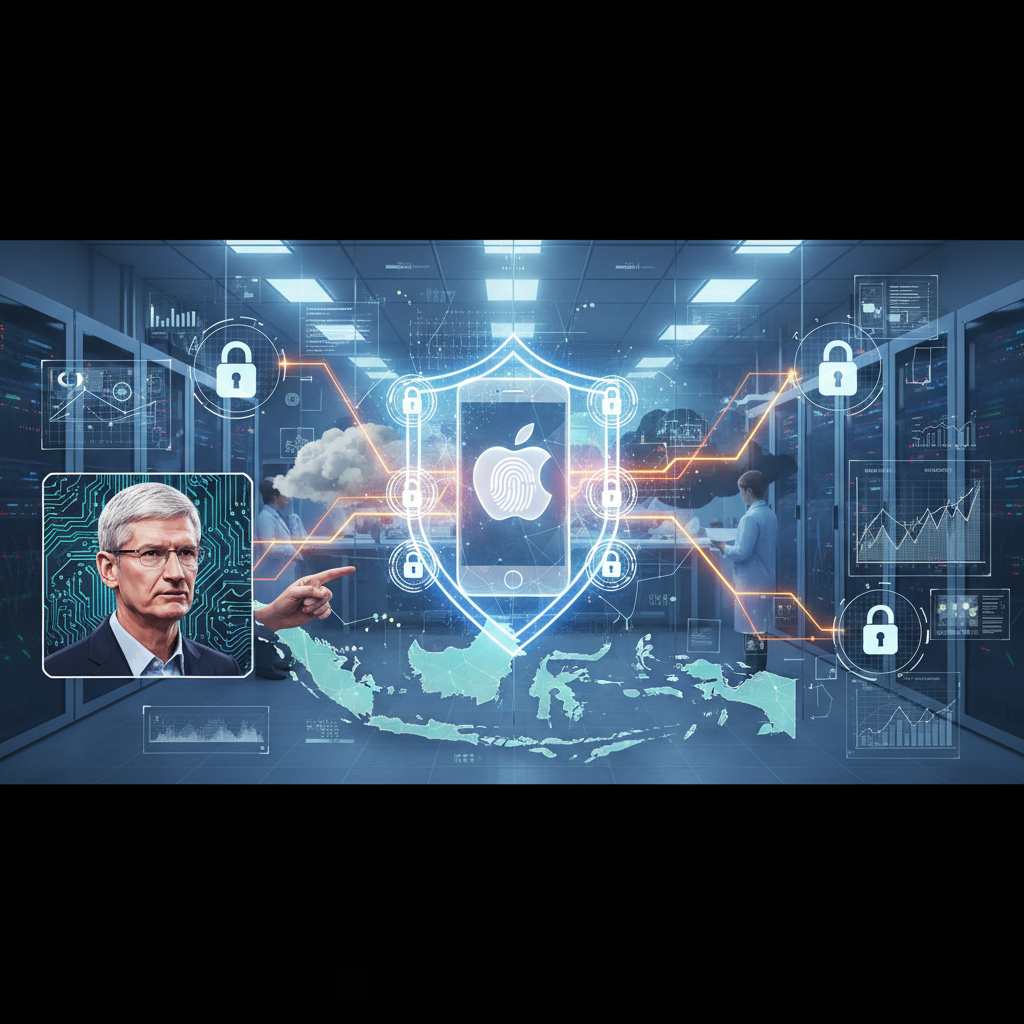

The digital world, much like a bustling Malaysian pasar malam, is a vibrant place filled with competing voices and enticing offerings. In the grand bazaar of artificial intelligence, we have seen giants like Google and Microsoft touting their massive cloud-based models, demanding constant internet access and vast server farms. But what if the real magic, the true intelligence, is not in the distant cloud, but right here, in the palm of your hand? This is the audacious bet Apple is making with its 'Apple Intelligence' initiative, and it is a strategy that resonates deeply, particularly for us here in Southeast Asia.
For years, the narrative has been clear: bigger models, bigger data centers, bigger clouds. OpenAI's GPT series, Google's Gemini, and Anthropic's Claude have pushed the boundaries of what large language models can do, but they all share a common architectural dependency: the cloud. Your queries, your data, your interactions, all travel across the internet to distant servers for processing. Apple, however, is charting a different course, one that prioritizes privacy and efficiency by bringing significant AI capabilities directly onto your device. It is like having a personal chef who prepares your favourite nasi lemak right in your kitchen, rather than ordering from a central catering service that knows everyone's dietary preferences.
The Breakthrough in Plain Language: Tiny Models, Big Impact
At its core, Apple's strategy hinges on making AI models incredibly efficient, small enough to run on the specialized Neural Engine within their devices, from iPhones to MacBooks. Think of it this way: traditional cloud AI is like a massive supercomputer in a data center, capable of anything but requiring a constant connection and sharing your data. Apple's on-device AI is more like a highly specialized, incredibly powerful microchip within your phone, capable of performing complex tasks locally without sending your personal information over the internet. This is not about running a full-blown GPT-4 equivalent on your phone today, but about intelligently distributing tasks. Simple requests stay local, while more complex ones might be routed through a secure, private cloud infrastructure that still respects user privacy, a concept they term 'Private Cloud Compute'.
This approach is built on years of quiet research. While others were loudly announcing ever-larger models, Apple's Ai/ml team, often publishing under pseudonyms or generic 'Apple' affiliations, has been refining techniques for efficient on-device inference, model compression, and federated learning. Researchers like those at MIT Technology Review have highlighted the sophistication of these techniques, noting how Apple has consistently pushed the envelope in making powerful AI models practical for consumer hardware. Their work on neural network quantization, for instance, allows models to retain high accuracy even when their size is drastically reduced, making them suitable for the memory and power constraints of a smartphone.
Why This Matters: Privacy, Speed, and Local Relevance
Let me explain why this matters for Southeast Asia. In a region where data privacy concerns are growing, and internet connectivity can sometimes be a patchwork quilt of speeds and reliability, Apple's on-device AI offers compelling advantages. Firstly, privacy. When your AI assistant processes your personal data locally, it means your sensitive information, be it your calendar appointments, messages, or photos, never leaves your device. This is a significant differentiator from cloud-first models, where data anonymization and encryption are paramount, but the fundamental architecture still involves data transmission to third-party servers. For countries like Malaysia, where digital trust and data sovereignty are increasingly important, this privacy-by-design approach is a breath of fresh air.
Secondly, speed and reliability. Imagine asking your phone to summarize a long email or generate a quick reply, and it does so instantly, without waiting for a server round trip. This is the promise of on-device AI. It is not reliant on a stable, high-speed internet connection, making it incredibly useful in areas with patchy Wi-Fi or limited mobile data. This local processing also reduces latency, making interactions feel snappier and more natural. It is like comparing the immediate satisfaction of a freshly cooked meal at home to the slight delay of a delivery service.
The Technical Details: Neural Engines and Private Cloud Compute
Under the hood, Apple's strategy relies heavily on its custom silicon, particularly the Neural Engine in its A-series and M-series chips. This dedicated hardware accelerator is designed specifically for machine learning tasks, allowing complex AI computations to be performed with incredible efficiency and low power consumption. It is the engine that makes on-device AI a reality, much like the specialized wok that gives Malaysian street food its unique flavour and speed of preparation.
When a task is too complex for on-device processing, Apple introduces 'Private Cloud Compute'. This is not your typical cloud. It uses Apple Silicon servers, designed with the same privacy principles as their devices. These servers are cryptographically isolated, meaning Apple itself cannot access your data. The data is processed, and the results are sent back, without ever being stored or linked to your Apple ID. This