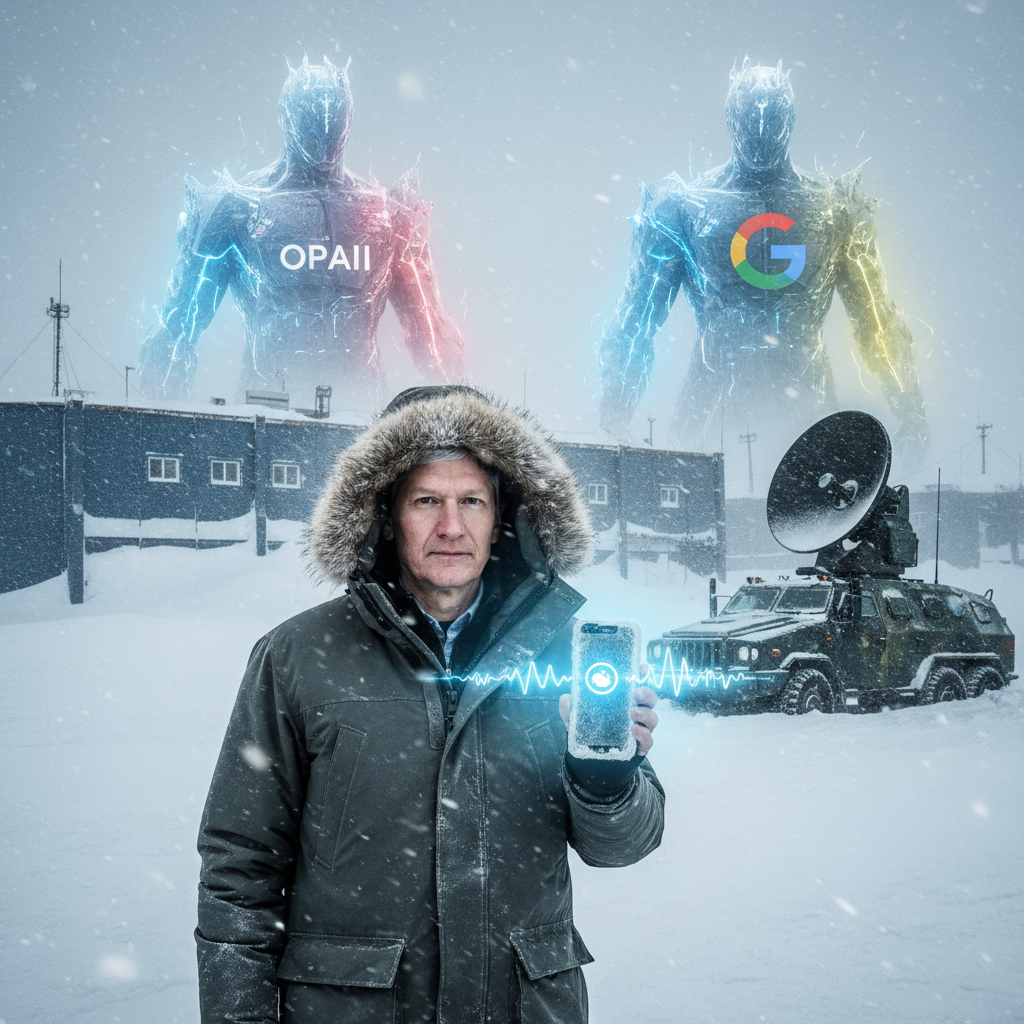

From the frost-heaved laboratories of Vostok Station, where the very air crystallizes our breath, we observe the global technological currents with a perspective sharpened by isolation and extreme conditions. Here, at -40°C, technology behaves differently, and the resilience of systems is tested to its absolute limit. This unique vantage point offers a stark contrast to the often-heated discussions surrounding artificial intelligence in the warmer climes of Silicon Valley.
The latest tempest brewing in the AI landscape concerns Apple's ambitious, and some might say overdue, revitalization of its digital assistant, Siri. For years, Siri has been perceived as lagging behind its more conversational and context-aware rivals, Google Assistant and OpenAI's ChatGPT. The recent announcements from Apple, hinting at a significant architectural shift towards on-device and hybrid cloud models, signal a profound recognition of this competitive gap. The question, however, remains: is this a strategic masterpiece or a desperate scramble to reclaim lost ground?
Apple's historical approach to AI has been characterized by a steadfast commitment to privacy and on-device processing. While commendable, this philosophy has often constrained the computational power and data access necessary for the kind of large language models that underpin the success of ChatGPT and Google Gemini. These models thrive on vast datasets and immense cloud infrastructure, a paradigm Apple has been reluctant to fully embrace. The data from our Antarctic station reveals a clear trend: the most advanced AI systems today are those with unparalleled access to diverse data and scalable compute resources.
Dr. Anya Petrova, a leading computational linguist at the Russian Academy of Sciences' Institute of Artificial Intelligence, articulated this challenge with precision. "Apple's dilemma is akin to trying to build a nuclear icebreaker with the constraints of a small fishing trawler," she explained during a recent virtual conference. "Their privacy-first stance, while ethically sound, necessitates innovative engineering to achieve parity with models trained on practically the entire internet. It requires a fundamental rethinking of how intelligence is distributed and accessed." Her analogy resonates deeply here, where the scale of engineering required for any endeavor, from research to mere survival, is colossal.
Recent reports suggest Apple is indeed pursuing a hybrid approach, leveraging its powerful M-series chips for on-device processing of less complex queries, while offloading more sophisticated generative tasks to secure cloud infrastructure, potentially powered by Google's Gemini models or even a bespoke Apple LLM. This strategic pivot, if successfully executed, could offer a compelling blend of privacy and performance. However, the integration of third-party models, even under strict privacy agreements, introduces new layers of complexity and potential vulnerabilities. The digital sovereignty of data, a topic of increasing geopolitical importance, becomes central to such partnerships.
Mr. Sergei Volkov, head of cybersecurity research at the Arctic and Antarctic Research Institute in St. Petersburg, expressed cautious optimism. "The security implications of hybrid AI models are non-trivial. While on-device processing offers inherent advantages, the handoff to cloud services, even encrypted ones, creates new attack surfaces. Apple's reputation for robust security will be tested not just by their own code, but by the integrity of their partners' systems." His concerns are particularly pertinent in an era where state-sponsored cyber threats are a constant, chilling reality.
The competitive landscape is unforgiving. OpenAI, with its continually evolving GPT series, and Google, with its multimodal Gemini, have set a high bar for conversational AI. Their models are not merely answering questions; they are generating creative content, summarizing complex documents, and even writing code. Apple's Siri, in its current iteration, struggles with basic contextual continuity and often requires precise phrasing. The perception gap is significant, and consumer expectations have been recalibrated by the fluid interactions offered by competitors.
Consider the practical applications. For researchers at our station, rapid data synthesis and intelligent query processing are paramount. Imagine asking Siri to summarize a week's worth of seismic data from the Gamburtsev Subglacial Mountains, or to draft a preliminary report on atmospheric ice crystal formation based on real-time sensor readings. Current Siri would falter. ChatGPT or Gemini, however, could provide a coherent, actionable summary, albeit with caveats regarding accuracy. This disparity underscores the functional chasm Apple must bridge.
Dr. Elena Morozova, a glaciologist operating one of our automated weather stations, highlighted the real-world impact. "When we are analyzing complex climate models or predicting severe weather events, every second counts. The speed and accuracy with which an AI can process and interpret vast datasets directly impacts our operational safety and scientific output. We need an assistant that is truly intelligent, not just a glorified voice interface." Her words echo the sentiments of professionals across countless industries.
Apple's challenge is not merely technological; it is one of perception and market momentum. While their ecosystem remains incredibly sticky, with over 1.5 billion active devices globally, the absence of a truly competitive generative AI assistant could erode user loyalty over time. The company's recent acquisitions in the AI space, though undisclosed in detail, suggest a significant investment in talent and technology. However, integrating these disparate elements into a cohesive, performant, and privacy-preserving system is a monumental undertaking.
The market has reacted with a mix of anticipation and skepticism. Apple's stock has seen fluctuations tied to AI news, reflecting investor uncertainty regarding its long-term strategy. Analysts at Bloomberg Intelligence estimate that Apple's AI R&D budget for 2025 could exceed 30 billion dollars, a testament to the scale of this endeavor. Yet, even with such resources, catching up to companies that have spent years, if not decades, focused solely on AI research and development is a formidable task. For more insights into the broader AI industry, one might consult TechCrunch's AI category.
Ultimately, Apple's success will hinge on its ability to innovate within its own strictures. Can they develop a generative AI that feels as intuitive and seamless as their hardware, while maintaining their stringent privacy standards? The answer will not only determine Siri's fate but also influence the trajectory of personal AI for years to come. The data from our Antarctic station reveals that in the realm of AI, just as in polar exploration, true progress demands not just ambition, but also meticulous planning, robust engineering, and an unwavering commitment to overcoming seemingly insurmountable obstacles. The global AI race is far from over, and Apple's next move will be watched with bated breath, even from the bottom of the world. For a deeper dive into the technical aspects of AI, MIT Technology Review often provides excellent analyses. The future of AI, much like the unpredictable weather patterns here, remains dynamic and full of surprises.