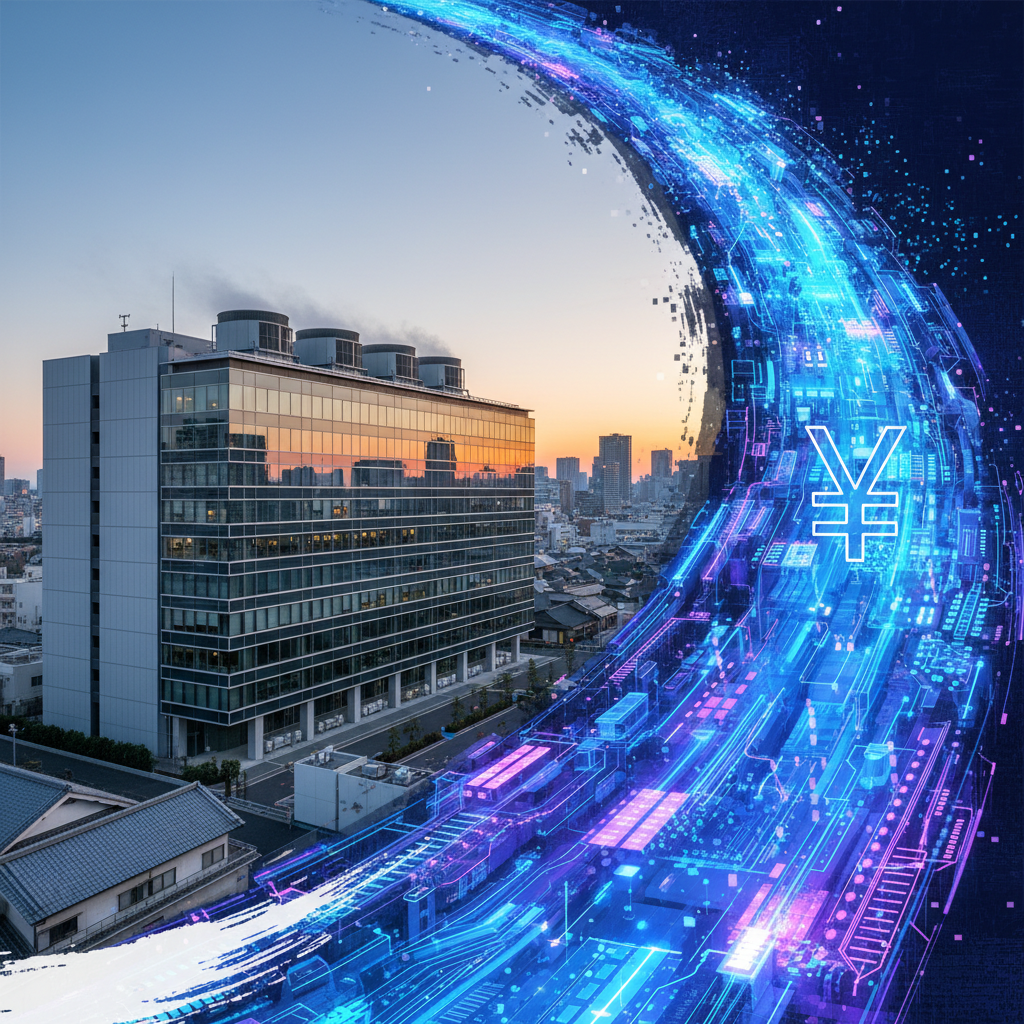

The gentle hum of a server room, a sound often dismissed as background noise, now whispers a profound challenge to our future. In Japan, a nation that prides itself on harmony and efficiency, the rise of artificial intelligence brings with it a silent, yet formidable, thirst for electricity. We are not just talking about a few extra lightbulbs, but a demand so vast it could rival the energy consumption of entire countries. This is the AI energy crisis, and understanding its mechanics is crucial for anyone who believes in a sustainable tomorrow.
I remember a conversation with an elderly craftsman in Kyoto, his hands gnarled from decades of shaping wood. He spoke of mottainai, the Japanese philosophy of regret concerning waste. He whispered something that changed my perspective, saying, "Yuki-san, even invisible things, like electricity, have a spirit. To waste it is to dishonor the effort of its making." His words echo in my mind as I look at the burgeoning data centers, the cathedrals of our digital age, and ponder the immense power flowing through their veins.
The Big Picture: What Does This System Do?
At its heart, the AI energy crisis is about the sheer scale of computation required to train and run sophisticated AI models, especially large language models (LLMs) and generative AI. These systems, which power everything from advanced medical diagnostics to the chatbots that help us plan our holidays, do not just think; they compute on an unprecedented scale. Each query, each generated image, each training cycle translates into billions, sometimes trillions, of calculations per second. This computational intensity demands specialized hardware, primarily Graphics Processing Units, or GPUs, which are incredibly efficient at parallel processing but also incredibly power-hungry. These GPUs reside in massive data centers, facilities that are essentially giant, climate-controlled warehouses filled with racks of servers, networking equipment, and cooling systems.
Think of it like this: if a traditional computer is a single chef preparing a meal, an AI data center is a thousand chefs, each with their own specialized tools, working simultaneously on an infinitely complex banquet. The more elaborate the banquet, the more chefs, the more ingredients, and critically, the more energy consumed by their ovens and refrigerators.
The Building Blocks: Key Components Explained Simply
To understand the energy demand, we must look at the data center's core components:
- GPUs (Graphics Processing Units): These are the workhorses of AI. Unlike general-purpose Central Processing Units (CPUs), GPUs are designed to perform many calculations concurrently. NVIDIA, for instance, has become a titan in this space, with its H100 and B200 'Blackwell' GPUs being central to modern AI training. A single H100 GPU can consume hundreds of watts, and a server rack might house dozens of them. Imagine thousands of these racks in one building.
- CPUs (Central Processing Units): While GPUs handle the heavy lifting for AI computations, CPUs still manage the overall operations, data movement, and less parallelizable tasks within the data center. They also contribute significantly to the power draw.
- Memory (RAM and Storage): AI models require vast amounts of data, both for training and for inference. This data needs to be stored and accessed quickly. High-bandwidth memory (HBM) and fast solid-state drives (SSDs) are essential, and they too consume power.
- Networking Equipment: To move data between GPUs, servers, and storage, high-speed network switches and cables are necessary. These components ensure that the thousands of processors can communicate efficiently, but they also require electricity to operate.
- Cooling Systems: This is perhaps the most significant, and often overlooked, energy consumer. All these powerful components generate immense heat. Without effective cooling, the equipment would overheat and fail. Data centers use elaborate air conditioning, liquid cooling, and even advanced immersion cooling systems, all of which demand substantial electricity. In a country like Japan, with its warm, humid summers, cooling efficiency is a constant battle.
Step by Step: How It Works From Input to Output
Let's trace the journey of an AI query, from your voice command to a generated response, and see the energy footprint it leaves:
- User Input: You ask a question to a generative AI model, perhaps through your smartphone or a smart speaker. This request travels over the internet.
- Data Center Ingress: Your request arrives at a data center, often one operated by tech giants like Google, Microsoft, or OpenAI. It hits a load balancer, which directs it to an available server.
- CPU Processing: A CPU on a server receives the request. It preprocesses the input, perhaps converting your speech to text, and prepares it for the AI model.
- GPU Inference: The CPU then hands off the processed input to a cluster of GPUs. These GPUs, loaded with the pre-trained AI model, perform the complex calculations to generate a response. This is where the bulk of the computational energy is expended. The model might access vast databases of information stored on other servers, requiring more data transfer and thus more networking power.
- Cooling in Action: Throughout this process, the GPUs and other components are generating heat. The data center's cooling systems work tirelessly to maintain optimal temperatures, drawing significant power to run fans, pumps, and chillers.
- Output Generation: Once the AI model generates its response, the GPUs send it back to the CPU.
- Data Center Egress: The CPU formats the response and sends it back over the internet to your device.
This entire process, from your question to the AI's answer, can take mere milliseconds, but it involves an intricate dance of hardware, software, and a constant, enormous flow of electricity. Training these models, an even more intensive process, can take weeks or months, consuming thousands of megawatt-hours, equivalent to the annual consumption of small towns.
A Worked Example: Training a New LLM
Imagine a company like Anthropic or Google DeepMind is training a new, more powerful large language model. This is not a quick task. It involves feeding the model petabytes of text and image data, allowing it to learn patterns and relationships. This process, often called "pre-training," can take months.
In a quiet Tokyo lab, a team of engineers might be overseeing this. They allocate thousands of NVIDIA H100 GPUs to the task. These GPUs are housed in multiple racks, each consuming tens of kilowatts. The training process runs continuously, 24 hours a day, seven days a week. The power draw for these GPUs alone can easily exceed several megawatts. Add to this the energy for the CPUs, the vast amounts of high-speed memory, the networking infrastructure, and crucially, the sophisticated cooling systems needed to prevent the entire setup from melting down. The total energy consumption for a single, state-of-the-art LLM training run can be equivalent to the annual electricity usage of tens of thousands of Japanese households. This is the human side of the machine, the dedicated engineers pushing the boundaries, aware of the energy cost but driven by the promise of what AI can achieve.
Why It Sometimes Fails: Limitations and Edge Cases
The energy demands of AI are not just a matter of scale, but also efficiency. There are several reasons why the system can become inefficient or face limitations:
- Underutilized Hardware: Sometimes, GPUs or entire servers sit idle or are not fully utilized, yet they still draw power for basic operation and cooling. Optimizing workload distribution is a constant challenge.
- Inefficient Algorithms: Not all AI algorithms are created equal. Some are more computationally efficient than others. Researchers are constantly working on new methods to achieve similar results with less computation.
- Cooling Challenges: As mentioned, cooling is a massive energy sink. If cooling systems are not optimally designed or maintained, they can waste enormous amounts of electricity. Japan's humid climate makes this particularly challenging, requiring advanced solutions.
- Data Transfer Overhead: Moving vast amounts of data between different parts of a data center, or even between data centers, consumes energy. Minimizing unnecessary data movement is key.
- Legacy Infrastructure: Older data centers might not be as energy-efficient as newer ones, leading to higher power consumption per unit of computation.
Where This Is Heading: Future Improvements
The future of AI's energy footprint is a critical area of innovation. Several avenues are being explored:
- Hardware Innovation: Chip manufacturers like NVIDIA, Intel, and AMD are continuously developing more power-efficient GPUs and specialized AI accelerators. The goal is to achieve more computations per watt. For example, NVIDIA's next-generation Blackwell platform promises significant efficiency gains over previous generations. You can read more about these advancements on TechCrunch.
- Algorithmic Efficiency: Researchers are developing smaller, more efficient AI models that can perform tasks with fewer parameters and less computation. Techniques like model pruning, quantization, and knowledge distillation aim to reduce the energy required for both training and inference.
- Sustainable Data Centers: Companies are investing heavily in designing and operating data centers that are more energy-efficient. This includes using renewable energy sources, optimizing cooling systems (e.g., liquid cooling, free cooling with outside air), and even locating data centers in colder climates or near renewable energy sources. Microsoft, for example, has pledged to be carbon negative by 2030, which includes powering its data centers with 100% renewable energy. Bloomberg Technology often covers these corporate sustainability efforts.
- Edge AI: Moving AI processing closer to the data source, on devices like smartphones or industrial sensors, can reduce the need to send data to large, centralized data centers, thereby saving energy. This is particularly relevant for applications where real-time processing is crucial.
- Government and Industry Collaboration: In Japan, the Ministry of Economy, Trade and Industry (meti) is actively exploring strategies to ensure energy stability amidst growing AI demand. Initiatives to promote renewable energy and smart grid technologies are crucial. "The scale of AI's energy needs demands a national strategy, not just corporate initiatives," says Dr. Akiko Nakamura, a leading energy policy expert at the University of Tokyo. "We must invest in a resilient, green infrastructure now, or risk hindering our own digital progress."
The challenge is immense, but so is the ingenuity being applied to solve it. From the engineers optimizing server racks in a data center outside Fukuoka to the policymakers in Tokyo debating renewable energy targets, countless individuals are working to ensure that our digital future does not come at an unsustainable cost. The spirit of mottainai reminds us that even in the invisible world of electricity, mindful consumption is a path to a harmonious future. The human element, our shared desire for progress and sustainability, will ultimately guide us through this silent thirst. {{youtube:5p248yoa3oE}}
As we embrace the marvels of AI, we must also embrace the responsibility that comes with its power. The choices we make today, in how we generate, consume, and conserve energy, will define the landscape of tomorrow's digital world. It is a story of innovation, of infrastructure, and ultimately, of our collective commitment to a future where technology thrives in balance with our planet. This is not just a technical problem; it is a societal one, deeply intertwined with our values and our vision for what it means to live well. The path ahead is complex, but with careful planning and a commitment to sustainability, Japan, and the world, can navigate the immense energy demands of AI without compromising our future. For more insights into the broader implications of AI, you might find this article on AI ethics and safety [blocked] interesting, as it touches on the responsible development of these powerful systems.