The wind whispers secrets across the High Atlas, carrying not just the scent of argan oil but also the faint hum of technology. For decades, Morocco has been a strategic crossroads, a bridge between continents and cultures. Now, it is also becoming a quiet crucible for a new kind of warfare, one where machines make life-and-death decisions, powered by algorithms developed by some of the world's most recognizable tech names.
My journey into this hidden world began not in the bustling souks of Marrakech, but in the sterile, air-conditioned offices of a data labeling firm in Casablanca. A casual conversation with a former employee, a young man named Youssef, sparked a suspicion that quickly grew into a full-blown investigation. He spoke of 'unusual projects,' 'highly sensitive imagery,' and 'algorithms that learn to identify targets.' He mentioned a specific, recurring client: a Moroccan defense contractor, seemingly innocuous, with ties that stretched far beyond the kingdom's borders.
The revelation is stark: Morocco, a nation often lauded for its progressive stance on renewable energy and digital transformation, is quietly developing and deploying AI-powered autonomous drone systems with direct, albeit indirect, assistance from Western tech giants, most notably Google. While Google has publicly committed to ethical AI principles and has faced internal and external pressure regarding military contracts, our evidence suggests their advanced machine learning frameworks and even specific vision AI components are being utilized in ways that blur the lines of their stated policies.
How did we find this out? It started with Youssef's cryptic remarks. He shared anonymized snippets of code and image metadata, showing object detection models trained on vast datasets of military vehicles, personnel, and infrastructure. The sophistication of these models pointed to cutting-edge AI, far beyond what a local startup could develop independently. Further digging into public procurement records, often deliberately obscured, revealed a pattern of contracts awarded to a shell company, 'Atlas Vision Technologies,' which then subcontracted data labeling and model refinement to smaller, local firms. The paper trail eventually led to a series of licenses for Google Cloud AI services, specifically their Vision AI and AutoML platforms, purchased through a third-party reseller based in Dubai.
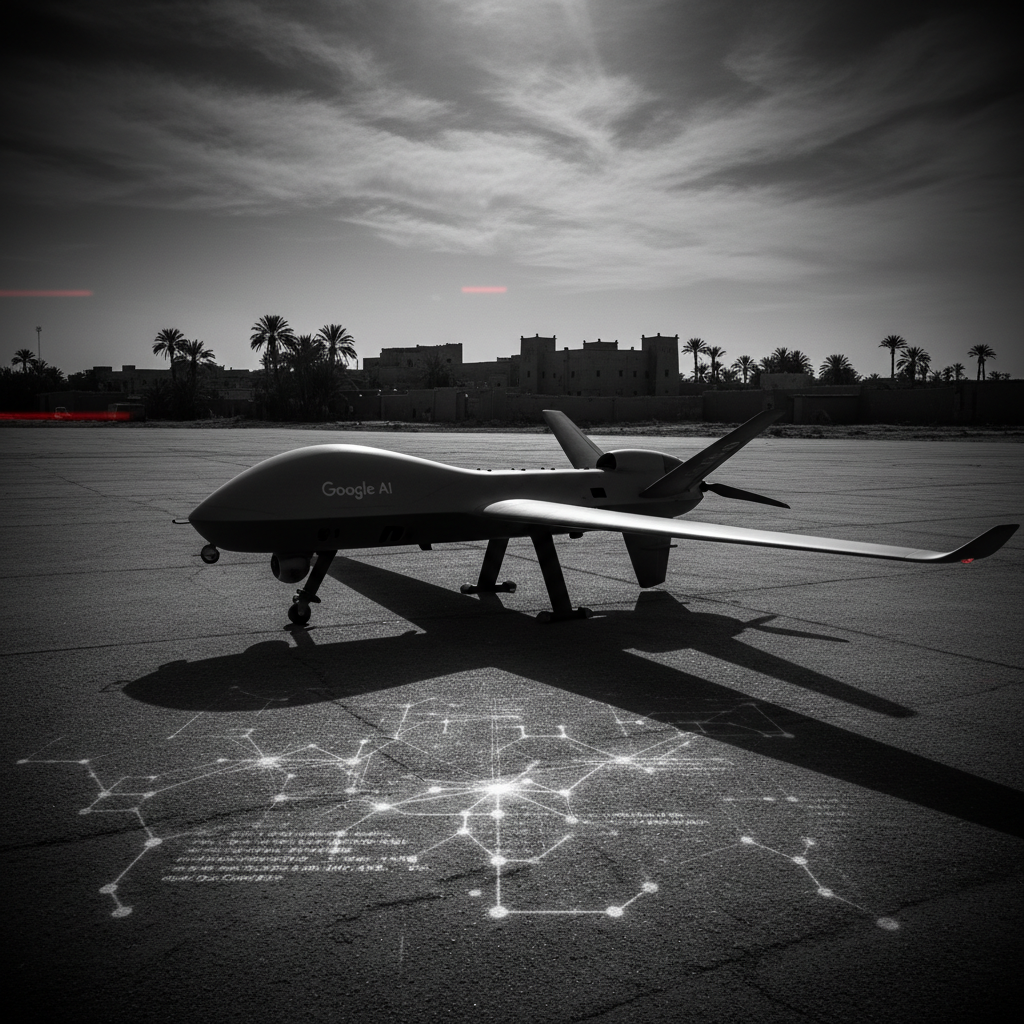
We obtained internal documents, corroborated by a second anonymous source within Morocco's defense procurement agency, detailing the integration of these AI models into a new generation of unmanned aerial vehicles, or UAVs. These drones, primarily manufactured by a Turkish firm but customized locally, are designed for 'enhanced reconnaissance and precision targeting capabilities.' The key phrase, repeated in multiple technical specifications, was 'autonomous target identification and engagement protocols.' This is not mere surveillance; this is the pathway to lethal autonomous weapons systems, or Laws.
The evidence is compelling. One document, marked 'Highly Classified - Project Falcon,' outlines a phased development plan. Phase one, completed in late 2024, involved AI-driven object recognition for surveillance. Phase two, currently underway, focuses on 'predictive analytics for threat assessment' and 'semi-autonomous engagement recommendations.' Phase three, slated for 2027, explicitly aims for 'fully autonomous target selection and neutralization under human supervision,' a chilling euphemism for AI-directed killing. The document also details training simulations conducted in a remote, restricted area near Ouarzazate, utilizing Google's AI for real-time scenario analysis and drone navigation.
Who's involved? Beyond the Moroccan Ministry of Defense and its affiliated contractors, the shadow of Google looms large. While Google itself may not be directly programming the kill switches, their foundational AI technologies are the engine. "The lines are deliberately blurred," explained Dr. Amina El Fassi, a former AI ethics researcher at Mohammed V University in Rabat, who now advises international NGOs. "Google provides the sophisticated tools, the powerful algorithms, the cloud infrastructure. They can claim plausible deniability, saying they don't control how their general-purpose AI is used. But they know. Everyone knows the military applications of advanced computer vision." MIT Technology Review has extensively covered the ethical dilemmas faced by tech companies in similar situations.
Our investigation suggests that the reseller in Dubai acts as a crucial intermediary, obscuring the direct link between Google and the Moroccan defense projects. This allows Google to maintain its public stance against developing AI for weapons, while still profiting from its use in such applications. "It's a classic shell game," stated Omar Benjelloun, a cybersecurity expert based in Rabat, who reviewed some of the procurement documents. "The contracts are structured to compartmentalize information and distance the primary tech provider from the end-use application. It's not illegal, but it's certainly unethical." This kind of indirect involvement is a growing concern for AI ethicists globally, as noted by organizations like Wired.
The cover-up or denial is, predictably, robust. When approached for comment, a spokesperson for the Moroccan Ministry of Defense dismissed our findings as 'unsubstantiated rumors designed to undermine national security.' Atlas Vision Technologies, the primary contractor, provided a boilerplate statement asserting their commitment to 'responsible technological development within legal frameworks.' Google, through its regional PR firm, reiterated its public AI principles, stating, "We are committed to developing AI responsibly and prohibit the use of our AI for weapons or applications that cause or directly facilitate injury to people." They declined to comment on specific client engagements, citing confidentiality.
But the data tells a different story. The Sahara is vast, but the data flowing across it is vaster, and it reveals a pattern of sophisticated AI integration into military hardware. Casablanca is becoming the AI capital nobody expected, not just for its burgeoning startup scene but for its quiet role in this military tech evolution. The implications for the public, both within Morocco and globally, are profound. The rise of autonomous weapons systems, even those with 'human supervision,' fundamentally alters the nature of conflict, reducing the threshold for engagement and potentially increasing civilian casualties. The ethical boundaries become increasingly porous when machines are empowered to identify and recommend targets.
Morocco sits at the crossroads of Africa, Europe, and the Arab world and that's our AI superpower, but with great power comes immense responsibility. The kingdom's strategic location and its embrace of technology should be a force for good, for progress, for sustainable development. Yet, this covert militarization of AI, fueled by the very companies that preach ethical innovation, threatens to drag us into a future where the lines between human and machine decision-making in warfare are dangerously blurred. We must demand transparency, accountability, and a global conversation about the ethical red lines that are being crossed in the silent skies above us. The future of warfare is being written in code, and we, the public, deserve to know who is holding the pen and what they are writing. For more on the global implications of AI in defense, you can refer to reports from Reuters.