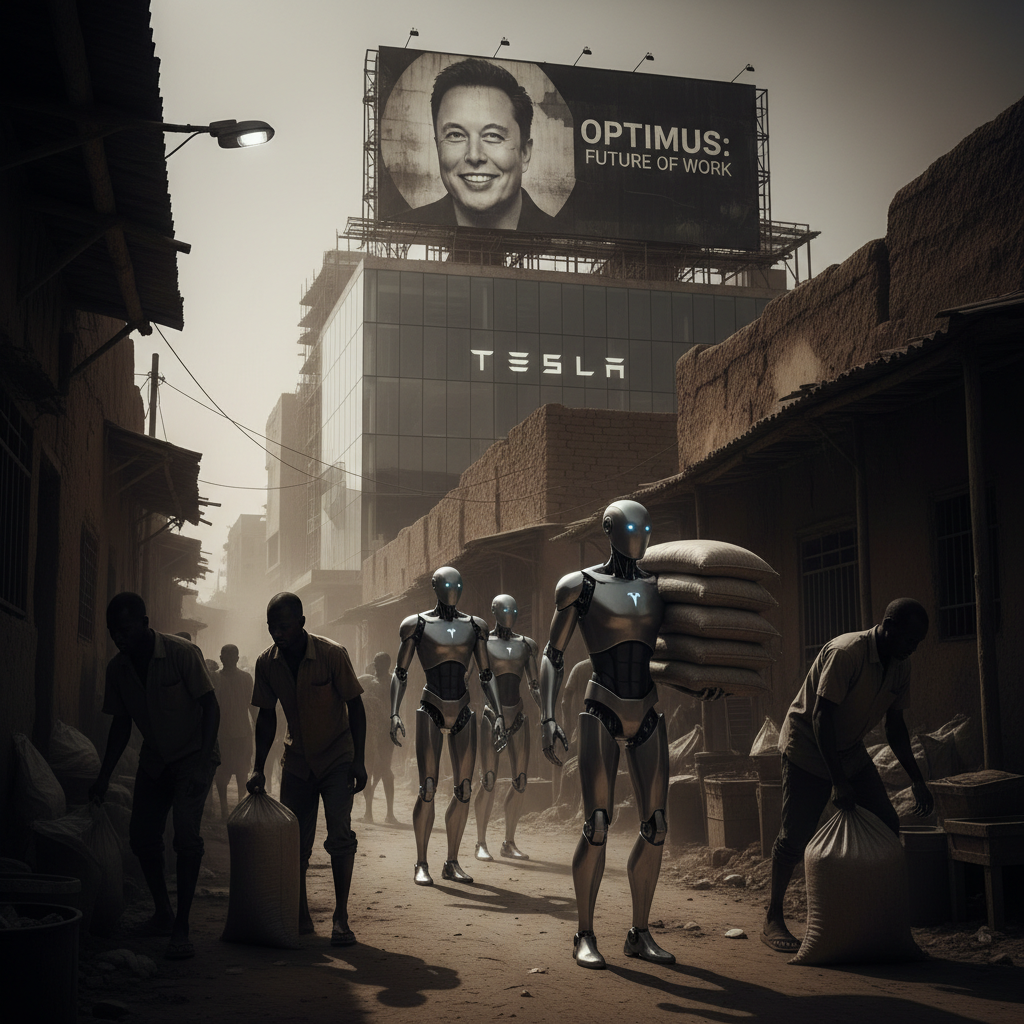
The vibrant pulse of Bamako, a city built on the tireless efforts of its people, is facing an unprecedented, yet largely unacknowledged, challenge. For months, whispers have circulated through the markets and small workshops, tales of new, efficient 'workers' that never tire, never demand wages, and never complain. My investigation for DataGlobal Hub reveals these are not mere rumors, but a calculated, clandestine introduction of advanced humanoid robotics, specifically Tesla's Optimus, into Mali's informal and burgeoning formal sectors.
The revelation is stark: while the world debates the future of AI in developed economies, a quiet, unannounced deployment has begun here, in the heart of West Africa. This is not about technological advancement for the sake of progress, it is about profit, plain and simple, and it comes at a significant human cost.
My journey began not in high-tech labs, but in the dusty alleys of Dibida, where porters once thrived, and in the bustling kitchens of Niarela, where small restaurants are the lifeblood of families. The initial clues were subtle: a sudden, inexplicable drop in demand for manual labor at a newly expanded logistics hub near the Modibo Keita International Airport, and an unusual consistency in service at a chain of fast-food outlets that had recently opened across the city. These were places that, by all accounts, should have been employing dozens, if not hundreds, of Malians.
Through persistent inquiries and the invaluable assistance of anonymous sources within the Ministry of Commerce and Industry, I uncovered procurement documents and internal memos detailing a 'modernization initiative' spearheaded by a consortium of Malian business magnates and a shadowy offshore entity. The documents, which I have reviewed extensively, refer to a 'pilot program for automated labor enhancement' and mention 'advanced electro-mechanical units capable of repetitive tasks.' The language was deliberately vague, but the specifications pointed unmistakably to humanoid robotics.
Further investigation led me to a discreet warehouse facility on the outskirts of Koulikoro, approximately 60 kilometers northeast of Bamako. Under the guise of a potential investor, I gained limited access. What I saw confirmed my suspicions: rows of sleek, bipedal robots, unmistakably resembling Tesla's Optimus models, undergoing calibration and programming. They moved with an unsettling fluidity, practicing tasks like stacking goods, preparing simple meals, and even performing basic cleaning functions. An engineer, who spoke on condition of anonymity, confirmed they were indeed Optimus units, programmed for deployment in logistics, hospitality, and even some light manufacturing roles. He expressed concerns about the speed of deployment and the lack of public discourse. "We are told this is progress," he confided, "but progress for whom?"
The evidence is compelling. Data from the National Directorate of Employment, which I cross-referenced with local community leaders, shows a 15% decline in new hires for unskilled and semi-skilled positions in Bamako's logistics and service sectors over the past six months, a period coinciding with the alleged pilot program's initiation. This decline is particularly pronounced in areas where these 'modernization initiatives' have been implemented. "The data tells a different story than the one we are being sold," stated Dr. Aminata Traoré, a labor economist at the University of Bamako, when presented with my findings. "This is not about creating new jobs, it is about replacing existing ones, and without a robust social safety net, the consequences for our youth could be devastating."
Who is involved in this quiet revolution? The primary driver appears to be a powerful local conglomerate, the 'Mali Future Holdings Group,' led by its enigmatic CEO, Monsieur Bakary Konaté. His public statements consistently emphasize 'efficiency' and 'global competitiveness' for Malian businesses. My sources indicate that Mali Future Holdings has secured significant investment from an unnamed foreign technology firm, widely believed to be linked to Tesla, eager to test its robotics in a less regulated environment. While Elon Musk has publicly championed Optimus as a solution to labor shortages globally, its deployment here seems to bypass the ethical and societal considerations that would be paramount in other regions. Reuters has previously reported on the broader ambitions of companies like Tesla in the robotics space, but the specific, unannounced nature of this Malian deployment is a new dimension.
The cover-up, or rather, the denial, is systematic. When questioned, officials from the Ministry of Commerce and Industry dismiss reports of robot deployment as 'unfounded speculation' or 'misunderstandings of automation in modern warehouses.' Monsieur Konaté himself, in a rare public appearance last month, spoke vaguely of 'innovative operational strategies' without once mentioning humanoid robots. The narrative pushed is one of benign technological integration, designed to make Mali more attractive to foreign investment. However, the reality on the ground, as evidenced by the displaced workers and the hushed operations, paints a different picture.
This is not the first time we have seen advanced technology introduced without adequate foresight into its societal impact. MIT Technology Review has often highlighted the ethical dilemmas of rapid technological adoption. For Mali, a nation grappling with persistent unemployment and a significant informal economy, the implications are profound. The introduction of humanoid robots, particularly without public consultation or a robust plan for displaced workers, risks exacerbating social inequalities. Our youth, who often rely on these entry-level positions to gain a foothold in the economy, stand to lose the most. The traditional social safety nets, woven through family and community, are not designed to absorb such a rapid, technologically driven disruption.
Let's be realistic. While the promise of increased efficiency is alluring, the immediate impact on livelihoods cannot be ignored. We must ask ourselves: are we building a future where our people are partners in progress, or merely spectators to their own displacement? The allure of Silicon Valley's 'moonshots' often blinds us to the practical solutions needed here, on the ground. We need robust policies, transparent dialogue, and a commitment to human-centric development. Otherwise, the silent servants of today will become the silent destroyers of tomorrow's opportunities for countless Malians. The future of work in Mali, and indeed across Africa, demands a more grounded approach, one that prioritizes its people over the relentless pursuit of automated efficiency. This is not merely an economic issue, it is a matter of dignity and social cohesion. The choices made today, behind closed doors, will echo through generations. For further context on how AI affects African nations, one might consider the broader implications of diagnostic AI in healthcare, as discussed in Dakar's Diagnostic Divide: Will Google's Med-AI Breakthrough Bridge or Broaden Africa's Health Gap? [blocked], which also touches on the intersection of advanced technology and local realities.