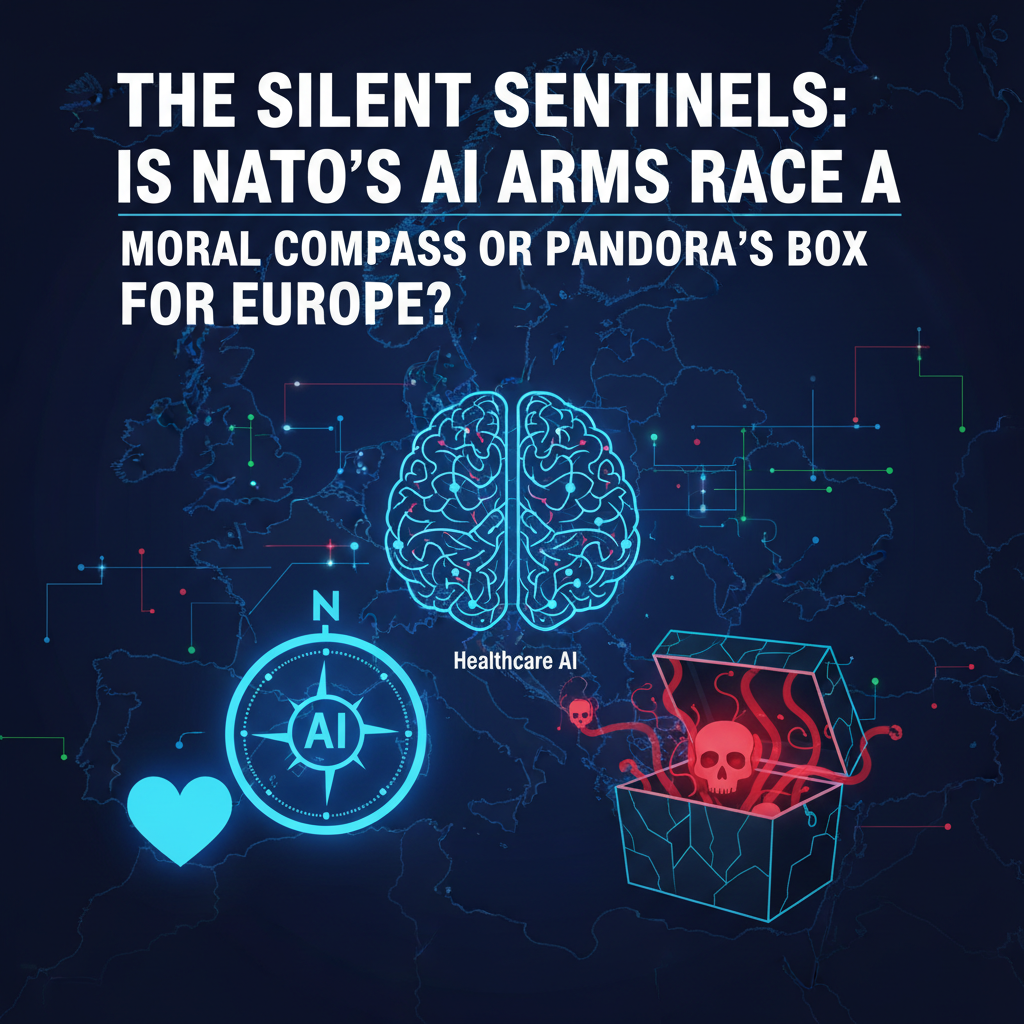

The question is no longer if artificial intelligence will reshape modern warfare, but how profoundly and with what ethical cost. Will the integration of AI into military operations, from drone swarms to autonomous decision-making, solidify a new era of strategic stability, or will it unleash a technological maelstrom that defies human control? This is the pressing dilemma confronting defense strategists and ethicists across Europe, particularly within the Nato alliance.
From the ancient Roman legions to the mechanized divisions of the 20th century, military innovation has consistently pushed the boundaries of human capacity and moral consideration. Today, we stand at a similar precipice, where algorithms and machine learning are poised to become the new spearhead of defense. The current trajectory suggests an accelerating adoption of AI in military applications, moving beyond mere assistance to genuine autonomy. This is not a distant future; it is a present reality, with implications that resonate deeply from the Pentagon to the Ministry of Defence in Prague.
The historical context of military technology often reveals a pattern: initial apprehension followed by widespread integration. Consider the advent of gunpowder, then the machine gun, and later nuclear weapons. Each introduced unprecedented destructive power, forcing humanity to grapple with new doctrines, treaties, and moral frameworks. AI, however, presents a unique challenge. Unlike previous technologies, which amplified human physical capabilities, AI promises to augment or even replace human cognitive functions in combat. This shift from 'man in the loop' to 'man on the loop' or even 'man out of the loop' is what fundamentally differentiates this era.
Currently, the global defense sector is investing heavily in AI. According to a report by the Stockholm International Peace Research Institute (sipri), global military spending reached an estimated $2.44 trillion in 2023, with a significant portion increasingly allocated to AI research and development. The United States, China, and Russia lead this charge, but European nations, including France, Germany, and the United Kingdom, are also rapidly advancing their capabilities. The European Defence Agency (EDA) has identified AI as a critical enabler for future military operations, emphasizing its potential in areas such as intelligence, surveillance, reconnaissance, logistics, and autonomous systems.
Drone warfare, for instance, has already transitioned from a niche capability to a cornerstone of modern conflict. The conflict in Ukraine has served as a stark, real-world laboratory, showcasing the devastating effectiveness of inexpensive, AI-enhanced drones for reconnaissance, targeting, and even direct attack. These systems, often equipped with computer vision for target identification and navigation, reduce risk to human operators and can operate in environments too dangerous for manned aircraft. The Czech Republic, with its robust defense industry and engineering prowess, is actively exploring these technologies. Our local firms are contributing to NATO's collective defense capabilities, often focusing on secure communication and data processing for these advanced systems. Prague's engineering tradition meets modern AI, creating solutions that are both innovative and rigorously tested.
However, the ethical boundaries of autonomous weapons systems, or 'killer robots' as they are often dramatically termed, remain fiercely debated. The core concern revolves around accountability and the potential for unintended escalation. If an AI system makes a lethal decision, who is responsible? The programmer, the commander, the manufacturer, or the machine itself? This question strikes at the very heart of international humanitarian law.
Several expert perspectives illuminate this complex landscape. General Petr Pavel, former Chairman of the Nato Military Committee and former President of the Czech Republic, has frequently emphasized the need for a robust ethical framework. He stated in a recent public address,