
The hum of electricity, a constant in our modern lives, belies a complex, often fragile dance of generation, transmission, and consumption. In Lesotho, a nation grappling with both energy scarcity and the imperative for sustainable development, the promise of Artificial Intelligence in managing this delicate balance has become a whispered mantra among policymakers and corporate strategists. But what they're not telling you, and what this learning path aims to uncover, is the intricate web of interests, technologies, and potential pitfalls that accompany this silent revolution.
This is not a mere technical manual. It is an investigative roadmap for those who seek to understand not just how AI works in energy and grid management, but who benefits, who pays, and what it truly means for nations like ours. We will follow the money, from the sprawling data centers of global tech giants to the local cooperatives struggling to keep the lights on in remote villages. This path is for the curious, the skeptical, and the determined, whether you are a student in Maseru, an engineer in Gaborone, or a policy analyst in Brussels.
Who This Is For
This learning path is designed for individuals with a foundational understanding of basic mathematics and programming concepts, particularly in Python. No prior AI or advanced energy sector knowledge is strictly required, but a keen interest in both technology and its societal impact is essential. If you are an aspiring data scientist, an energy sector professional seeking to upskill, a policymaker, or simply a concerned citizen wanting to demystify the rhetoric around AI and energy, this guide is for you.
The Big Picture: A Visual Roadmap Overview
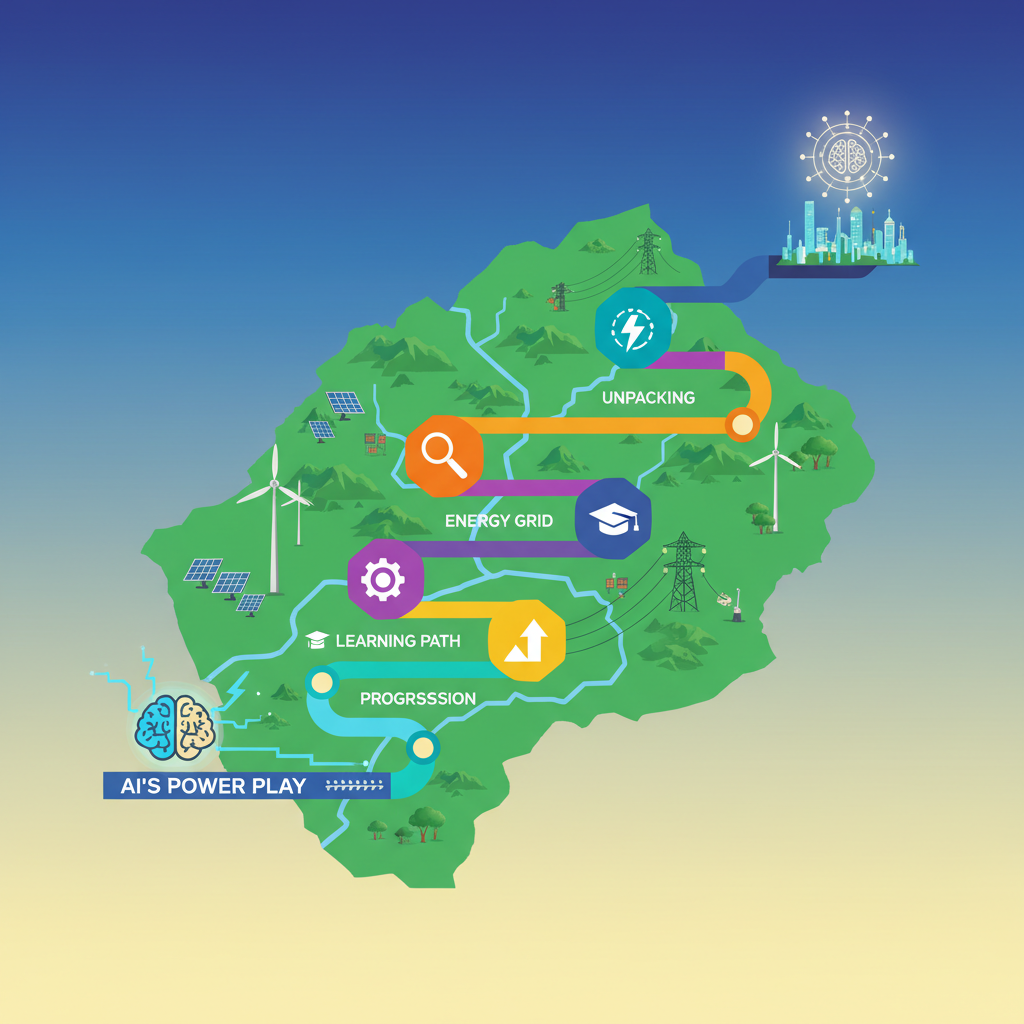
Imagine a journey from the foothills of the Maloti Mountains, where traditional energy sources are still vital, to the digital peaks where AI orchestrates a smart grid. Our path begins with understanding the terrain, moves through building the tools, then applying them to real-world challenges, and finally specializing in the most complex, often contentious, areas of AI in energy. Each stage builds upon the last, ensuring a comprehensive grasp of the subject.
Stage 1: Foundations of AI and Energy Systems (2-4 weeks)
This initial stage lays the groundwork, ensuring you speak the language of both AI and energy. It is crucial to understand the basics before delving into advanced applications. Consider it learning the rules of the game before you can investigate the players.
- Key Concepts: Introduction to Artificial Intelligence and Machine Learning, supervised and unsupervised learning, neural networks. Basic electricity generation, transmission, and distribution principles. Renewable energy sources (solar, wind, hydro) and their intermittency challenges. Grid stability and reliability concepts. Data types in energy systems (sensor data, consumption patterns, weather data).
- Resources:
- Free: Andrew Ng's Machine Learning course on Coursera (audit mode), Khan Academy's Electrical Engineering basics. MIT Technology Review for high-level industry insights.
- Paid: "Hands-On Machine Learning with Scikit-Learn, Keras, and TensorFlow" by Aurélien Géron. Online courses on renewable energy basics from platforms like edX.
- Hands-on Projects: Simple Python scripts to analyze energy consumption data from a simulated household. Visualize basic grid topology.
- Assessment: Quiz on Ai/ml terminology and energy system components. Explain the difference between a traditional grid and a smart grid.
Stage 2: Core AI Skills for Energy Data (4-6 weeks)
Now that you understand the concepts, it is time to get your hands dirty with the tools. This stage focuses on data manipulation, predictive modeling, and basic optimization techniques relevant to energy datasets.
- Key Concepts: Data preprocessing and feature engineering for time-series energy data. Regression models for load forecasting. Classification models for fault detection. Introduction to Python libraries: Pandas, NumPy, Scikit-learn, Matplotlib.
- Resources:
- Free: Kaggle datasets on energy consumption and generation. Tutorials on time-series analysis with Python.
- Paid: DataCamp or Dataquest courses on Python for Data Science.
- Hands-on Projects: Build a simple load forecasting model using historical consumption data. Develop a script to identify anomalies in simulated sensor readings from a power plant.
- Assessment: Present a load forecasting model, discussing its accuracy and limitations. Debug a given Python script for data cleaning.
Stage 3: Intermediate Applications in Grid Management (4-8 weeks)
This stage moves beyond basic modeling to practical applications within the energy grid, exploring how AI can directly impact operations and planning. This is where the rubber meets the road, and where the real-world implications begin to emerge.
- Key Concepts: Demand-side management and response. Renewable energy integration and forecasting. Predictive maintenance for grid infrastructure. Energy storage optimization (batteries, pumped hydro). Introduction to reinforcement learning for grid control.
- Resources:
- Free: Research papers on AI in smart grids from arXiv. Reuters for news on energy sector AI deployments.
- Paid: Specialized courses on smart grid technologies or energy analytics.
- Hands-on Projects: Simulate a demand response program using AI to shift load. Develop an AI agent to optimize battery charging and discharging cycles based on price signals and renewable generation forecasts.
- Assessment: Design a conceptual AI system for predictive maintenance of a specific grid component, outlining data requirements and expected benefits.
Stage 4: Advanced Topics and Specialization (Ongoing)
At this advanced stage, you will delve into the cutting edge, exploring complex challenges and emerging technologies. This is where you begin to specialize and contribute to the discourse, perhaps even uncovering some of the deeper truths about who truly benefits.
- Key Concepts: Decentralized energy systems (microgrids). Cybersecurity for AI-enabled grids. Ethical AI in energy, addressing bias in data and decision-making. AI for climate change mitigation and adaptation in the energy sector. Quantum computing's potential impact on grid optimization. What they're not telling you: The geopolitical implications of AI-driven energy independence and resource allocation.
- Resources:
- Free: Academic journals and conferences on AI and energy. White papers from organizations like the International Energy Agency. The Verge for broader tech and societal impacts.
- Paid: Advanced degrees or certifications in AI, energy systems engineering, or related fields.
- Hands-on Projects: Research and propose an AI framework for managing a community microgrid in a rural Lesotho setting. Analyze the ethical implications of using AI to prioritize energy distribution during a crisis.
- Assessment: Develop a research proposal on a novel application of AI in energy, including a critical analysis of its potential societal impact.
Milestone Projects
These projects are designed to build a robust portfolio, showcasing your capabilities at various levels:
- Beginner: Household Energy Predictor: Create a Python application that predicts daily household energy consumption based on historical data and weather forecasts. Visualize the predictions and actual consumption.
- Intermediate: Renewable Integration Optimizer: Develop an AI model to optimize the dispatch of a hybrid solar-battery system, aiming to minimize reliance on grid electricity and maximize self-consumption.
- Advanced: Fault Detection and Isolation System: Design and implement a prototype AI system that can detect and localize faults in a simulated power distribution network using sensor data, providing recommendations for rapid restoration.
- Expert: AI for Energy Policy Analysis: Create a simulation model using AI to evaluate the long-term economic and environmental impact of different energy policies (e.g., carbon tax, renewable subsidies) on Lesotho's grid stability and energy access.
Recommended Resources
- Books: "Data Science for Energy Systems" by Peter D. F. Smith, "Reinforcement Learning: An Introduction" by Richard S. Sutton and Andrew G. Barto.
- Courses: Coursera's "AI for Everyone," edX's "Smart Grids" specialization, Udacity's "AI Engineer" Nanodegree.
- Communities: Local AI meetups in major African cities, online forums like Stack Overflow, Reddit communities like r/MachineLearning and r/Energy.
- Tools: Python, TensorFlow, PyTorch, scikit-learn, Pandas, Jupyter Notebooks, Matlab (for power system simulation).
Career Paths
Mastering AI in energy and grid management opens doors to diverse and impactful careers:
- AI Engineer/Data Scientist: Developing and deploying AI models for forecasting, optimization, and control.
- Smart Grid Architect: Designing and implementing AI-enabled grid infrastructure.
- Energy Analyst/Consultant: Advising utilities, governments, and corporations on AI strategies for energy.
- Research Scientist: Pushing the boundaries of AI applications in sustainable energy and grid resilience.
- Policy Advisor: Informing national and international energy policy with data-driven insights, particularly crucial in contexts like Lesotho where energy access and sustainability are paramount.
Tips for Staying on Track
Consistency is key. Dedicate specific hours each week to learning. Join online communities or local study groups. Don't be afraid to experiment and break things; that is how true understanding is forged. Seek out mentors, perhaps even within Lesotho's nascent tech scene or established energy sector. Remember, the goal is not just to learn the technology, but to critically engage with its implications. As a journalist, I can tell you that the most valuable insights often come from questioning the accepted narrative, from looking beyond the official statements, and from understanding the human element behind every algorithm. The future of our energy, and indeed our nation, depends on it.