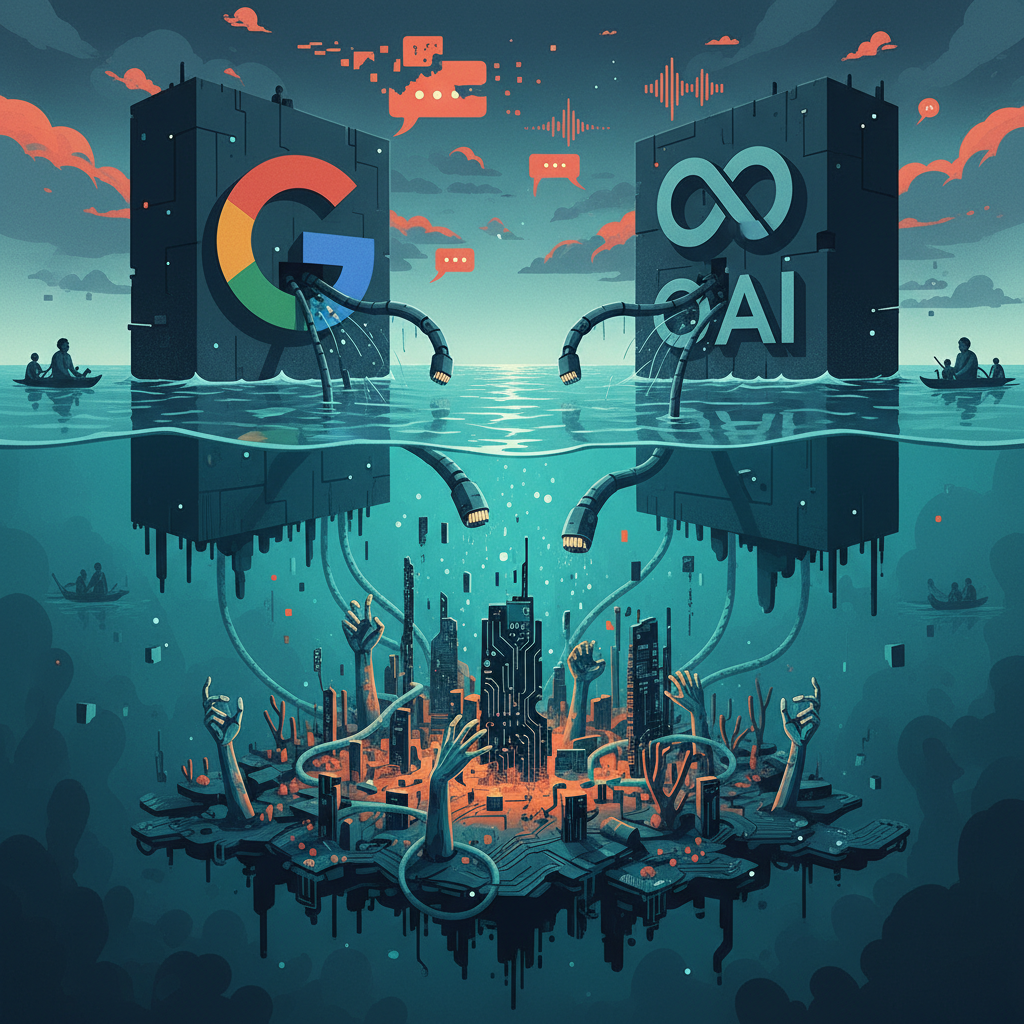

The sun rises over Matavai Bay, painting the sky in hues of orange and violet, much like it has for centuries. Here, in Tahiti, the news isn't just about headlines; it's about the whispers carried on the trade winds, the stories shared over a cup of kava, the deep connection to our fenua, our land. So when I hear the chatter about AI transforming journalism, about automated reporting and fact-checking, my heart feels a familiar tug of both hope and apprehension. It's a story about paradise and pixels, and I worry about what gets lost in translation.
Let me be clear: the promise of AI in journalism is seductive. Imagine an AI, perhaps one powered by OpenAI's GPT models or Google's Gemini, sifting through mountains of data to uncover corruption, or instantly translating complex scientific reports into accessible language for our local communities. Think of the fact-checking capabilities, a digital sentinel against the rising tide of misinformation, a tool that could help smaller newsrooms, like those struggling across our scattered islands, verify stories with unprecedented speed. For a region often overlooked by global media, the idea of AI democratizing access to information, helping us tell our own stories with greater reach and accuracy, is compelling. It could be a powerful tool for good, a way to ensure our voices are heard beyond the horizon.
Yet, my experience living and reporting from the heart of the Pacific tells me that this vision, while beautiful, is incomplete, perhaps even dangerously so. The very essence of journalism, the part that truly matters, is human connection, empathy, and the nuanced understanding of culture and context. AI, no matter how advanced, struggles with this. It cannot feel the warmth of a community gathering, nor understand the unspoken tensions in a village meeting. It cannot discern the subtle humor in a local idiom or grasp the historical weight of a sacred site. These are the threads that weave the rich tapestry of our stories, the very things that make our journalism resonate.
I’ve watched as these powerful AI systems, developed in distant Silicon Valley, often stumble when confronted with the realities of our diverse world. Their training data, largely drawn from Western sources, often lacks the depth and breadth of Pacific knowledge, history, and perspectives. This isn't a criticism of the technology itself, but of its inherent limitations when applied without careful, culturally informed consideration. When an AI is tasked with writing a news report about a traditional fishing practice, for instance, will it understand the intricate relationship between the moon cycles, the tides, and the ancestral knowledge passed down through generations? Or will it simply pull generic facts from a limited database, stripping the story of its soul?
Some might argue that these are minor concerns, easily addressed by fine-tuning AI models with more diverse data. They might say that AI is merely a tool, and its impact depends on how we wield it. Indeed, giants like Microsoft and Meta are investing heavily in making their AI more globally aware, more adaptable. They envision a future where AI assists journalists, freeing them from mundane tasks to focus on deeper investigative work. This sounds logical, even desirable. If AI can write the basic sports scores or weather reports, then surely journalists can spend more time on the stories that truly matter, the ones that require a human touch.
But here’s my rebuttal: the danger isn't just in the accuracy of the facts, but in the erosion of the human element. If AI becomes the primary gatekeeper of information, even in an assistive role, whose perspectives will be prioritized? Whose stories will be deemed newsworthy? The algorithms, by their very nature, reflect the biases and priorities embedded in their training data. If that data is predominantly Western, urban, and English-centric, then the news produced, even if factually correct, will inherently marginalize voices from places like French Polynesia. We risk a future where our unique narratives are either ignored or, worse, homogenized into bland, algorithmically generated content that lacks any true connection to our lived experiences.
Consider the vital role of local journalists, the ones who live and breathe the stories they report. They are not just reporters; they are community members, trusted voices, cultural interpreters. Their presence builds trust, fosters understanding, and holds power accountable in ways an AI never can. When a local journalist covers a climate change forum in Papeete, they understand the immediate impact on the taro patches, the rising sea levels threatening coastal homes, the anxiety in the eyes of the elders. An AI might generate a report on the scientific data, but it cannot convey the human cost, the emotional weight, or the cultural significance. This is where the true value of human journalism lies, and it is irreplaceable.
Furthermore, the economic implications for smaller newsrooms are profound. Many local media outlets, already struggling with revenue, might see AI as a cost-saving measure, leading to fewer human journalists. This could create a void, leaving communities without dedicated, local reporters who understand their specific needs and concerns. The ocean connects us and so does AI, but only if we ensure that connectivity doesn't come at the cost of local autonomy and voice. We need to empower local newsrooms, not replace them.
So, what is my call to action? It's not to reject AI outright. That would be foolish and unrealistic. Technology is a powerful current, and we must learn to navigate it. Instead, we must demand that the development and deployment of AI in journalism be guided by principles of cultural sensitivity, equity, and human empowerment. We need to actively participate in shaping these tools, ensuring they serve our diverse communities rather than diminish them. This means investing in training local journalists to use AI responsibly, and perhaps more importantly, to critically evaluate its outputs. It means advocating for AI models to be trained on diverse, culturally rich datasets, reflecting the full spectrum of human experience, not just a dominant few.
We must also champion the irreplaceable value of human journalists, especially those rooted in their communities. Their role is not just to report facts, but to provide context, interpretation, and empathy. The future of journalism, particularly for regions like ours, depends on a symbiotic relationship between advanced technology and deeply human storytelling. We need AI to be a canoe, helping us navigate vast oceans of information, but the paddlers, the navigators, must always be human, guided by the stars of truth and the currents of community. Otherwise, we risk losing our way, adrift in a sea of automated narratives that speak to no one, and for no one. The stories of our islands are too precious, too vital, to be left solely to algorithms. We must ensure that the digital tide lifts all boats, especially the smaller ones, and that the vibrant chorus of human voices continues to echo across our blue planet. According to MIT Technology Review, the ethical considerations of AI in content creation are becoming increasingly critical, and this applies doubly to journalism. We must ensure that the tools built by giants like Google and OpenAI respect the nuances of human experience.
This is not a battle against progress; it is a plea for thoughtful, inclusive progress. It is a reminder that in the Pacific, technology takes a different form, one that must honor our traditions, our people, and our unique way of seeing the world. We must ensure that the algorithms serve humanity, not the other way around. The future of our news, and indeed our cultural narratives, depends on it. The digital transformation of newsrooms, as discussed on TechCrunch, must include a robust discussion about how these tools impact global diversity. We must not let the pursuit of efficiency overshadow the need for authenticity. For more on the broader implications of AI, Reuters often covers the global business and societal impacts, but the local perspective remains crucial.