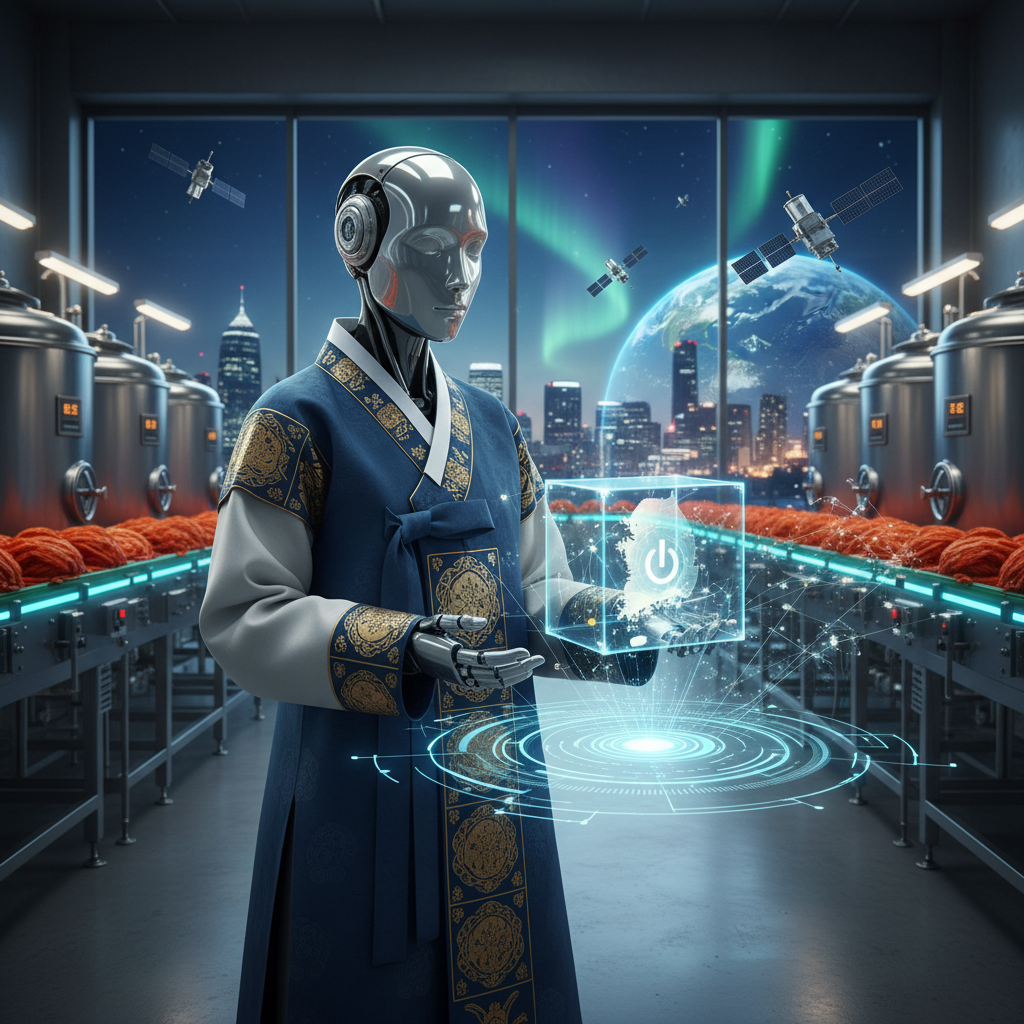

The air in the Gyeonggi-do kimchi factory used to hum with the chatter of ajummas, their hands a blur of motion, expertly salting cabbage and mixing spices. Now, it’s a different kind of hum, a low, rhythmic whirring. A sleek, bipedal robot, its metallic fingers surprisingly dexterous, carefully places a perfectly seasoned cabbage head into a fermentation jar. No complaints about back pain, no gossip about the latest K-drama, just relentless, precise efficiency. This isn’t a scene from a science fiction movie, it’s April 2026, and this is the new reality for many South Korean businesses.
Everyone's wrong about this, or at least, they are missing the bigger picture. The global narrative around AI in robotics, especially humanoid robots, often devolves into a simplistic 'robots taking jobs' panic. While that fear is understandable, particularly in economies with aging populations and declining birth rates like ours, Seoul has a different answer. Here, the deployment of AI-powered humanoids isn't just about cutting costs or filling labor gaps, it's a strategic, national imperative to maintain industrial competitiveness and carve out a lead in the next technological frontier. It's about power, plain and simple.
Consider the data. A recent report from the Korea Institute of Science and Technology, or Kist, indicates that South Korea’s adoption rate for advanced manufacturing robots, including early-stage humanoids, jumped by an astonishing 38% in the last 18 months. This isn't just confined to heavy industry. We're seeing these machines in logistics, healthcare, and even customer service. Hanwha Robotics, for instance, reported a 250% increase in orders for their service-oriented humanoids last year, largely from retail and hospitality sectors struggling with labor shortages and rising minimum wages. The return on investment for these early adopters is compelling, with many companies reporting a full ROI within 3 to 5 years, primarily through reduced labor costs and increased operational hours.
But let's be clear, this revolution has its winners and losers. On the winning side, you have companies like Hyundai Robotics and Doosan Robotics, who are not just deploying these machines but manufacturing them. They are at the forefront, creating the very tools that are reshaping our economy. Their stock valuations have soared, their R&D budgets are overflowing, and they are attracting the brightest engineering talent from Kaist and Seoul National University. Then there are the agile small and medium enterprises, the SMEs, who are leveraging these robots to scale operations without the massive overhead of human expansion. Take 'Gourmet Gimbap,' a chain of popular gimbap restaurants. They introduced a fleet of small, collaborative robots from a local startup, 'RoboChef,' to handle repetitive tasks like rice spreading and rolling. Their sales are up 15% and their employee satisfaction, surprisingly, has also improved because their human staff are now focused on higher-value tasks like customer interaction and custom orders.
On the other hand, the losers are often the workers in low-skill, repetitive roles. Kim Min-jun, a 48-year-old former assembly line worker at a major electronics manufacturer, found himself out of a job when his entire section was automated with AI-driven robotic arms. “They told us it was progress,” he told me, his voice tinged with bitterness, “but it felt like a betrayal. I gave them 20 years, and a machine took my place in 20 weeks.” His story is not unique. While the government and industry leaders talk about retraining initiatives, the reality on the ground is far more complex. The skills gap is widening, and the pace of technological change often outstrips the capacity for human adaptation. “We are seeing a significant psychological impact on workers,” explains Dr. Lee Ji-hye, a labor sociologist at Yonsei University. “The fear of obsolescence is real, and for many, the promised 'upskilling' feels like a distant, unattainable goal. We need more robust social safety nets and truly effective retraining programs, not just rhetoric.”
Yet, the K-wave is coming for AI too, and it’s not just about flashy pop culture. Our government views AI and robotics as critical for national prosperity. The Ministry of Science and ICT recently announced a new ₩5 trillion (approximately $3.7 billion USD) fund dedicated to fostering AI robotics startups and integrating humanoids into public services by 2030. This isn't just about economic growth; it's about national security and geopolitical influence. “To be a leading nation in the 21st century, we must lead in AI and robotics,” stated Minister Park Jin-woo in a recent press conference. “Our investment is not merely commercial, it is foundational for our future.” This sentiment echoes throughout the corporate landscape. Companies are not just buying robots; they are investing in the underlying AI, often collaborating with research institutions like Etri, the Electronics and Telecommunications Research Institute, to develop proprietary algorithms and hardware.
This aggressive push is also fueled by a pragmatic understanding of demographics. South Korea faces one of the world's lowest birth rates and a rapidly aging population. Who will staff the factories, care for the elderly, and deliver packages when the human workforce shrinks? Humanoid robots, powered by increasingly sophisticated AI, are seen as a vital part of the answer. They are not merely replacements but supplements, designed to fill gaps that humans either cannot or will not fill. The vision is not a world without human workers, but one where humans and machines collaborate, each playing to their strengths.
However, this vision is not without its critics. Concerns about ethical AI, data privacy, and the potential for increased social stratification are growing. Who will own the data generated by these robots? How will we ensure fairness in their deployment? These are questions that demand urgent attention. According to Wired, these ethical dilemmas are universal, but in South Korea, the speed of adoption makes them particularly pressing. We are moving faster than many, and the societal implications are only just beginning to surface.
What's coming next? Expect to see a proliferation of specialized humanoids, not just general-purpose ones. Robots designed specifically for elder care, for precision agriculture, or for complex construction tasks. Expect more sophisticated human-robot interaction, driven by advancements in natural language processing and emotional AI. NVIDIA’s continued dominance in AI hardware will undoubtedly play a significant role, powering the next generation of these intelligent machines. The competition for AI talent will intensify, with companies like Samsung and LG aggressively recruiting from top global universities. This isn't a slow evolution; it's a sprint, and South Korea is determined to be at the finish line first.
The robot in the kimchi factory is more than just a machine; it's a symbol of a nation grappling with its future, balancing economic ambition with social responsibility. It’s a bold gamble, but one that Seoul believes it must take. The question is not if AI and humanoids will transform our world, but how we, as a society, will shape that transformation. We must ensure that this technological leap benefits all, not just a select few. The stakes, after all, could not be higher. For further insights into the broader impact of AI on industry, you might find this article on Enterprise AI [blocked] relevant, as it touches on similar themes of organizational change and impact. For a more global perspective on AI in business, Bloomberg Technology often provides excellent coverage.